



If you’ve ever seen “ash” pop up in a text message or social media caption and wondered what it actually meant, you’re far from alone. This three-letter word is one of those sneaky terms in digital communication that wears multiple masks. Depending on who’s using it, where they’re using it, and what they’re talking about, “ash” can be a name, an emotional expression, a Gen Z slang intensifier, or even a scientific term.
In 2026, “ash” has firmly planted itself in the vocabulary of younger generations — especially on TikTok, Snapchat, Instagram, and WhatsApp. This guide breaks down every meaning of “ash” in text, its background, how it differs across platforms, what it means in Gen Z culture, and how to respond when you encounter it. Whether you’re a parent, a curious learner, or just someone who received a confusing message, this article covers everything you need to know.
Meaning & Definition: What Does “Ash” Mean in Text?
The word “ash” carries three primary meanings in digital communication, each dependent entirely on context:
1. As Hell (Slang Intensifier)
The most common modern slang meaning of “ash” in text is “as hell” — a phonetic shorthand used to emphasize or exaggerate a feeling or statement.
Example: “I’m tired ash” = “I’m tired as hell” Example: “She’s funny ash” = “She’s funny as hell”
It works just like the word “very” or “so,” but carries a distinctly casual, youthful tone. Instead of typing the full phrase “as hell,” digital users compress it into the single word “ash” for speed and style.
2. A Name or Nickname
“Ash” is widely used as a short form for names like Ashley, Ashton, Ashlyn, or Asher. When someone signs off a message as “— Ash” or uses it in their username, it’s almost certainly a name reference rather than slang.
3. Symbolic / Emotional Expression
In more poetic or aesthetic online spaces, “ash” is sometimes used to convey emotional exhaustion, burnout, or the idea of something fading away — drawing from the literal image of ash left after fire. Phrases like “turning to ash” or “feeling like ash” appear in emotional captions and bios, particularly on platforms like Tumblr, Instagram, and X (Twitter).
Background: Where Did “Ash” Slang Come From?
The slang evolution of “ash” didn’t happen overnight. Here’s a rough digital timeline of how it developed:
- Pre-2010s: “Ash” exists purely as a name, a tree, or a reference to burnt residue. No slang meaning yet.
- 2013–2015: “AF” (as f***) explodes through meme culture and hip-hop, popularizing the concept of phonetic slang intensifiers.
- 2016–2018: Younger Gen Z users begin using “ash” as a softer, less explicit phonetic alternative to “af” on Instagram and Snapchat.
- 2019–2021: TikTok accelerates its spread. Short-form video captions demand punchy, space-saving language — “ash” fits perfectly.
- 2022–2026: “Ash” achieves mainstream adoption across DMs, comment sections, and even brand social media posts.
The slang grew organically from spoken American English. People already said “as hell” out loud — texting habits simply compressed the sound into a single phonetic unit. It’s the same process that gave us “gonna,” “wanna,” and “kinda” — speech patterns bleeding into writing.
The name association also played a cultural role. The globally iconic character Ash Ketchum from Pokémon made “Ash” a familiar, friendly reference across generations, cementing the name in pop culture consciousness well before the slang meaning arrived.
What Does “Ash” Mean in Text? — Usage by Context
In Casual Texting
In everyday personal messaging, “ash” most frequently appears as a slang intensifier after an adjective:
| Example Message | What It Means |
| “I’m hungry ash rn” | I’m extremely hungry right now |
| “That test was hard ash” | That test was extremely hard |
| “She’s smart ash” | She’s really, really smart |
| “I’m bored ash at home” | I’m terribly bored at home |
| “He’s cute ash tho” | He’s honestly very cute |
Ash Meaning in Chat, WhatsApp, Instagram, and TikTok
The meaning of “ash” can shift slightly depending on the platform. Here’s a breakdown:
On WhatsApp, “ash” typically shows up in private one-on-one chats or group messages between friends. Here it functions as a casual tone-setter — a quick way to add emphasis without sounding formal. Because WhatsApp conversations are personal, “ash” in this context is almost always either slang or a nickname. It would be unusual to misread it here.
“Just finished gym. Dead ash 😅”
On Instagram, “ash” appears primarily in captions and comments — sometimes as a slang intensifier, sometimes as a username, and occasionally in the more poetic/aesthetic sense (especially in darker or minimalist profiles). Its flexible tone makes it ideal for Instagram’s expressive culture.
Caption: “Golden hour hitting different ash ☀️”
TikTok
TikTok is arguably where “ash” slang is most alive. The platform’s emphasis on short, punchy captions and comment-section wit makes “ash” a natural fit. On TikTok, “ash” can also carry a secondary meaning: “As Savage As Hell” — used when someone does something impressively bold or daring.
“That trick was ash 🔥” (= That trick was insane / as savage as hell)
Snapchat
Snapchat’s casual, fleeting communication style makes “ash” one of its most natural homes. It’s used in snap captions and chat replies to convey strong emotions quickly — usually enthusiasm, frustration, or humor.
“Waiting for my food. Hungry ash 😤”
Ash Meaning for Gen Z
For Gen Z (those born roughly 1997–2012), “ash” is a native slang term — something they absorbed through platforms rather than learned from a dictionary. It sits alongside other phonetic intensifiers in their digital vocabulary: “af,” “asl,” “asf,” and now “ash.”
What makes “ash” specifically appealing to Gen Z is its softness compared to “af.” While “af” is more aggressive and explicit, “ash” softens the emphasis slightly — it’s expressive without being too strong. That makes it more versatile across different emotional tones, from playful to genuinely intense.
Gen Z also uses “ash” in aesthetic or emotional contexts to describe burning out, fading, or transforming — tying the slang into a broader cultural language of mental health awareness and emotional expression that defines much of their online communication.
Ash Meaning in Physics, Medical, and Aircraft Terminology
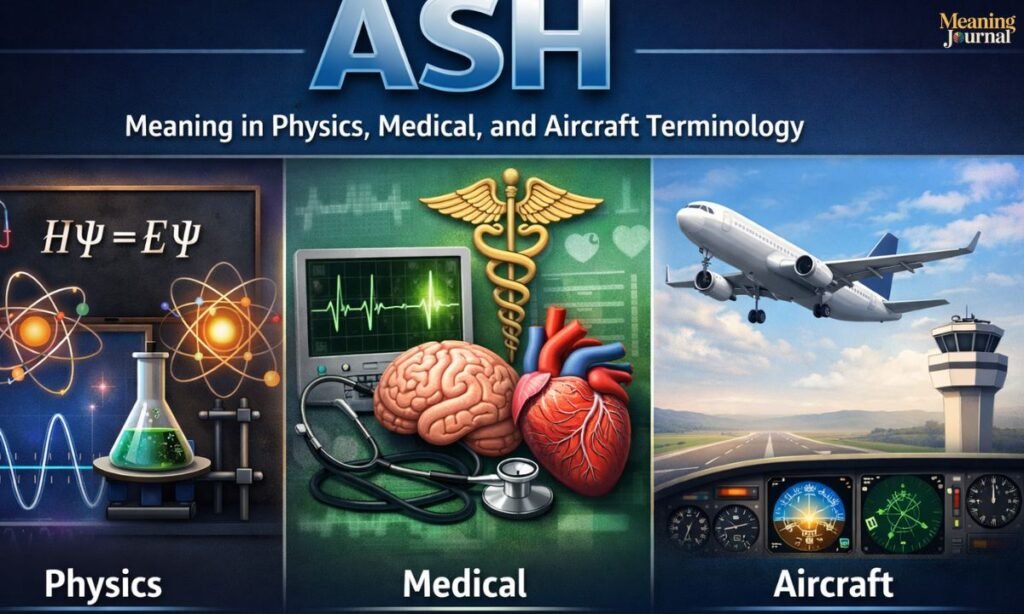
It’s worth addressing the technical side — because “ash” absolutely has recognized meanings outside of texting:
Physics & Chemistry
In physics and chemistry, ash refers to the inorganic residue remaining after a substance is fully combusted. Wood ash, for example, is rich in calcium, potassium, and other minerals. Scientists measure “ash content” to understand the composition of fuels, food, and organic materials.
Medical / Biological Context
In medical and nutritional science, ash content is a standard measurement used to determine the mineral content of food, tissue samples, or pharmaceutical compounds. A food product’s “ash” percentage on a nutritional label refers to its mineral-based components after burning away organic material.
Aviation & Aircraft Terminology
Volcanic ash is taken extremely seriously in aviation. Volcanic ash clouds can cause catastrophic engine failure in aircraft, which is why aviation authorities like the FAA and ICAO issue formal ash advisories and flight restrictions during volcanic events. The 2010 eruption of Iceland’s Eyjafjallajökull volcano, which grounded thousands of flights across Europe, is one of the most dramatic real-world examples of ash’s impact on aviation.
Key takeaway: In any of these technical fields, “ash” retains its literal meaning — fine particulate residue. It has no slang meaning whatsoever in professional or scientific contexts.
Common Misconceptions About “Ash” in Text
Several misunderstandings float around when it comes to “ash” in digital communication:
Misconception 1: “Ash” is always a name. Not true. While it’s frequently a nickname for Ashley or Ashton, in most texting contexts today, “ash” is used as slang for “as hell.”
Misconception 2: “Ash” is offensive or vulgar. It isn’t. While “as hell” is an informal phrase, “ash” itself is not considered offensive, explicit, or inappropriate in standard digital communication. It’s casual, not rude.
Misconception 3: “Ash” means the same thing everywhere. Context is everything. “Ash” after an adjective = slang intensifier. “Ash” at the end of a message with a capital A = probably a name. “Ash” in a poetic caption = likely symbolic.
Misconception 4: Only teenagers use “ash” slang. While it’s most common among Gen Z and younger Millennials, “ash” slang has gradually spread into wider online communities, including adult social media users who consume TikTok and Instagram content regularly.
Misconception 5: “Ash” and “asf” mean the same thing. They’re similar but not identical. “Asf” (as f***) is stronger and more explicit. “Ash” (as hell) is slightly gentler — same function, different intensity.
Similar Terms & Alternatives to “Ash” Slang
If you’re looking for comparable slang with the same function as “ash,” here are the most common alternatives in the same family:
| Slang Term | Full Phrase | Intensity Level | Common Platform |
| ash | as hell | Medium | TikTok, Snapchat, WhatsApp |
| af | as f*** | High | Twitter/X, Instagram |
| asf | as f*** | High | TikTok, texting |
| asl | as hell (variant) | Medium | TikTok, Gen Z chats |
| lowkey | subtly / quietly | Low-Medium | All platforms |
| deadass | seriously / for real | Medium | Twitter/X, texting |
| fr | for real | Low-Medium | All platforms |
How to Respond to “Ash” in Text
How you respond depends entirely on which meaning of “ash” is being used:
If it’s used as slang (“I’m tired ash”):
- Match the energy and tone: “Same honestly 😭”
- Or build on it: “Go sleep then lol”
- Or empathize: “I feel that, long day?”
If it’s a name (“- Ash”):
- Simply respond naturally to the content of the message — the “Ash” is just a sign-off.
If it’s symbolic/emotional (“feeling like ash lately”):
- Respond with empathy: “Hey, are you okay? Want to talk?”
- Don’t brush past it — symbolic usage of “ash” often signals genuine emotional weight.
The rule of thumb: read the sentence structure first. If “ash” follows an adjective, it’s almost always slang. If it appears alone or after a dash, it’s probably a name.
Differences from Similar Words
“Ash” vs. “AF”
Both are intensifiers that follow adjectives, but “af” is stronger and more widely recognized globally. “Ash” is more specifically tied to Gen Z American English. “AF” is mainstream; “ash” is still more niche.
“Ash” vs. “Ashy”
These are completely different words. “Ashy” is an adjective describing dry, pale, or flaky skin — it has nothing to do with the “as hell” slang meaning of “ash.” Context makes this clear almost immediately.
“Ash” vs. “ASL”
“ASL” in Gen Z slang also means “as hell” (or sometimes “as f***”), making it a direct competitor to “ash.” The difference is mostly spelling preference and regional habit — some users prefer “asl,” others prefer “ash.”
“Ash” (Name) vs. “Ash” (Slang)
The clearest differentiator is capitalization and position in a sentence. A capital “Ash” mid-message or at the end = name. Lowercase “ash” after a descriptive word = slang.
Also Read This: IMYT Meaning in Text: Understanding This Popular Online Abbreviation (Updated 2026)
Relevance in Online Conversations & Dating Apps

On dating apps like Tinder, Hinge, and Bumble, “ash” most commonly appears as either a name in a bio or casual slang in early conversations. Someone introducing themselves as “Ash” is giving you a friendly, approachable name — it carries a relaxed, low-key personality vibe. On the other hand, using “ash” as slang in a flirty message (“You’re cute ash 👀”) signals comfort with Gen Z communication style and a casual, playful tone.
Understanding this dual identity matters on dating apps because misreading “ash” can lead to genuine confusion. Thinking someone signed off with their name when they were actually using slang — or vice versa — could create an awkward follow-up message.
In online communities more broadly, “ash” in its symbolic form appears frequently in mental health discussions, aesthetic communities, and creative writing spaces. Phrases like “I felt like ash after everything” carry emotional weight and deserve a thoughtful response, not a slang-based interpretation.
Frequently Asked Questions
What does “ash” mean in text slang?
It means “as hell” — used after an adjective to intensify a feeling, like “tired ash” meaning “extremely tired.”
What does ash mean on Snapchat?
On Snapchat, “ash” almost always means “as hell,” used in snap captions or chat messages to add emphasis or humor.
What does ash mean for Gen Z?
For Gen Z, “ash” is a casual phonetic intensifier meaning “as hell,” similar to “af” but slightly softer in tone.
Is “ash” a bad word in texting?
No. “Ash” is informal slang but not offensive or explicit in any recognized sense.
Can ash mean a name in text?
Yes. “Ash” is a common nickname for Ashley, Ashton, Ashlyn, and Asher. Capitalization and context usually make this clear.
What’s the difference between “ash” and “af” in slang?
Both mean “as hell/as f***” and function as intensifiers, but “af” is stronger and more globally recognized. “Ash” is gentler and more Gen Z-specific.
Does “ash” have a meaning in science?
Yes. In physics, chemistry, medicine, and aviation, “ash” refers to inorganic residue from combustion — completely unrelated to its texting meaning.
How do I know which meaning of “ash” someone is using?
Look at the sentence structure: “ash” after an adjective = slang; standalone or capitalized = name; in a poetic or emotional context = symbolic expression.
Conclusion
“Ash” is one of those words that proves how layered and context-dependent modern digital language has become. In three letters, it can mean extreme tiredness, a person’s identity, an emotion too heavy for full sentences, or the residue of combustion in a chemistry lab. None of these meanings are wrong — they’re just different applications of the same word in very different worlds.
For most people reading this in 2026, the most practical takeaway is simple: when you see “ash” after an adjective in a casual text or social media post, it almost certainly means “as hell.” When you see it capitalized alone, it’s likely a name. And when you see it used poetically in emotional content, treat it with the care that kind of language deserves.
Language in the digital age doesn’t stand still, and “ash” is a perfect example of how a common word can evolve into something new, expressive, and culturally specific — one text message at a time.

1 Comment
Pingback: What Does ISK Mean in Text? Full Meaning Explained Simply 2026