If you’ve ever spotted “WWA” in a text message, WhatsApp group chat, TikTok comment, or Instagram DM and had no idea what it meant — you’re in the right place. Internet slang moves fast, and three-letter abbreviations like WWA can mean different things depending on who’s typing, where they’re posting, and what the conversation is about.
In this complete guide, you’ll learn every meaning of WWA in text, its origins, how people use it across different platforms in 2026, what it means when a guy sends it, real chat examples, and how to reply like a native digital communicator. No fluff, no confusion — just everything you need to decode WWA with confidence.
What Does WWA Mean in Text & Chat?
WWA does not have one locked-in definition. Its meaning shifts based on the tone of the conversation, the platform, and the relationship between the people chatting. That said, the most widely recognized meanings of WWA in casual texting and online chat include:
- “What’s Wrong Again?” — Used when someone is following up on a problem or situation, often with concern or mild frustration.
- “Where We At?” — A quick, casual check-in to ask about plans, location, or the status of something.
- “We Want Answers” — Used when someone is pressing for clarity or demanding a response, often playfully.
- “What We Are” — Sometimes appears in conversations about relationships, where someone is asking about the nature of their connection.
- “What’s With That?” — A reaction of mild surprise or curiosity toward something unexpected.
The bottom line: context is king with WWA. Read the message around it, check the tone, and the correct meaning will almost always become obvious.
Full Form, Stands For & Short Meaning of WWA
Here is a structured breakdown of the most common full forms of WWA and when each one is typically used:
| Full Form | Context | Tone |
| What’s Wrong Again? | Emotional check-in, concern | Caring, curious |
| Where We At? | Plans, location, group coordination | Casual, informal |
| We Want Answers | Pressing for a reply | Playful, slightly urgent |
| What We Are | Relationship status discussion | Thoughtful, emotional |
| What’s With That? | Reacting to something surprising | Surprised, amused |
| We Were All | Shared past experience | Nostalgic, relatable |
| We Will Arrange | Semi-formal planning | Polite, professional-adjacent |
Quick snapshot:
- Abbreviation: WWA
- Most common texting meaning: “What’s Wrong Again?” or “Where We At?”
- Register: Informal, casual slang
- Used by: Primarily Gen Z and Millennials
- Platforms: WhatsApp, Instagram, TikTok, Snapchat, Discord
Origin, History & First Known Use of WWA
Like most text slang, WWA doesn’t have a single inventor or a precise birth date stamped in internet history. Its roots are tied to the broader explosion of SMS abbreviations that swept through digital communication in the early 2000s.
How WWA evolved over time:
Early 2000s — The SMS Era: As mobile phones became mainstream and character limits made typing long sentences impractical, abbreviations exploded. Words like LOL, BRB, IDK, and IMO became part of everyday language. WWA emerged in this environment as a natural shorthand for common phrases people wanted to say quickly.
2010s — Messaging Apps Take Over: Platforms like WhatsApp, iMessage, and BBM gave abbreviations a new home. Teens and young adults carried WWA from SMS culture into chat apps where it found a bigger, more connected audience.
2015–2020 — Meme Culture & Social Media: As platforms like Instagram and Twitter accelerated the spread of internet slang, WWA began showing up in comment sections and meme replies. Its ambiguity made it flexible — perfect for sarcasm, support, or surprise.
2021–2026 — Gaming Communities & TikTok: Discord servers and gaming lobbies adopted WWA as a quick, punchy reaction. TikTok further amplified casual slang, and WWA found its way into video captions, Duet replies, and comment threads across the platform.
Today, WWA sits comfortably in the casual digital vocabulary of anyone who communicates informally online — especially in group chats, social media comments, and direct messages.
How People Use WWA in Daily Conversations
In real everyday texting, WWA tends to be a reactive abbreviation. People drop it when something unexpected comes up, when they want a quick update, or when they’re checking in on someone. Here’s how it typically plays out:
As a concerned check-in: Someone’s been quiet all day, and you notice something might be off. Typing “WWA?” is a fast, low-pressure way to ask if everything’s okay without making a big deal of it.
As a location or plan update: Before a hangout or meetup, group chats move fast. “WWA?” cuts through the noise and asks simply: where is everyone, and what’s the current plan?
As a reaction to something surprising: A friend sends you unexpected news. Instead of typing a full paragraph, “WWA 😳” captures the disbelief in three letters and an emoji.
As a demand for clarity: In a thread that’s going in circles, “WWA” can signal: let’s get back on track and actually answer the question.
Usage tips:
- Always pair with an emoji if you want to soften or clarify the tone
- Use it in one-on-one chats or group messages with people who know you
- Avoid it with people who aren’t familiar with internet slang — it will just cause more confusion
- Never use it in professional, formal, or academic settings
WWA Meaning Across WhatsApp, Instagram, TikTok & Snapchat
The same abbreviation can feel slightly different depending on the app. Here’s how WWA behaves across the major platforms:
| Platform | How WWA Is Used | Most Common Meaning |
| Group chats, personal DMs, plan coordination | “Where We At?” or “What’s Wrong Again?” | |
| Comments, DMs, reacting to posts or stories | “What’s With That?” or playful surprise | |
| TikTok | Video captions, comment reactions, Duet threads | Casual curiosity, humor, surprise |
| Snapchat | Quick snaps, short chat replies | Light check-in, playful teasing |
| Discord | Gaming chats, server threads | “Where We At?” — group status or plan check |
| Twitter/X | Reply threads, meme reactions | Expressing confusion or playful challenge |
Platform nuance matters. A WWA on TikTok under a viral meme video carries a very different energy than a WWA in a WhatsApp message from your best friend at midnight. The context and platform together tell the full story.
Different Meanings of WWA in Other Fields
Beyond casual texting, WWA appears as an acronym in several professional and specialized fields. These meanings are completely unrelated to social media slang and only make sense in their specific contexts.
Science & Climate Research: World Weather Attribution (WWA) is a legitimate global scientific initiative that studies the connection between human-caused climate change and extreme weather events. If you see WWA in a news article about floods, heatwaves, or hurricanes, this is almost certainly what it means.
Legal Terminology: In estate law, WWA can stand for “With Will Annexed” — a legal term used in probate proceedings when an administrator is appointed because the named executor is unable or unwilling to serve.
Sports & Entertainment: World Wrestling Association (WWA) was a professional wrestling organization with historical significance in the sport. This meaning surfaces only in wrestling history discussions and vintage sports content.
Aviation & Technical Fields: In certain aviation manuals and operational documentation, WWA may refer to warning systems, aircraft assessments, or weather-related classifications.
Gaming Communities: In online gaming, WWA can be used as a clan tag, group identifier, or custom abbreviation invented by a specific gaming community.
The key rule: if you see WWA in a casual chat, it’s slang. If you see it in a scientific paper, legal document, or aviation manual, it’s a formal acronym.
Common Confusions, Mistakes & Wrong Interpretations
WWA trips people up regularly. Here are the most common mistakes people make when they encounter it:
Confusing WWA with WYA: These two abbreviations look similar and serve related purposes. WYA means “Where You At?” and refers to a single person’s location. WWA (as “Where We At?”) refers to the group collectively. They’re not interchangeable.
Assuming it’s always negative: Many people read “What’s Wrong Again?” with a frustrated or annoyed tone. In most cases, it’s actually concerned or caring — especially when sent by a friend who notices something is off.
Treating it as a greeting: WWA is a reactive phrase, not an opener. Using it to start a conversation out of nowhere can come across as abrupt or confusing.
Ignoring the emoji context: A “WWA 😂” and a “WWA 😟” are almost opposite in emotional tone. Never read the letters without reading the emoji beside them.
Assuming one fixed meaning: The single biggest mistake is picking one definition and applying it everywhere. Always pause, read the surrounding message, and let context guide you.
Similar Terms, Alternatives & Related Slang
If you want to express the same ideas as WWA but with different phrasing, here are the closest alternatives:
| Term | Full Form | When to Use |
| WYA | Where You At? | Checking one person’s location |
| WYD | What You Doing? | Asking about current activity |
| WYO | What You On? | Asking about plans or availability |
| HYB | How You Been? | Emotional check-in, similar to “What’s Wrong Again?” |
| U good? | Are you okay? | Informal wellness check |
| ETA | Estimated Time of Arrival | Logistical follow-up after WWA |
| LMK | Let Me Know | Requesting a response or update |
| SMH | Shaking My Head | Disbelief or disappointment (like a sharp version of WWA) |
| IDK | I Don’t Know | Expressing uncertainty |
| ICYMI | In Case You Missed It | Sharing updates or follow-ups |
These alternatives overlap with WWA in different ways. Choose based on the specific nuance you want to convey — emotional concern, logistical check-in, or playful reaction.
WWA Meaning in Text From a Guy
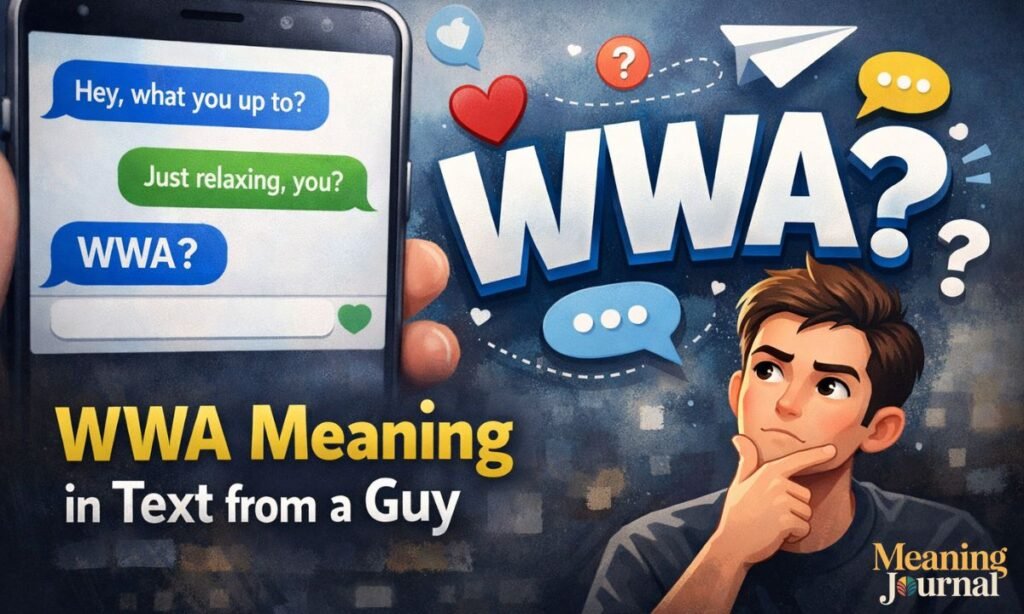
When a guy sends you “WWA” in a text or DM, the meaning depends heavily on the relationship dynamic and the conversation history. Here’s what it usually signals:
If you’ve been discussing plans: He’s asking where things stand — “Where We At?” with the evening, the weekend, or a decision you were supposed to make together.
If something emotional came up earlier: He might be circling back with a “What’s Wrong Again?” — a low-key way of checking in without making it feel heavy or intense.
If it follows something surprising: It’s likely a playful “What’s With That?” — reacting to something you said or did that caught him off guard.
If the conversation is about your relationship: WWA in this context can carry the meaning “What We Are” — a soft, indirect way of approaching a conversation about where things stand between the two of you. It’s non-confrontational and leaves room for you to set the tone in your reply.
The general read: From a guy, WWA is almost never aggressive or confrontational. It’s typically curious, casual, or caring. Emojis alongside the message are your best clue to the real intent.
Examples of WWA in Real Chat Situations
Seeing abbreviations in action makes them click. Here are realistic chat scenarios showing how WWA appears in everyday digital conversations:
Example 1 — Group Meetup Coordination
Alex: Leaving in 10 🚗 Jordan: WWA? Is everyone ready or nah? Sam: Still getting dressed lol give me 5
Example 2 — Emotional Check-In
Maya: … Priya: Hey you’ve been quiet all day. WWA? Maya: Rough afternoon honestly 😞 Priya: Talk to me. What happened?
Example 3 — Reacting to Surprising News
Chris: Just quit my job out of nowhere 😅 Tyler: WWA 😳 for real?? What happened??
Example 4 — Relationship Conversation
Jamie: I don’t even know what we’re doing anymore Riley: same tbh. WWA at this point? Jamie: That’s exactly what I want to figure out
Example 5 — TikTok Comment
[User commenting on a viral video]: WWA with everyone suddenly becoming a chef 😂
Example 6 — Gaming Chat on Discord
Player1: WWA on the mission? Y’all ready? Player2: Loading now, give me 2 mins Player3: Already in, waiting
How to Reply When Someone Says WWA

Your reply depends entirely on which meaning fits the context. Here’s a simple guide:
If WWA = “What’s Wrong Again?” (emotional) Be honest and open. They’re checking on you. A simple “I’m okay, just tired” or “Actually yeah, kind of stressed today” keeps things moving. If you don’t want to get into it: “All good, just a lot going on 😅” works perfectly.
If WWA = “Where We At?” (logistical) Give a clear, direct update. “5 minutes away,” “Almost done with the slides,” or “Still at work, leaving at 6” are all clean, helpful replies that match the energy.
If WWA = “What’s With That?” (reactive) Match the playful tone. “I know right 😂,” “Don’t even ask lol,” or “Honestly no idea 🤷” all land naturally.
If WWA = “We Want Answers” (pressing for clarity) Give a clear, direct response to whatever question is on the table. Dodging it will only lead to a follow-up.
If you genuinely aren’t sure: It’s always okay to reply with “Wait, what do you mean by that?” A quick clarification beats a misread reply every time.
Is WWA Still Popular? Trends & Online Usage in 2026
WWA has never been a mainstream viral sensation the way LOL or OMG became household abbreviations. It sits comfortably in a middle tier of internet slang — niche enough that not everyone knows it, but common enough that it circulates steadily in the right communities.
Where it’s growing: Discord servers, gaming communities, TikTok comment sections, and tight-knit WhatsApp group chats keep WWA in regular circulation. Gen Z users who communicate primarily through fast, shorthand messaging naturally keep abbreviations like WWA alive.
Where it’s less visible: Public posts on professional networks, formal communication, and older demographics rarely use WWA. Outside of English-speaking online communities, it’s virtually unknown.
Trend forecast: WWA is unlikely to disappear anytime soon, but it’s also unlikely to spike into mainstream territory. Its flexibility — the fact that it can mean different things in different contexts — actually contributes to its staying power. Slang that can do multiple jobs tends to stick around longer than single-purpose terms.
The verdict: If you’re communicating with Gen Z or younger Millennials in casual digital spaces in 2026, knowing WWA is genuinely useful. It’s not dying out, but it’s also not trending on the front page.
WWA vs. Other Common Texting Abbreviations: How It Compares
Understanding where WWA fits in the broader landscape of texting abbreviations helps you use it more naturally.
| Abbreviation | Meaning | Similarity to WWA |
| WYA | Where You At? | Similar but singular (one person vs. group) |
| SMH | Shaking My Head | Both react to surprising situations |
| LOL | Laugh Out Loud | WWA reacts; LOL responds with laughter |
| HYB | How You Been? | Both check in emotionally |
| IDK | I Don’t Know | Neither is confrontational; both are casual |
| FWIW | For What It’s Worth | Both soften potentially tense messages |
| BRB | Be Right Back | Both pause or redirect a conversation |
| NGL | Not Gonna Lie | Both add honesty to casual exchanges |
Why Context Matters More Than Definition With WWA
One thing that separates WWA from most abbreviations is that it genuinely cannot be decoded without context. Unlike LOL (always laughter) or BRB (always “stepping away”), WWA shape-shifts depending on the conversation.
This is actually a feature, not a bug. Digital communication is about efficiency and tone — and WWA delivers both. The person reading it fills in the meaning from the surrounding conversation, which is exactly how natural, spoken language works. We do this all the time with phrases like “really?” or “seriously?” — the meaning shifts based entirely on tone and context.
So the real skill with WWA isn’t memorizing all its definitions. It’s getting comfortable with reading context quickly — something that becomes second nature the more you engage with casual digital communication.
FAQs About WWA Meaning in Text
Q1: What is the most common meaning of WWA in text?
The most common meanings are “What’s Wrong Again?” (emotional check-in) and “Where We At?” (logistical update), depending on the conversation context.
Q2: Is WWA slang or a formal abbreviation?
It is informal slang, used in casual texting and social media — never appropriate for professional emails or formal documents.
Q3: Can WWA mean different things on different platforms?
Yes. On WhatsApp it tends to be a personal check-in; on TikTok it’s often a playful comment reaction; on Discord it’s usually a group coordination signal.
Q4: What does WWA mean in a relationship context?
In relationship conversations, WWA often stands for “What We Are” — a soft way of asking about the status or nature of a connection.
Q5: Is WWA rude or negative?
No. WWA is generally neutral to positive in tone. Even when it means “What’s Wrong Again?”, it’s typically caring, not critical.
Q6: How is WWA different from WYA?
WYA (“Where You At?”) targets a single person. WWA (“Where We At?”) refers to the group collectively — the “we” is the key difference.
Q7: Should I use WWA in professional messages?
Never. Use the full phrase instead — “Where are we with this?” or “What’s going on?” in any professional context.
Q8: What does WWA stand for in science?
In climate science, WWA stands for World Weather Attribution — an organization studying the link between climate change and extreme weather events.
Q9: Is WWA still used in 2026?
Yes, particularly among Gen Z and younger Millennials in group chats, gaming communities, and social media platforms.
Q10: How should I respond when someone sends me WWA?
Read the context first. Then reply with a direct update (if it’s logistical), honest feelings (if it’s emotional), or a playful response (if it’s reactive humor).
Conclusion
WWA is one of those abbreviations that looks small but carries a lot of weight depending on the conversation. Whether it means “What’s Wrong Again?” in a caring message from a friend, “Where We At?” in a frantic group chat before a meetup, or “What We Are” in a late-night relationship conversation — the three letters adapt to fit the moment.
The key takeaways from this guide: always read context before assuming a meaning, pair your reply to the tone of the message, and never use WWA in professional or formal settings. In casual digital spaces in 2026, knowing how WWA works puts you ahead of the confusion and lets you communicate with confidence.
Slang evolves constantly, but the ability to read context never goes out of style. And now that you understand WWA inside and out — you’re ready for whatever lands in your inbox next.
