

You’re scrolling through your WhatsApp messages or Instagram DMs, and suddenly — STFU. Four letters. No explanation. And now you’re staring at your screen wondering if you should laugh, respond, or quietly panic.
You’re not alone. Millions of people search for the meaning of STFU every single day. Whether it popped up in a group chat, a TikTok comment, or a late-night text from a friend, knowing what it means — and how to use it — matters more than you’d think.
This guide breaks down everything: the full meaning of STFU in text, its origins, how it’s used across platforms in 2026, and when you absolutely should not use it.
What Does STFU Stand For?
STFU stands for “Shut The F* Up.”**
At face value, it’s a blunt, direct instruction to stop talking. But in digital communication, context transforms its meaning entirely. Depending on who sends it and why, STFU can be:
- A playful reaction to something shocking (“STFU, no way that happened!”)
- A genuine expression of frustration or anger
- A casual joke between close friends
- A sarcastic response in an online debate
The letters themselves carry strong emotional weight — but the tone behind them determines everything.
The Origins of STFU
STFU didn’t appear overnight. Its roots trace back to the late 1990s and early 2000s, during the explosive rise of internet chat culture.
Platforms like AIM (AOL Instant Messenger), MSN Messenger, 4chan, and early internet forums created a need for fast, punchy communication. Typing full phrases was slow and clunky in fast-paced chat rooms, so users began abbreviating everything. STFU was part of that first wave of internet shorthand — alongside LOL, BRB, and OMG.
As mobile texting became mainstream, STFU moved from desktop chat rooms into text messages. By the time social media exploded in the 2010s, it was already deeply embedded in everyday digital vocabulary.
Today in 2026, STFU appears across WhatsApp, Snapchat, TikTok, Instagram, Discord, and Twitter/X — used by teens, young adults, and even older generations who’ve picked it up from pop culture and memes.
How STFU Is Used in Text Messaging
The same four letters can mean wildly different things depending on the situation. Here are the most common real-world contexts:
1. Expressing Frustration
This is the most literal use. When someone is genuinely irritated — whether in an argument, a group chat gone sideways, or a repeated conversation — they drop STFU as a blunt signal to stop.
Example: “Bro, STFU. I’m trying to study and you haven’t stopped talking for an hour.”
This usage carries real emotional charge. Take it seriously when the tone of the conversation warrants it.
2. Joking or Playful Banter
Among close friends, STFU often carries zero aggression. It’s frequently used as a reaction of shock, excitement, or disbelief — similar to saying “No way!” or “Stop it!”
Example: A: “I just won concert tickets for free!” B: “STFU 😂 you’re lying right now!!”
Here, STFU expresses genuine excitement. It’s the digital equivalent of a playful shove.
3. Online Gaming / Stream Chat
Gaming culture practically runs on STFU. In competitive gaming environments — Twitch streams, Discord servers, multiplayer lobbies — it’s thrown around constantly, often directed at noisy teammates, toxic players, or over-excited commenters.
Example: “STFU and focus on the objective, we’re about to lose!”
In gaming communities, it’s rarely taken personally unless the relationship is already hostile.
4. Social Media Comments
On TikTok, Instagram, and Twitter, STFU commonly appears in comment sections as a reaction to something surprising, hilarious, or unbelievable. In this context, it functions more like dramatic emphasis than a genuine command.
Example: “STFU this dog just spoke actual words 😭😭”
Here, it’s not rude — it’s enthusiastic. Social media has genuinely softened its edge in many contexts.
STFU Mean in Text From a Boy
When a boy or guy sends you STFU in a text, the meaning depends heavily on your relationship dynamic.
Among guy friends, it’s often pure banter — an instinctive response to something funny, shocking, or outrageous. It doesn’t signal real anger.
“stfu no way you got the promotion?? 🔥” — this is excitement, not hostility.
However, if STFU arrives mid-argument or without any playful context, it can be genuinely dismissive or aggressive. Pay attention to the tone of the overall conversation. If the vibe has been lighthearted, he’s probably joking. If things were already tense, it’s worth clarifying.
The same logic applies when a girl sends it — context and relationship always determine intent.
Is STFU Considered Offensive?
Short answer: it depends.
STFU includes explicit profanity, so it carries an inherently strong tone. Whether it lands as offensive comes down to three factors:
| Factor | Low Offense Risk | High Offense Risk |
| Relationship | Close friends | Strangers or acquaintances |
| Tone | Joking, with emojis | Serious, mid-argument |
| Platform | Casual group chat | Professional or formal setting |
| Audience | Gen Z peers | Older adults, family, authority figures |
A golden rule: if you’d hesitate to say it out loud in that situation, don’t type it. Written text strips away facial expressions, vocal tone, and body language — making STFU much easier to misread than spoken slang.
Variations and Similar Text Slang
STFU has inspired a family of related expressions used across online spaces. Here’s how they compare:
| Slang | Stands For | Tone |
| STFU | Shut The F*** Up | Blunt, direct, playful or aggressive |
| SMH | Shaking My Head | Disappointment or disbelief |
| WTF | What The F*** | Shock or confusion |
| GTFO | Get The F*** Out | Disbelief, shock, or dismissal |
| FR / FR FR | For Real | Emphasis or agreement |
| NGL | Not Gonna Lie | Honest admission |
| LMAO | Laughing My A** Off | Strong amusement |
| OMG | Oh My God | Surprise or excitement |
STFU sits at the blunter end of internet slang — stronger than SMH, similar in weight to GTFO, and much more direct than FR or NGL.
Why People Use STFU in Text
1. Convenience and Speed
Four letters versus fourteen. In fast digital conversations, acronyms win every time. STFU communicates a complete, emotionally loaded thought instantly — no additional context required.
2. Emotional Expression
Sometimes the full phrase feels too heavy or formal. STFU captures the same emotion in a punchy, low-stakes shorthand that fits the casual rhythm of texting.
3. Cultural Trend
Gen Z and millennial communication styles heavily favor sharp, ironic, and exaggerated language. STFU fits that aesthetic perfectly — it’s blunt, memorable, and versatile enough to work in dozens of contexts. Memes, Reels, and TikToks have only amplified its reach.
How to Respond to STFU
Receiving STFU in a text doesn’t always require a dramatic response. Here’s how to handle it based on context:
- If it felt playful: Match the energy. Reply with “😂 okay rude” or “make me” — keep it light.
- If it felt aggressive: Stay calm. Don’t escalate. A simple “that was harsh” opens the door to honest conversation.
- If you’re unsure: A quick “wait, seriously or joking?” clears things up without drama.
- If it came from a stranger: It’s okay to set a boundary. Something like “hey, that’s not cool” is completely reasonable.
Never feel pressured to absorb rudeness just because it arrived in slang form. STFU is still a strong phrase regardless of the format.
Also Read This: BSF Meaning in Text: What It Really Means, Where It’s Used & How to Reply
Playful Alternatives to STFU
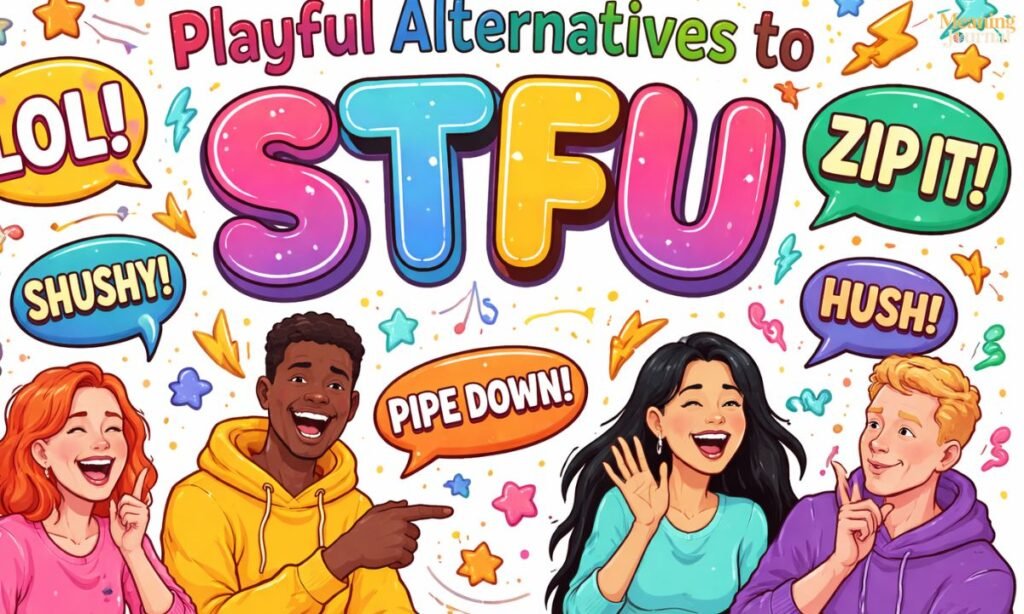
Want to convey the same feeling without the explicit language? These alternatives hit similar notes with less risk:
- “Okay wow 😶” — expresses shock without aggression
- “No more talking 🤐” — playful and clear
- “Pause ✋” — firm but less harsh
- “You did NOT just say that” — dramatized disbelief
- “I can’t right now 💀” — funny, Gen Z-coded deflection
- “Please hush” — gentle and lighthearted
These work especially well when you’re unsure of your audience or want to keep the tone friendly.
STFU in Pop Culture and Media
STFU has transcended texting. It shows up constantly in:
- Memes: Often used as a humorous caption to express “I can’t believe this”
- TikTok reactions: Creators use it in captions and voiceovers for comedic effect
- YouTube Gaming content: Common in reaction videos and streaming culture
- Music: Several artists have referenced or titled tracks using STFU as part of the broader internet slang aesthetic
- TV and film dialogue: Writers increasingly include texting slang in scripts to reflect how younger characters communicate
Its presence in mainstream media has helped normalize STFU even among audiences who don’t actively use it in conversation.
Risks of Using STFU
STFU carries real social risk when used without care. Consider these before you send it:
- Damaged relationships — even joking STFU can land wrong if the other person isn’t in a playful mood
- Professional consequences — one STFU in a work Slack or email could seriously affect your reputation
- Family misunderstandings — parents, grandparents, or family members may interpret it as straightforwardly disrespectful
- Escalation — in an already tense conversation, STFU can pour fuel on a fire instead of ending the discussion
The smarter move: read the room, know your audience, and add an emoji if the playful intent isn’t obvious.
STFU vs. Other Slang Words
| Comparison | Key Difference |
| STFU vs. “Shut up” | STFU is stronger and more explicit; “shut up” can be casual |
| STFU vs. GTFO | STFU = be quiet; GTFO = leave; both are blunt but different commands |
| STFU vs. SMH | SMH is passive disappointment; STFU is active and direct |
| STFU vs. “Hush” | “Hush” is gentle and cute; STFU carries real edge |
Custom Example Sentences Using STFU
Here are ten realistic examples showing how STFU naturally appears in modern texting:
- “STFU 😱 she actually said yes??”
- “Bro STFU I’m on a call right now”
- “STFU this is the funniest video I’ve ever seen”
- “You’ve been complaining for 20 minutes, STFU already”
- “Wait STFU — you got into the program?? That’s insane!”
- “STFU about that rumor, it’s not true”
- “Tell him to STFU in the group chat, he’s spamming”
- “STFU 😂 I literally can’t breathe”
- “I need everyone to STFU so I can think for one second”
- “She told me STFU in front of everyone and I was mortified”
Notice the range: some are celebratory, some are frustrated, some are purely comedic. Same four letters — completely different emotional register.
How to Use STFU Safely
If you decide to use STFU, follow these practical guidelines:
- Know your audience — only use it with people who understand your sense of humor
- Read the current tone — if the conversation is already tense, hold off
- Add an emoji — a 😂 or 😅 signals playful intent clearly
- Avoid professional spaces — no Slack, no work emails, no LinkedIn
- Don’t use it with elders or authority figures — regardless of intent, it reads as disrespectful
- Match the energy first — if someone else is already using edgy slang, the context is probably safe
Cultural Insights on Text Slang
Language evolves with the communities that use it. STFU is a perfect example of how internet culture recycles and reshapes words over time.
What began as an aggressive command in online forums has become — in many contexts — a neutral expression of shock or humor. This kind of semantic shift happens constantly in digital communication: LOL went from “laughing out loud” to a tone softener; “literally” now often means the opposite; “dead” means hilarious.
STFU follows the same path. Its intensity has softened through repetition, meme culture, and mainstream adoption. But that softening is uneven — older users, non-native speakers, and those unfamiliar with internet culture may still read it in its original, harsher context.
That gap is exactly why understanding audience matters more than understanding the slang itself.
Related Internet Acronyms to Know
If STFU is in your vocabulary, you’ll likely encounter these in the same spaces:
| Acronym | Meaning | Common Use |
| LOL | Laugh Out Loud | Humor |
| WTF | What The F*** | Shock/confusion |
| SMH | Shaking My Head | Disappointment |
| LMAO | Laughing My A** Off | Strong laughter |
| GTFO | Get The F*** Out | Shock or dismissal |
| OMG | Oh My God | Surprise |
| NGL | Not Gonna Lie | Honesty |
| TBH | To Be Honest | Candid opinion |
| IDK | I Don’t Know | Uncertainty |
| BRB | Be Right Back | Temporary absence |
| TTYL | Talk To You Later | Goodbye |
| FR | For Real | Emphasis |
Frequently Asked Questions
What does STFU mean in texting?
It stands for “Shut The F*** Up” — used to tell someone to stop talking or to react to something shocking or funny.
Is STFU always offensive?
No. Among friends with a playful dynamic, it’s often harmless humor — but context and relationship always matter.
Can I use STFU at work or in professional messages?
Absolutely not. It’s considered highly inappropriate in any professional setting.
What does STFU mean when a boy sends it?
Usually playful banter or shock — but if the conversation was already tense, it can be genuinely dismissive.
What are polite alternatives to STFU?
Try “please hush,” “let’s pause,” “I need a moment,” or “okay, wow 😶” depending on tone.
Can emojis change how STFU reads?
Yes — a 😂 or 😅 after STFU immediately signals humor and reduces the chance of offense.
Is STFU formal or casual?
Purely casual. It belongs in informal chats, not formal communication of any kind.
Does STFU have any other meanings?
In rare niche contexts, STFU has been used as an acronym for “Speak To Follow-Up” in corporate shorthand, but “Shut The F*** Up” is the overwhelmingly dominant meaning.
Conclusion
STFU is one of the most searched, most used, and most misunderstood abbreviations in modern digital communication. In 2026, it lives everywhere — text threads, TikTok captions, gaming lobbies, meme formats, and reaction videos.
The key insight is this: STFU isn’t inherently rude or inherently harmless — it’s whatever the context makes it. Among trusted friends, it can be warm and funny. In the wrong moment with the wrong person, it can genuinely damage a relationship.
Smart communication in the digital age means knowing your slang and knowing your audience. Use STFU wisely, read the room carefully, and when in doubt — a well-placed emoji covers a multitude of tonal sins.

Matt Henry is a writer with 4 years of experience in researching and explaining the meanings of words, names, and phrases. He is passionate about language and enjoys exploring the origins and true meanings behind everyday terms.