

You’re mid-conversation on WhatsApp, and suddenly someone drops “ISK.” No context. No explanation. Just three letters staring back at you.
Sound familiar?
You’re not alone. Text slang moves fast — faster than most people can keep up with. New abbreviations pop up overnight, spread across TikTok and Instagram, and before long they’re everywhere. ISK is one of those terms that confuses people because it doesn’t have a single locked-in meaning. Depending on who’s typing it, where they’re typing it, and what the conversation is about, ISK can mean very different things.
This guide breaks it all down — clearly, simply, and completely — so you’ll never feel lost in a chat again.
What Does ISK Mean in Text?
The most widely used meaning of ISK in text is “I Should Know.”
When someone types ISK, they’re usually acknowledging that they already have — or are expected to have — knowledge about something. It’s a quick, casual way to signal familiarity, or sometimes mild embarrassment at having forgotten something obvious.
Quick Answer Box:
ISK = I Should Know (most common texting meaning)
It can carry different emotional weight depending on tone — sometimes self-deprecating (“I can’t believe I didn’t know that, ISK 😂”), sometimes confident (“ISK, I’ve been following this for years”), and sometimes slightly sarcastic.
What Does ISK Mean From a Girl?
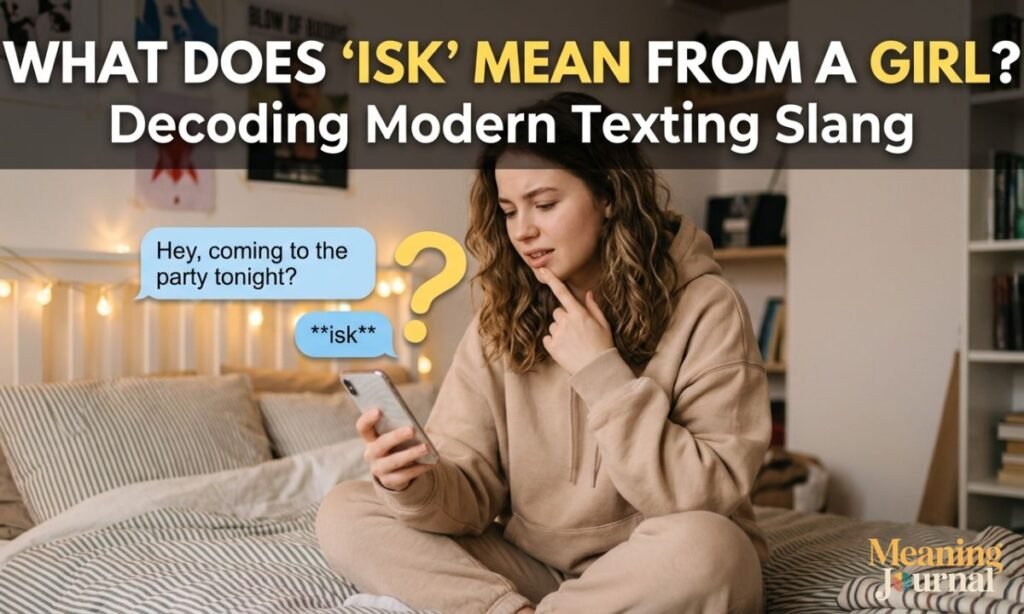
When a girl uses ISK in a text message, it typically carries the same core meaning — “I Should Know” — but the tone often leans more toward self-awareness, light humor, or playful honesty.
For example, if she texts:
“ISK, I don’t know why I keep forgetting your coffee order 😅”
She’s admitting she should have remembered, with a friendly, self-deprecating touch. It’s not a serious statement — it’s a casual, relatable moment of honesty.
Girls also sometimes use ISK in a positive, confident way:
“ISK — I’ve watched every episode of that show three times.”
Here it signals expertise or strong familiarity with a topic. In this context, it’s almost a subtle flex.
The key takeaway: context and emoji are your best guides when interpreting ISK from anyone, girl or guy.
ISK Meaning in Texting Language
In the broader world of texting language and digital slang, ISK sits comfortably alongside abbreviations like IDK, TBH, and NGL. These are all shorthand ways to express feelings or states of mind without typing full sentences.
ISK as a texting term reflects something specific: the gap between what we know and what we feel we should know. That’s a surprisingly universal human experience — which is probably why the abbreviation caught on.
Where it fits in texting language:
- Casual conversations between friends
- Group chats discussing pop culture, news, or shared experiences
- Reactions to surprising information
- Self-aware humor or light self-criticism
Different Meanings of ISK Based on Context
One of the biggest reasons ISK confuses people is that it genuinely does have more than one meaning. Here’s a breakdown:
| Meaning | Context | Tone |
| I Should Know | General texting, social media | Casual, self-aware |
| I Suck (at something) | Gaming, frustration | Self-deprecating |
| I Don’t Know (typo of IDK) | Fast typing errors | Neutral/accidental |
| InterStellar Kredits | EVE Online gaming | Gaming-specific |
| Icelandic Króna (ISK) | Finance/travel | Formal/technical |
For 99% of everyday text conversations, you can safely assume ISK means “I Should Know.”
ISK as “I Should Know” (Most Common)
This is the definition you’ll encounter most often in modern texting. The phrase “I Should Know” captures a moment of self-reflection — someone realizing they have relevant experience or knowledge on a topic.
Common usage patterns:
- Admitting a gap: “ISK what time the store closes, I go there every week 😩”
- Showing expertise: “ISK — I’ve been coding for six years”
- Mild embarrassment: “ISK his last name and we’ve been friends for two years 💀”
The abbreviation is especially popular among Gen Z and Millennials, who often layer humor and self-awareness into even the shortest messages.
ISK as an Expression of Mild Pressure
ISK can also carry a subtle pressure — the idea that someone should have known something, directed not just inward but sometimes outward.
For example:
“You forgot the meeting? ISK, it’s been on the calendar for a month.”
Here, ISK subtly signals: “This was your responsibility and you missed it.” It’s not harsh, but it implies expectation. This is a less common usage, but worth knowing so you don’t misread the tone in a conversation.
Less Common Meanings of ISK
Beyond “I Should Know,” ISK pops up in a few niche contexts:
- “I Suck” — Used colloquially, especially in gaming or after making an obvious mistake. Not widely used, but documented in older internet slang communities.
- Typo for IDK — On mobile keyboards, the “S” and “D” keys are very close together. Many instances of “ISK” in chats are simply a fast-typing error for “IDK” (I Don’t Know). If the message doesn’t seem to match “I Should Know,” this is worth considering.
- Emotional filler — Similar to “ugh” or “idk,” some people use ISK as a vague expression when they don’t know what else to say.
ISK Meaning in Social Media and Chats
ISK on WhatsApp
On WhatsApp, ISK almost always appears in private chats or group conversations among friends. It’s used in a warm, informal tone — usually to acknowledge a shared experience or admit a knowledge gap. Because WhatsApp conversations are typically between people who know each other well, ISK rarely causes confusion in this context.
Example:
“Wait, the café closed down? ISK — I just went there last month 😱”
ISK on Instagram DMs
Instagram DMs lean heavily on casual, fast-paced communication. ISK fits right in. You’ll often see it in reactions to posts, memes, or trending topics. It pairs naturally with Instagram culture, where admitting you’re “out of the loop” on a trend is relatable and even charming.
Example:
“ISK how I missed that collab announcement 😭 everyone’s talking about it”
ISK in Online Chats
In gaming communities, Discord servers, and Twitch chats, ISK can mean either “I Should Know” (in casual conversation) or carry the older slang meaning of “I Suck” when someone makes a gameplay mistake. Always read the room — or in this case, the channel.
How Tone Changes the Meaning of ISK
This is the part most people overlook. ISK is not a neutral acronym — tone transforms it completely.
- With a laughing emoji 😂: Self-deprecating, light-hearted
- With a thinking emoji 🤔: Genuine confusion or self-reflection
- With a flexing emoji 💪: Confident, showing off knowledge
- With no emoji, in a serious conversation: Could imply mild criticism or pressure
- In all caps (ISK!): Emphasis, frustration, or sarcasm
Reading ISK without reading the full message around it is like reading a word without the sentence — context is everything.
ISK vs Similar Text Abbreviations
How does ISK compare to other common texting abbreviations? Here’s a simple comparison:
| Abbreviation | Meaning | Vibe |
| ISK | I Should Know | Self-aware, reflective |
| IDK | I Don’t Know | Neutral uncertainty |
| IKR | I Know, Right? | Agreement, validation |
| TBH | To Be Honest | Directness, confession |
| NGL | Not Gonna Lie | Honesty with a casual edge |
| SMH | Shaking My Head | Disappointment or disbelief |
ISK is unique in that it’s specifically about expected knowledge — the feeling that you should already have an answer, which separates it from simple uncertainty (IDK) or agreement (IKR).
Also Read This: Understanding “Ash” Meaning in Text – What It Really Means and How to Use It (2026)
Real-Life Examples of ISK in Text Messages
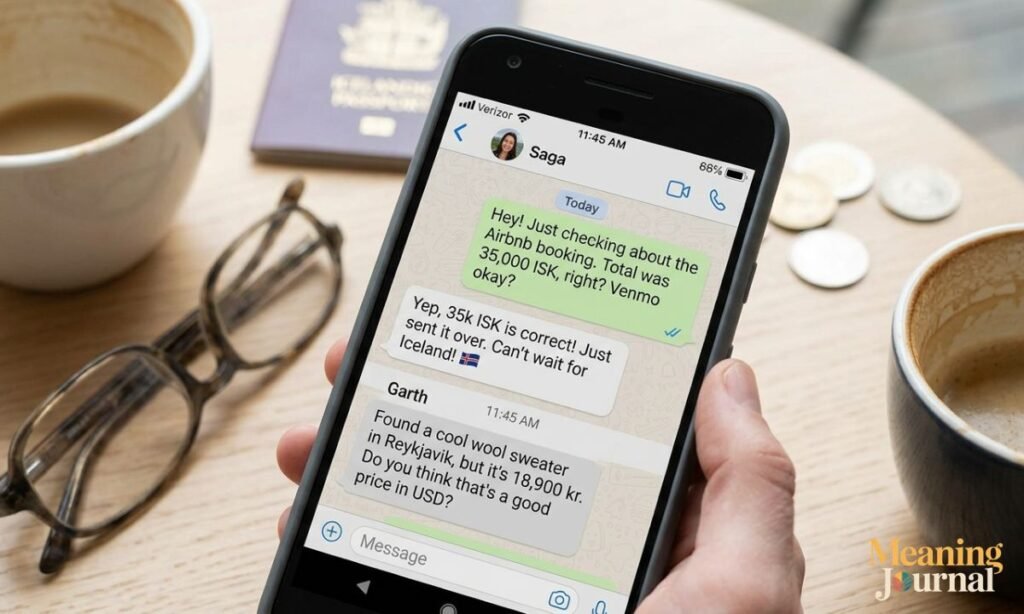
Here are realistic conversation examples to show ISK in action:
Example 1 — Self-deprecating:
Alex: “Did you know they renamed the street behind our school?” Jordan: “What?? No way. ISK, I walk that route every single day 😂”
Example 2 — Showing expertise:
Sam: “Is it worth watching Dune before the sequel?” Riley: “Absolutely yes. ISK — I’ve read the books twice and seen every adaptation.”
Example 3 — Accidental typo for IDK:
Maya: “What time does the party start?” Lena: “ISK lol wait let me check” (Here, Lena likely meant IDK)
Example 4 — Mild pressure:
Boss: “Did you send the report?” Coworker: “Not yet, sorry.” Boss: “ISK that was due this morning…”
Can ISK Be Used Alone?
Yes — and it’s pretty common. Sending just “ISK” as a standalone reply works in many situations:
- As a reaction to surprising news you feel you should have already heard
- As a quick self-aware admission without needing to elaborate
- As a vague, dismissive response (though this can come across as cold)
It functions similarly to “wow” or “of course” depending on context. Alone, it works best when the other person already understands the shared reference or situation.
Is ISK Formal or Informal?
Completely informal. ISK belongs in casual digital conversations — not work emails, professional Slack channels, or formal writing of any kind.
Using ISK in a formal setting would seem out of place at best and unprofessional at worst. Save it for:
✅ Text messages with friends
✅ Social media comments
✅ Casual group chats
✅ Gaming or hobby communities
❌ Work emails
❌ Academic writing
❌ Client communications
❌ Professional networking messages
Why People Use ISK Instead of Full Sentences
Digital communication has a built-in demand for speed. Nobody wants to type “I realize I should probably already know this, but I’ve forgotten” when they can type “ISK” instead. This is the core driver behind all text slang.
But ISK also does something a full sentence can’t quite do — it creates a moment of shared understanding. When you text ISK, you’re not just admitting something; you’re doing it in a way that signals you’re fluent in the language of modern digital conversation. It’s a small social signal that says: I’m in on the shorthand.
Common Mistakes When Interpreting ISK
Even people who know text slang sometimes get ISK wrong. Here are the most frequent errors:
- Assuming it always means IDK. ISK and IDK look similar and are close on a keyboard, but they mean different things. ISK = I Should Know; IDK = I Don’t Know.
- Missing the tone. ISK can be humble, confident, or critical depending on context. Don’t interpret it in a vacuum.
- Assuming it’s a typo every time. Yes, some ISKs are fat-finger IDKs — but many are intentional. Look at the rest of the message.
- Using it in formal settings. It’s informal slang. Context matters for when you use it, not just what it means.
How to Respond When Someone Uses ISK
Not sure how to reply when ISK shows up in your chat? Here are some natural, situation-appropriate responses:
- If they’re being self-deprecating: “Haha don’t worry, I had no idea either!”
- If they’re showing expertise: “Okay so you’re the person I need to ask about this 😂”
- If it was a typo for IDK: “No worries — the party starts at 8!”
- If the tone felt like mild pressure: Address what they’re pointing at directly and honestly.
The golden rule: match their energy. If they’re keeping it light with ISK, keep your reply light too.
ISK Meaning for Beginners
If you’re new to text slang, here’s the simplest possible summary:
ISK = I Should Know
Use it when:
- You realize you should already know something but don’t
- You want to show you’re familiar or experienced with something
- You want to react to surprising news in a self-aware way
That’s it. Three letters, one core idea, lots of flexibility.
Why Understanding Text Slang Is Important Today
Digital communication isn’t just a convenience anymore — it’s the primary way billions of people connect. Misreading slang can mean misreading someone’s tone, intention, or emotion entirely. A text that was meant to be funny can land as rude. A confident statement can read as arrogant.
Understanding abbreviations like ISK helps you:
- Communicate more naturally in digital spaces
- Avoid misunderstandings in chats and comments
- Connect with younger generations who rely heavily on shorthand
- Keep up with fast-moving internet culture
Language evolves constantly, and digital language evolves fastest of all. Staying fluent keeps conversations flowing.
How ISK Fits Into the Broader World of Internet Slang Evolution
ISK is just one example of how language naturally compresses in digital spaces. The same forces that gave us LOL, BRB, and SMH in the early 2000s continue to generate new shorthand today. Platforms like TikTok, Instagram, and Discord are now the primary incubators for new slang — and abbreviations travel faster than ever thanks to viral content.
What makes ISK interesting from a linguistic standpoint is its self-referential quality. Unlike IDK (which just expresses ignorance), ISK carries an implicit standard — I should be better than this. That layer of self-awareness fits perfectly with the ironic, self-deprecating humor that dominates Gen Z communication culture in 2026.
ISK on TikTok and Trending Slang Culture
TikTok has become one of the most powerful engines for spreading slang. ISK appears in comment sections, video captions, and duet responses — typically in the “I Should Know” sense, often paired with a reaction to surprising viral content.
You’ll frequently see it used like:
“ISK this trend has been going on for two months and I just found it 💀”
The platform’s short-form culture rewards brevity, and ISK delivers maximum meaning in minimum characters. As trends move faster, expect abbreviations like ISK to keep appearing in new contexts and combinations.
ISK in Gaming Communities
In gaming, ISK wears two hats. In EVE Online — a massively multiplayer space-based game — ISK stands for InterStellar Kredits, the in-game currency. Players “farm ISK,” “buy ISK,” and “spend ISK” as part of the game’s economy.
Outside of EVE, ISK in gaming chats can mean either “I Should Know” (in casual conversation) or the older slang “I Suck” (usually as a self-critical remark after a bad play).
If you’re in a gaming community and someone says “Ugh, ISK at this map” — they almost certainly mean “I suck at this map,” not “I should know this map.” Gaming subculture gives this abbreviation its own flavor.
Expert Insight on Digital Language
Linguists and digital communication researchers have consistently noted that text slang serves both practical and social functions. Practically, abbreviations save time. Socially, they create in-group identity — shared language signals that you belong to a community or generation.
ISK is a good example of an abbreviation that has migrated across communities, picking up slightly different shades of meaning as it travels. What started as niche gaming slang has become mainstream texting vocabulary, and what it means at any given moment depends entirely on the community using it.
This is normal for living language. Words and abbreviations don’t stay still. The best approach is always to read context first, meaning second.
Frequently Asked Questions
What does ISK mean in a text message?
ISK most commonly means “I Should Know” — used to acknowledge you’re familiar with something or should have remembered it.
Is ISK the same as IDK?
No. IDK means “I Don’t Know,” while ISK means “I Should Know.” They’re different in meaning, though the letters look similar and ISK is sometimes a typing error for IDK.
What does ISK mean from a girl?
It typically means “I Should Know” — used in a self-aware, sometimes playful or humble tone, just as it would from anyone else.
Can ISK be used alone in a text?
Yes. Sending just “ISK” works as a standalone reaction in many casual conversations.
Is ISK formal or informal slang?
ISK is informal slang. It’s appropriate for casual chats but not for professional or formal communication.
What does ISK mean in gaming?
In EVE Online, ISK means InterStellar Kredits (the game’s currency). In general gaming chats, it can also mean “I Suck” as a self-critical expression.
Why do people type ISK instead of IDK?
Sometimes it’s intentional (meaning “I Should Know”), and sometimes it’s a fat-finger typo — the S and D keys are adjacent on most mobile keyboards.
Does ISK mean anything on Snapchat specifically?
On Snapchat, ISK is used the same way as in regular texting — most commonly as “I Should Know.” There’s no Snapchat-specific definition.
Can ISK sound rude?
It can, if used in a sharp or sarcastic tone directed at someone else. Context and delivery matter a lot.
Is ISK popular in 2026?
Yes — while it’s not as widespread as IDK or LOL, ISK is actively used in texting, Instagram DMs, Snapchat, and online communities.
Conclusion
ISK might look like a throwaway cluster of letters, but it carries real weight in modern digital conversation. Whether you’re seeing it in a WhatsApp group, an Instagram DM, a Snapchat message, or a gaming chat, the meaning always comes back to one of a few clear possibilities — with “I Should Know” leading the pack.
The next time someone texts you ISK, you’ll know exactly what they mean. And if you want to use it yourself? Just remember: keep it casual, read your audience, and let the emoji do the heavy lifting when tone is ambiguous.
Digital language is always changing — but now you’re one step ahead of it.

Matt Henry is a writer with 4 years of experience in researching and explaining the meanings of words, names, and phrases. He is passionate about language and enjoys exploring the origins and true meanings behind everyday terms.