

You’re scrolling through your group chat. Someone shares a wild story, and their friend replies with just four letters: SMFH. No explanation. No context. Just those four characters carrying a mountain of emotion.
Sound familiar? You’re not alone.
Internet slang moves fast — and SMFH is one of those acronyms that seems to pop up everywhere, from TikTok comments to Twitter rants to private DMs. If you’ve been nodding along pretending to understand it, this guide ends the confusion for good.
By the end of this article, you’ll know exactly what SMFH means, where it came from, when to use it, when to avoid it, and what alternatives exist when you need to express the same emotion more professionally.
Let’s get into it.
What Does SMFH Mean in Text?
SMFH stands for “Shaking My F**king Head.”
It is an internet slang acronym used to express strong feelings of frustration, disbelief, disappointment, or disapproval. When someone types SMFH, they’re essentially saying: “This is so ridiculous or frustrating that all I can do is shake my head.”
Think of it as a digital gesture — the textual equivalent of watching someone do something so baffling that you physically shake your head in disbelief.
Quick Definition Box: SMFH = Shaking My F**king Head Type: Internet slang / texting acronym Tone: Frustrated, disapproving, disbelieving Usage: Informal only — casual texts, social media, group chats
Breaking Down SMFH Word by Word
Understanding each word in the acronym makes it much easier to use correctly.
| Letter | Word | What It Adds |
| S | Shaking | The physical gesture — head movement expressing strong reaction |
| M | My | Makes it personal — the speaker’s own reaction |
| F | F**king | The amplifier — intensifies the emotion significantly |
| H | Head | Completes the gesture — “shaking my head” |
The “F” is the key ingredient that separates SMFH from its milder cousin SMH. It’s not decorative — it carries real emotional weight. Removing it completely changes the tone.
SMFH vs SMH: What’s the Difference?
A lot of people wonder whether SMFH and SMH are interchangeable. They’re not — not quite.
| Feature | SMH | SMFH |
| Full Form | Shaking My Head | Shaking My F**king Head |
| Intensity | Mild disappointment | Strong frustration or disbelief |
| Profanity | None | Yes |
| Appropriate for work? | Sometimes | No |
| Emotional tone | Sigh | Facepalm + eye-roll |
| Common usage | Minor annoyances | Major frustrations, shocking behavior |
If SMH is a quiet sigh, then SMFH is a full-on exasperated groan. You’d use SMH when your friend is five minutes late. You’d use SMFH when they show up two hours late and blame traffic — for the third time.
Emotional Meaning Behind SMFH
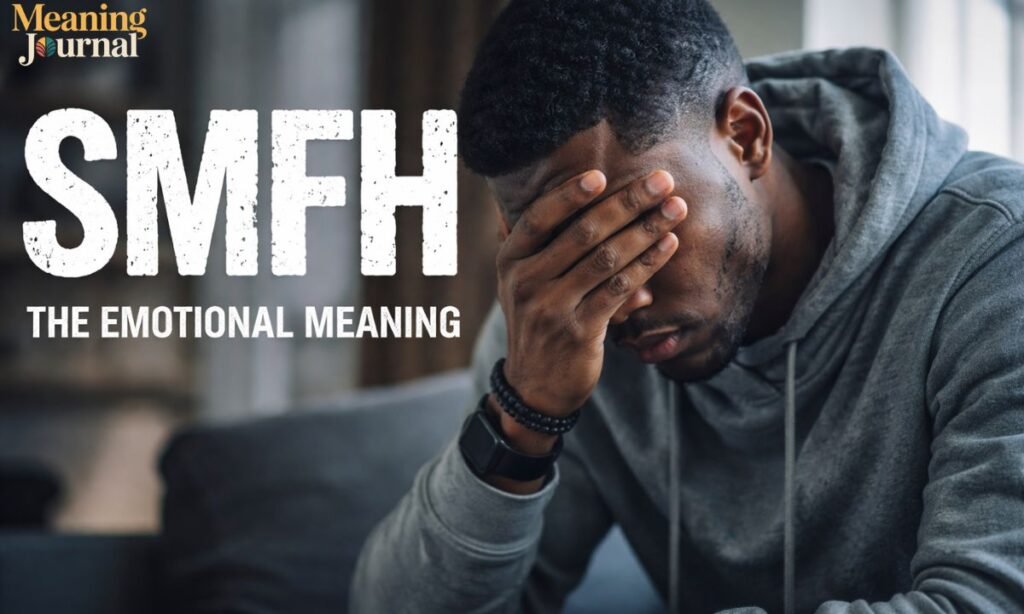
Words are only part of communication. Tone is everything — especially in text, where there’s no facial expression or voice pitch to help.
SMFH is almost never neutral. It almost always signals one or more of these emotional states:
- Frustration — Something happened that shouldn’t have
- Disbelief — The speaker can’t believe what they’re seeing or hearing
- Disappointment — Expectations weren’t just unmet — they were shattered
- Judgment — A quiet (or not-so-quiet) verdict on someone’s choices
- Exasperation — The “I give up trying to explain this” feeling
Depending on the context, SMFH can also carry a trace of humor. Between close friends, “SMFH 😂” in response to a funny mistake reads completely differently than “SMFH.” with no emoji after a serious frustration.
Common Situations Where People Use SMFH
Disappointment in Someone’s Actions
When someone close to you makes a choice that lets you down, SMFH captures the precise blend of sadness and frustration.
“He knew I had an early flight and still kept texting me until 2 AM. SMFH.”
Reacting to Bad Decisions
Watching someone make an obviously wrong choice — and ignoring all advice — is a classic SMFH moment.
“She deleted the presentation file instead of saving it. SMFH.”
Responding to Absurd Statements
When someone says something so illogical that a response feels pointless, SMFH does the heavy lifting.
“He actually argued that the moon landing was filmed in a Hollywood studio. SMFH.”
Online Drama or Gossip
Social media is practically built for SMFH moments. From celebrity behavior to viral news stories, it shows up constantly in comment sections.
“He went on live to explain his side and made it ten times worse. SMFH.”
Real-Life Examples of SMFH in Text
Seeing the acronym in actual conversation makes it click faster than any definition. Here are realistic examples across different contexts:
In a group chat:
Friend 1: “Tyler forgot the tickets and now we can’t get in.” Friend 2: “SMFH. Not again.”
On Twitter/X:
“They raised the price by 40% and removed half the features. SMFH. #Cancel”
In a one-on-one text:
“My boss asked me to redo the whole report because the font was slightly off. SMFH.”
Humorous use between friends:
“Locked myself out of the house wearing socks. SMFH 😭”
Reacting to a news headline:
“Another data breach? SMFH at this point.”
Notice how the tone shifts in each example — from pure frustration to weary resignation to self-deprecating humor. The same four letters carry different weight depending entirely on context.
SMFH Meaning in Medical Context
Here’s something most guides skip: SMFH does have a meaning in medical and scientific fields, and it’s completely unrelated to texting.
In medical literature, SMFH can stand for “Superficial Malignant Fibrous Histiocytoma” — a rare type of soft tissue tumor. Some sources also note it has appeared as an abbreviation for terms related to specific anatomical or clinical descriptions.
Important: If you encounter SMFH in a medical report, clinical document, or healthcare setting, it does not mean “Shaking My F**king Head.” Always verify abbreviations with your healthcare provider or the source document. Medical acronyms are highly context-dependent and vary between institutions.
The texting definition and the medical definition have zero overlap — they only share the same four letters.
Is SMFH Rude or Offensive?
Honestly? It depends on who’s reading it.
SMFH contains a profanity — that’s a fact. Whether it’s offensive comes down to three things: audience, relationship, and context.
When SMFH is generally acceptable:
- Among close friends who use casual language freely
- In informal group chats with people who know your communication style
- Reacting to memes, funny situations, or shared frustrations
- On social media platforms where casual tone is the norm
When SMFH crosses a line:
- Directed at someone as personal criticism (“You forgot again? SMFH.”)
- Sent to someone who doesn’t know you well
- Used in response to something serious or sensitive
- Aimed at a person from an older generation unfamiliar with the slang
The profanity makes it a higher-risk choice than SMH. When in doubt, go with a safer alternative — especially if there’s any chance the other person might take it personally.
SMFH in Social Media vs Private Texts
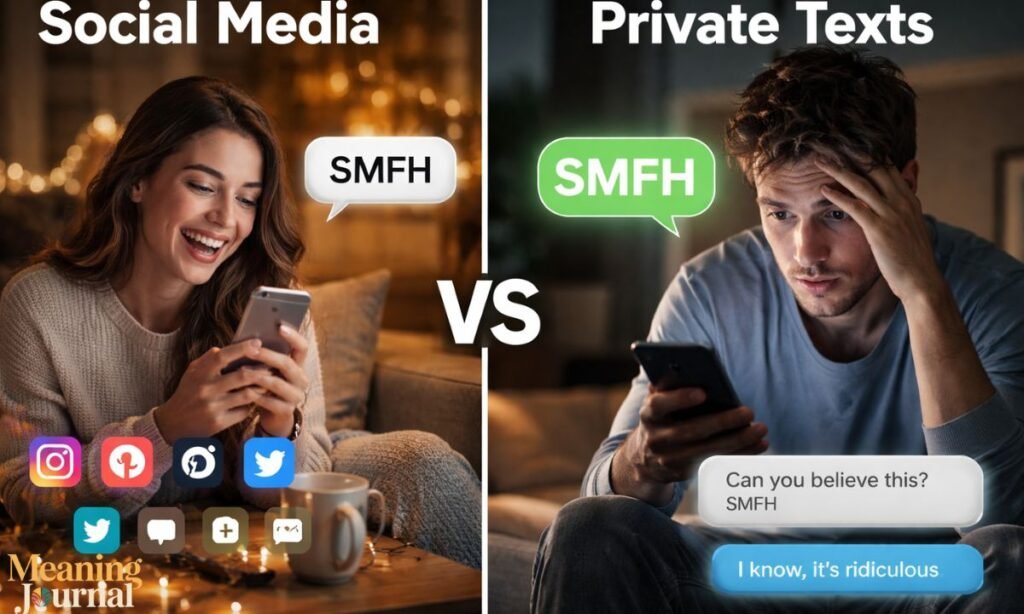
The platform you’re on changes how SMFH lands.
On Social Media (Twitter/X, Instagram, TikTok): SMFH functions almost like a hashtag reaction. It’s public, often performative, and rarely aimed at a specific person. Audiences expect casual, emotionally expressive language here. SMFH fits right in.
In Private Texts: Here the stakes are higher. You’re talking directly to a person. If SMFH is directed at them — their decision, their behavior — it can feel harsh, judgmental, or even aggressive, even if you didn’t mean it that way.
In Group Chats: Group chats split the difference. Among close friend groups, SMFH is common and rarely misread. In professional or mixed group chats (coworkers, family, school), it’s riskier.
Rule of thumb: The more personal the conversation, the more careful you should be with SMFH.
How to Respond When Someone Says SMFH to You
If someone sends you SMFH, your response depends on why they sent it.
- If they’re venting about a third party: Match their energy. “I know right, SMFH too.” You’re being supportive, not confrontational.
- If it’s directed at you: Don’t react defensively right away. Ask what’s wrong. They’re clearly frustrated — find out why before escalating.
- If you’re unsure of the tone: A simple “Everything okay?” opens a door without assuming.
- If it was clearly humorous: Play along. “Yeah SMFH at myself honestly 😂” keeps the mood light.
The biggest mistake is taking a casually-sent SMFH as a personal attack when it was just expressive shorthand.
Should You Use SMFH? Pros and Cons
| Pros | Cons |
| Quick and emotionally precise | Contains profanity |
| Universally understood in casual settings | Can come across as rude or judgmental |
| Saves time when words feel inadequate | Not appropriate in professional settings |
| Adds emotional depth to short texts | Risk of misinterpretation in sensitive conversations |
| Widely used across platforms | Can feel performative on social media |
Bottom line: SMFH is a useful tool in your informal communication toolkit. Just know when to put it away.
SMFH and Tone: Why It Matters So Much
In face-to-face conversation, tone, facial expressions, and body language carry about 55% of communication’s meaning. In text, you have none of that.
This makes context and word choice incredibly important. SMFH, by itself, is emotionally ambiguous in ways that people often underestimate:
- “SMFH 😂” = laughing it off, light-hearted
- “SMFH.” = heavy, serious, done with it
- “I just… SMFH” = exasperated resignation
- “SMFH at you right now” = direct and potentially confrontational
Punctuation, emojis, and surrounding sentences all change how SMFH reads. Be intentional about what you pair it with.
Generational Use of SMFH
SMFH isn’t universally understood across generations, and that creates real communication gaps.
Gen Z and Millennials use SMFH fluently. It’s part of their everyday digital vocabulary, often deployed with self-awareness and humor.
Gen X is mixed. Some are fully fluent in internet slang; others may recognize it but not use it themselves.
Baby Boomers and older generations are often unfamiliar with it entirely. Sending SMFH to an older relative might create genuine confusion — or offense if they look it up and see the full form.
The lesson: know your audience’s digital literacy before defaulting to heavy slang.
Cultural Context of SMFH
SMFH originated in English-speaking online spaces — primarily the United States — and spread through social media, gaming communities, and texting culture in the early 2000s.
It’s most common in American English digital communication, though it’s recognized in the UK, Canada, and Australia. Non-English speakers often recognize it from exposure to English social media but may not use it naturally in their own languages.
It also carries specific resonance in Black American internet culture, where expressive acronyms like SMH, SMDH, and SMFH became widely popularized through platforms like Twitter and Vine before going mainstream.
Can SMFH Be Used Professionally?
Short answer: No.
Longer answer: Absolutely not — and here’s why.
SMFH contains profanity. Even in 2026, where workplace communication has become increasingly casual, explicit language in professional messages signals a lack of restraint and poor judgment about audience awareness.
Using SMFH in:
- Emails to clients or colleagues → Appears unprofessional and careless
- Slack/Teams messages at work → High risk, even in casual channels
- LinkedIn posts → A clear red flag to professional audiences
- Academic writing → Never appropriate
If you feel the SMFH emotion at work, reach for cleaner alternatives: “I’m genuinely surprised by this,” “That’s concerning,” or even just “Wow.” They communicate the same feeling without the baggage.
Alternatives to SMFH (Safer Options)
When the context calls for expressing frustration or disbelief without profanity, these alternatives work well:
| Situation | Better Alternative |
| Mild frustration | SMH / “Sigh…” |
| Disbelief | “I can’t believe this.” / “Seriously?” |
| Disappointment | “That’s really disappointing.” |
| Exasperation | “I give up.” / “Facepalm.” |
| Professional settings | “This is unexpected.” / “I’m concerned.” |
| Humorous context | “The audacity 😂” / “Bruh.” |
| Social media reaction | 🤦 / “No words.” |
Also worth knowing: SMDH (Shaking My Damn Head) is a slightly softer alternative that conveys similar emotion without the harder profanity.
SMFH in Group Chats vs One-on-One Chats
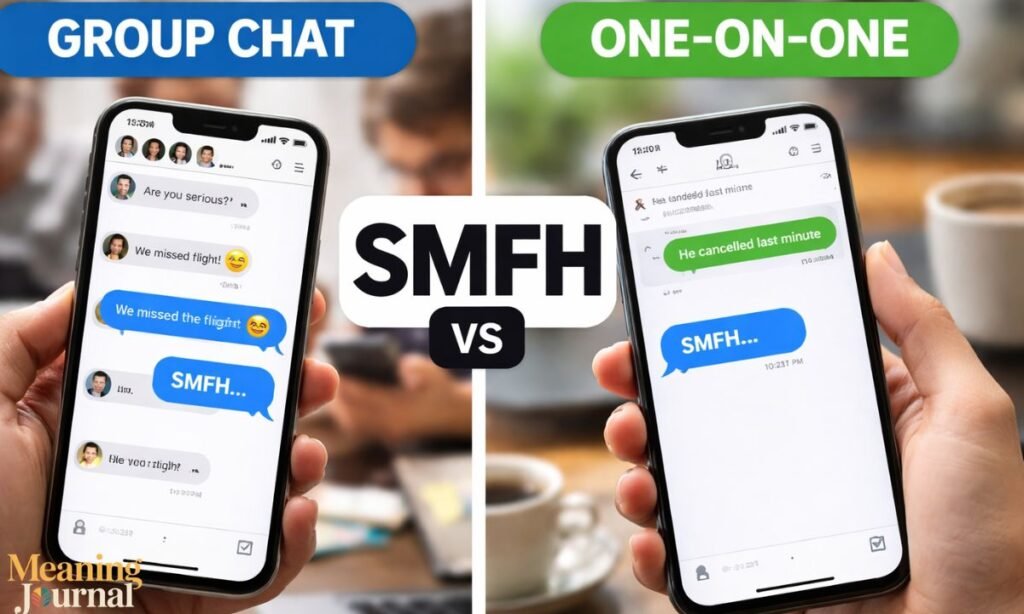
Group chats change the dynamics of SMFH significantly.
In a group chat among friends, SMFH is low-stakes. Everyone knows the culture, the humor, and the relationships. It reads as relatable frustration or shared exasperation.
In a one-on-one text, it can feel more pointed — especially if directed at the person you’re talking to. The same message that gets laughs in a group could cause hurt feelings in private.
In mixed groups (work teams, family threads, school groups), SMFH is almost always a bad idea. The audience is too varied to predict how it’ll land.
Misunderstandings Caused by SMFH
SMFH has caused its share of confusion and friction, particularly in three scenarios:
- Generational gap: An older person receives SMFH, doesn’t recognize it, Googles it, and is shocked by the profanity — even if the sender meant nothing serious.
- Tone misread: Sender types “SMFH” as playful teasing. Receiver, who’s already stressed, reads it as harsh judgment. Conflict follows.
- Acronym confusion: Some people mistake SMFH for other acronyms. A small percentage have misread it as “So Much Freaking Happiness” — the exact opposite meaning.
If there’s any ambiguity in your relationship or the situation’s tone, spell out your feelings instead of relying on four letters.
Is SMFH Still Popular in 2026?
Yes — but its use has evolved.
SMFH remains firmly embedded in casual digital communication in 2026. However, it has reached a kind of cultural saturation point where younger users increasingly layer it with irony or self-aware humor rather than pure frustration.
Platforms like TikTok have also introduced visual versions of the same emotion (the 🤦 facepalm emoji, reaction clips, etc.), which sometimes replace text-based acronyms. But SMFH hasn’t disappeared — it’s just one tool in a broader expressive toolkit.
Interestingly, platforms are also placing more scrutiny on profanity in public content, which may shift usage more toward private messaging over time.
Psychological Insight: Why We Use Slang Like SMFH
Internet slang serves a genuine psychological function — it’s not just laziness or shorthand.
Acronyms like SMFH allow people to:
- Express complex emotions quickly in environments where short responses are the norm
- Signal group membership — using the right slang shows you’re fluent in the community’s language
- Regulate emotional intensity — labeling an emotion (even in shorthand) helps process it
- Create emotional distance — sometimes it’s easier to type SMFH than to fully articulate a frustration
Linguists note that digital slang evolves to fill gaps in formal language — emotional nuances that standard vocabulary doesn’t efficiently capture. SMFH fills a very specific niche: maximum frustration in minimum characters.
Expert Insight
Language researcher and digital communication expert Dr. Lauren Squires has noted that internet acronyms function as “stance markers” — they signal the speaker’s emotional and evaluative position quickly and efficiently. Acronyms like SMFH compress not just words, but entire social attitudes into a compact form. They tell the reader: here’s how I feel and here’s my judgment on this situation — all in four characters.
This explains why SMFH hits differently than simply writing “I’m frustrated.” The acronym carries cultural context, emotional shorthand, and social signaling all at once.
What Does SMFH Mean on Snapchat and Instagram?
On Snapchat, Instagram, and TikTok, SMFH carries the same core meaning — Shaking My F**king Head — but the context shifts slightly.
On Snapchat, it appears in direct messages and story replies, usually as a reaction to something a friend shared. Because Snapchat is built on close friendships, SMFH here is almost always playful or sympathetic rather than harsh.
On Instagram, you’ll find it most in comments on viral posts, memes, or news reposts. It functions like a public reaction stamp — a way of adding your voice to a shared frustration.
On TikTok, it appears in comment sections and is often paired with the 🤦 emoji or reaction stitches that convey the same emotion visually.
Across all these platforms, the meaning doesn’t change — but the tone and intent often do based on who’s saying it and what they’re reacting to.
SMFH Full Form Variations: Other Meanings You Should Know
While the dominant meaning is “Shaking My F**king Head,” the acronym has a small handful of alternative interpretations:
| Variation | Full Form | Common? |
| Primary | Shaking My F**king Head | Very common |
| Softer version | Shaking My Freaking Head | Common |
| Medical | Superficial Malignant Fibrous Histiocytoma | Rare/specialized |
| Rare slang | So Many F**king Haters | Very rare |
| Rare slang | So Much F**king Homework | Very rare |
The softer “Freaking” version is worth knowing — it lets you use the same acronym in slightly more mixed company without the harder profanity, though the ambiguity can sometimes create its own confusion.
Example Sentences Using SMFH Naturally
Here’s how SMFH flows in genuine, natural conversation:
- “They cancelled the event one hour before it started. SMFH.”
- “My coworker keeps CC’ing the entire department on emails meant for one person. SMFH.”
- “He said he read the instructions but clearly didn’t. SMFH.”
- “They raised prices again and offered a loyalty discount of 2%. SMFH.”
- “My dog ate my charger. For the second time. SMFH 😂”
- “Politicians promising the same things every election cycle. SMFH.”
- “She texted me ‘k’ after I wrote three paragraphs. SMFH.”
Notice the range — some are genuinely frustrated, some are almost comedic. The common thread is a reaction to something the speaker finds baffling, ridiculous, or deeply frustrating.
Frequently Asked Questions
What does SMFH mean in text?
SMFH stands for “Shaking My F**king Head” — it expresses strong frustration, disbelief, or disappointment.
Is SMFH the same as SMH?
No. SMH is milder (“Shaking My Head”), while SMFH adds profanity for extra intensity.
Is SMFH offensive?
It contains a swear word, so it can offend depending on the audience and context — always consider who will read it.
Can I use SMFH at work?
No. It’s inappropriate in professional settings; use clearer, neutral language instead.
What does SMFH mean on Snapchat?
Same meaning — “Shaking My F**king Head” — typically used as a reaction to something ridiculous or frustrating.
What is the medical meaning of SMFH?
In medical contexts, SMFH can stand for “Superficial Malignant Fibrous Histiocytoma,” which is unrelated to the texting slang.
What are safer alternatives to SMFH?
Try SMH, SMDH, “I can’t believe this,” “Seriously?”, or the 🤦 emoji for a cleaner expression of the same feeling.
When did SMFH originate?
It grew from online chat rooms and forums in the early 2000s, evolving from SMH which dates back to the late 1990s.
Does SMFH always mean anger?
Not always — between close friends, it can be used humorously or affectionately with light-hearted frustration.
Is SMFH still used in 2026?
Yes, it remains popular in casual texting and social media, though often used with more irony than its early days.
Conclusion
SMFH is four letters doing a lot of heavy lifting. It compresses frustration, disbelief, and judgment into one fast, punchy reaction — which is exactly why it’s lasted so long in the ever-changing world of internet slang.
But like any sharp tool, it works best when used carefully. Know your audience. Know your platform. Know the tone you’re setting. A SMFH sent to the wrong person or in the wrong moment can create misunderstandings that a simple, fully-written sentence never would.
Whether you’re decoding it in someone else’s message or deciding whether to send it yourself, now you have everything you need. SMFH is no longer a mystery — just a very efficient, emotionally loaded acronym that’s earned its place in digital communication.
And if someone sends it to you? Take a breath, read the room, and respond with the same care you’d want in retu

Matt Henry is a writer with 4 years of experience in researching and explaining the meanings of words, names, and phrases. He is passionate about language and enjoys exploring the origins and true meanings behind everyday terms.