

You’ve probably seen it typed out in a caption, dropped in a group chat, or blasted across a TikTok comment section. IDGAF. Three letters (well, five) that carry a whole personality behind them. But what exactly does it mean, where did it come from, and — maybe more importantly — when should you not use it?
Let’s break it all down in plain, honest language.
What Does IDGAF Actually Mean?

IDGAF stands for “I Don’t Give A F**k.”
It’s an internet slang acronym used to express complete indifference, emotional detachment, or a bold refusal to care about what others think. The phrase isn’t new — people have been saying it out loud for decades — but its acronym form exploded with the rise of texting culture and social media in the 2010s.
At its core, IDGAF is a statement of liberation. It signals that the speaker has mentally checked out from caring about a specific person, opinion, situation, or outcome. Depending on context, it can come across as confident, dismissive, rebellious, or even empowering.
It’s important to note: IDGAF is explicit by nature. The “F” isn’t subtle. So while the meaning itself may feel familiar, the delivery is deliberately blunt.
The Backstory: How IDGAF Went from Street Slang to Global Internet Language
Long before smartphones existed, the phrase “I don’t give a f**k” was deeply embedded in hip-hop, punk, and urban street culture — used as an assertion of self-reliance and resistance to social pressure.
The acronym form started appearing in early online forums and SMS culture around the mid-2000s. By the time Twitter, Instagram, and Snapchat were mainstream, IDGAF had become a fluent part of digital expression.
Its cultural peak arguably came in 2018 when artist Dua Lipa released “IDGAF” — a breakup anthem that introduced the acronym to an even wider global audience. The song normalized the phrase in mainstream pop culture, turning it into something almost anthemic for people moving on from toxic relationships or societal expectations.
Today in 2026, IDGAF is not just slang — it’s a cultural attitude. It shows up in memes, brand campaigns, self-help language, tattoos, and merchandise.
How People Actually Use It: Real-World Context Breakdown
This is where it gets interesting. IDGAF doesn’t always mean the same thing. Context shifts its tone dramatically.
In Private Chats and Text Messages
In direct messages, IDGAF tends to be raw and honest. Someone venting to a friend might say:
“He texted me again and IDGAF anymore.”
Here, it’s cathartic — a release. The person isn’t performing for an audience. It’s genuine emotional expression. In this setting, it usually signals exhaustion, resolution, or emotional closure.
Sometimes it’s used more casually, almost humorously:
“Should I eat the whole pizza?” “IDGAF, you deserve it.”
In that case? It’s playful encouragement.
On Social Media — Instagram, TikTok, and Twitter/X
On public platforms, IDGAF takes on a slightly different role. It becomes part of personal branding. When someone posts a photo with the caption “Wore what I wanted. IDGAF 💅” — that’s not anger. That’s confidence theater. It’s a way of communicating authenticity and rebellion against criticism before it even arrives.
TikTok has its own relationship with the phrase. Whole video aesthetics have been built around the “IDGAF era” — a trend where creators announce they’re done people-pleasing, overexplaining, or seeking validation. It’s become an identity statement as much as a phrase.
On Instagram, it often accompanies:
- Post-breakup glow-up photos
- Bold fashion choices
- Candid, unfiltered selfies
In Professional Settings
Straightforwardly: IDGAF has no place in most professional environments. Using it in a work email, Slack message to your manager, or client communication is a fast track to serious misunderstanding.
However — and this is interesting — some startup cultures, especially in creative industries, have adopted casual slang as part of their brand voice. A copywriter writing for a streetwear label might use IDGAF in ad copy intentionally. Context, audience, and brand identity matter enormously here.
If you’re unsure whether it fits? It probably doesn’t. Stick to professional language in formal settings.
IDGAF Across Platforms: WhatsApp, Instagram, TikTok, and Beyond
Each platform shapes how slang lands:
WhatsApp — Usually private or small group conversations. IDGAF here feels intimate and unfiltered. It’s often used between close friends where the emotional weight is understood.
Instagram — Primarily performative. Captions using IDGAF are almost always about projecting confidence or setting a mood. Comments using it might be reactions to drama or unsolicited opinions.
TikTok — The heartland of the “IDGAF era” movement. Creators use it to mark personal transformations. The phrase has spawned entire content niches around unbothered living, boundary-setting, and self-reclamation.
Twitter/X — Used reactively, often in response to criticism or trending controversies. A quick “IDGAF what anyone thinks” under a ratio’d post is pretty standard behavior.
The Emotional Spectrum Behind the Phrase
Here’s something competitors rarely discuss: IDGAF doesn’t always mean someone truly doesn’t care. In fact, the opposite is often true.
Psychologically, people who loudly announce indifference are frequently processing a situation they care about deeply. It can be a defense mechanism — a way to protect ego, signal strength, or reclaim control in a situation where someone feels powerless.
When your friend texts “IDGAF that he canceled,” she might genuinely mean it — or she might be two minutes away from overthinking the whole thing. The phrase is as much about performing detachment as it is about actually feeling it.
This emotional nuance matters, especially if you’re on the receiving end of an IDGAF. Don’t always take it at face value. Sometimes it’s worth following up with a gentle “you okay?”
Similar Terms and How They Compare
| Term | Meaning | Intensity Level |
| IDC | I Don’t Care | Mild — casual disinterest |
| IDGAF | I Don’t Give A F**k | Strong — emphatic indifference |
| Whatever | General dismissal | Passive, sometimes sarcastic |
| DGAF | Don’t Give A F**k | Same as IDGAF, slightly shorter |
| NGL | Not Gonna Lie | Honesty marker, softer tone |
| SMH | Shaking My Head | Disappointment or disbelief |
The key difference between IDC and IDGAF is emotional intensity. IDC is like a shrug. IDGAF is slamming the door on your way out. Both express disinterest, but IDGAF adds weight, finality, and a slight edge of defiance.
Does IDGAF Appear in Technical Fields? (Physics, Medical, Aviation)
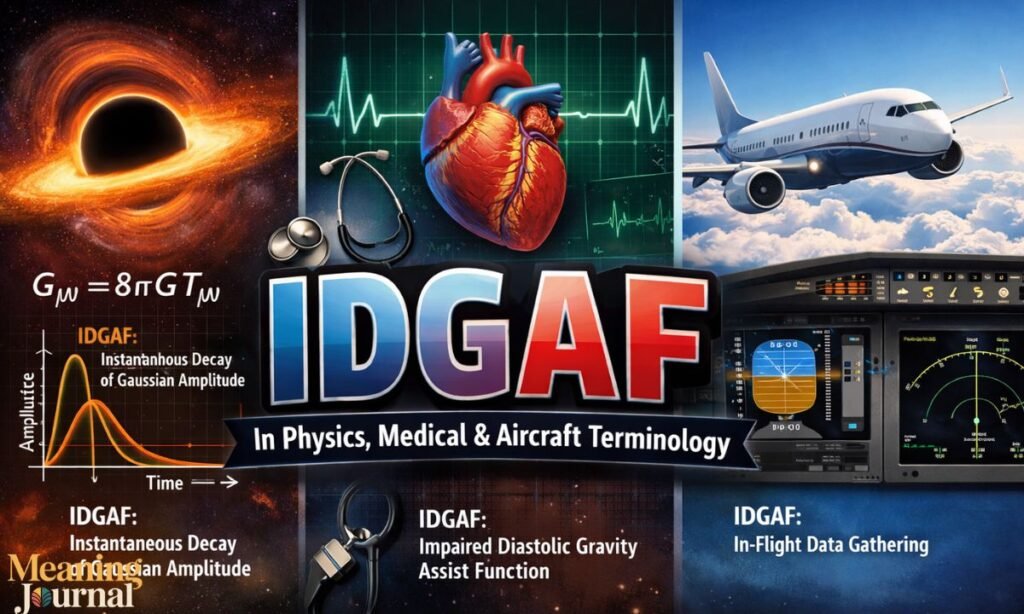
Short answer: No. IDGAF does not have any recognized definition in physics, medical terminology, or aviation/aircraft nomenclature.
In technical and professional fields, acronyms are extremely standardized and formally documented. IDGAF is exclusively internet and pop-culture slang — it hasn’t crossed into scientific or clinical use.
If you came across “IDGAF” in a medical document or aircraft manual, it would almost certainly be a typo or an error. In those contexts, always verify acronyms through official glossaries.
Common Misconceptions Worth Clearing Up
“IDGAF is always aggressive.” Not true. In many contexts, it’s lighthearted or even affectionate. Tone, relationship, and setting completely transform how it reads.
“Only young people use it.” Also not accurate. Slang travels across generations on the internet. Plenty of 30- and 40-somethings use IDGAF fluently in casual conversation.
“It’s the same as saying you’re rude.” The phrase is explicit, yes — but using strong language in the right context isn’t automatically rude. Among friends, in casual settings, it’s just expressive language.
“IDGAF means total emotional shutdown.” As mentioned earlier, it often masks deeper feelings. The bravado can be very real and very performative at the same time.
How to Respond When Someone Sends You IDGAF
Your response should match the context:
If it’s emotional venting — don’t challenge the sentiment. Validate first. Something like “honestly fair, you don’t have to” or “and you’re right not to” keeps the energy supportive.
If it’s playful — match the energy. Respond with humor. A simple “legend behavior” or “same honestly” works perfectly.
If it comes across as dismissive toward you — that’s worth addressing directly. A calm “I hear you, but that felt a little dismissive” opens a real conversation without escalating.
If you’re unsure — read the surrounding context. Was this person clearly frustrated before? Were you both joking around? The words before and after IDGAF usually tell you everything.
IDGAF in Dating Apps and Online Relationships
Dating app culture has a complicated relationship with IDGAF energy. On one hand, the “unbothered” persona is genuinely attractive to many people — someone who knows their worth and isn’t desperate for validation signals self-assurance.
On the other hand, someone who actually doesn’t care in a dating context — no follow-through, no emotional investment — is often just unavailable or avoidant. The persona and the reality can look very similar from the outside.
If someone on a dating app describes themselves with IDGAF vibes, it’s worth figuring out whether they mean:
- “I’m confident and don’t need outside approval” ✅
- “I won’t put in effort or communicate like an adult” ❌
In relationship conversations, IDGAF used at someone — “I don’t care what you think, IDGAF” — is a red flag for communication breakdown. It shuts dialogue down rather than opening it.
The Linguistic Evolution of IDGAF in 2026
One of the most fascinating things about internet slang is how it mutates over time. In 2026, IDGAF has become something of a tonal chameleon.
It’s been remixed into phrases like “IDGAF era” (a period of radical self-prioritization), “IDGAF attitude” (a personal philosophy), and even used ironically — where someone clearly does care deeply but labels their reaction “pure IDGAF energy” as self-aware humor.
This ironic usage is particularly common in Gen Z communication, where sincerity and irony often coexist in the same sentence. The phrase has essentially grown beyond its literal meaning into a cultural shorthand for self-determination.
Brands have started noticing. From streetwear to wellness companies, “IDGAF” energy is being marketed as empowerment — particularly to younger audiences tired of performative perfectionism and social media pressure.
Polite Alternatives If You Want the Same Energy Without the Explicitness
If you want to convey a similar meaning in situations where explicit language isn’t appropriate:
- “I’m not bothered by it.”
- “That doesn’t concern me.”
- “I’ve moved past caring about that.”
- “It’s not something I’m focused on anymore.”
- “I’m indifferent to the outcome.”
- “Not my concern.”
These carry a similar emotional weight — detachment, finality, confidence — without the explicit language. Useful for semi-professional contexts, conversations with family, or any setting where you want to maintain tone without the F-bomb.
Frequently Asked Questions
What does IDGAF stand for?
IDGAF stands for “I Don’t Give A F**k.” It’s an internet slang acronym used to express indifference, emotional detachment, or boldness in the face of criticism or social pressure.
Is IDGAF considered rude?
It depends entirely on context and audience. Among close friends in a casual setting, it’s normal expressive language. In formal, professional, or mixed-company environments, it’s generally considered inappropriate due to the explicit language.
Can I use IDGAF at work?
In most workplaces, no. It’s too informal and explicit for professional communication. There may be rare exceptions in highly casual creative industries, but as a general rule, avoid it in professional settings.
What’s the real difference between IDC and IDGAF?
IDC (“I Don’t Care”) is mild and casual — like a verbal shrug. IDGAF is much more emphatic and emotionally charged. It signals stronger finality and often a more deliberate rejection of outside opinions.
When did IDGAF become popular?
The acronym gained traction in the early-to-mid 2010s with the rise of social media and texting culture. It reached mainstream global recognition around 2018 with Dua Lipa’s hit song “IDGAF.”
Wrap-Up: More Than Just an Acronym
IDGAF might look like five random letters, but it carries real emotional weight, cultural history, and social nuance. Whether it’s someone finally letting go of a toxic relationship, an Instagram user owning their unbothered energy, or a TikToker announcing their “new era” — the phrase has become a linguistic marker of self-sovereignty in the digital age.
Use it where it fits. Skip it where it doesn’t. And if someone sends it to you, take a second to read the room before you respond.
Sometimes IDGAF really means freedom. Sometimes it means “I’m hurting and I need someone to ask me if I’m okay.” Often, it means both at the same time.
That’s the beautiful messiness of human communication — even in five letters.
