



Ever received a message with “FM” and had no clue what the sender meant? You’re not alone. This little two-letter abbreviation shows up in texts, tweets, TikToks, and even scientific papers — and it doesn’t always mean the same thing.
So, What Does FM Actually Mean?
At its most basic level, FM stands for “F**k Me” in casual digital conversation. Yes, really. It’s one of those expressions people fire off when something goes unexpectedly wrong, shockingly right, or just completely catches them off guard.
But here’s the thing — FM doesn’t only mean that. Context changes everything. Depending on where you see it, FM could mean something entirely different. In a physics textbook, it refers to Frequency Modulation. In an aviation manual, it might point to Flight Manual. In a medical chart, it could stand for Fibromyalgia.
So before you assume your friend is being dramatic about their Monday, it’s worth slowing down and reading the room — or in this case, the thread.
The Background: Where Did “FM” Come From?
Text-based slang didn’t appear overnight. It evolved alongside the internet itself, beginning in early chat rooms and SMS culture where every character counted. People started abbreviating naturally — not out of laziness, but out of necessity.
FM, as a slang term, grew organically from the broader trend of shortening emotional expressions. Think of how “OMG,” “WTF,” and “SMH” all took off in the mid-2000s. FM followed that same wave. It gave people a quick, punchy way to react — without having to spell out an entire emotional reaction.
Today, it lives comfortably in the vocabulary of Gen Z and millennials, especially on platforms like TikTok, Snapchat, and Twitter/X.
How FM Shows Up Across Different Platforms
This is where it gets interesting. FM behaves differently depending on where it’s being used. Let’s break that down.
In regular texting and WhatsApp, FM is almost always used as a reaction — surprise, frustration, or disbelief. Someone texts you that they just failed their driving test for the fourth time? You might respond with a simple “FM.” It’s raw, relatable, and immediate.
On Instagram, you’ll mostly see FM in comment sections. People drop it under memes, fail videos, or shocking news. It’s short enough to scan quickly in a busy comments feed, which is exactly why it works.
On TikTok, FM shows up both in comments and in caption text. It’s often paired with other slang or used ironically for comedic effect. Someone watching a video of a cake failing spectacularly might comment “FM that looked so good 😭.” The tone here is usually playful rather than genuinely upset.
On Snapchat and DMs, FM tends to be more personal and emotionally raw — used between close friends who know each other’s communication style well enough to decode shorthand.
FM in Love and Relationships — A Softer Reading
Here’s a context that surprises a lot of people: FM isn’t always frustrated or negative. In flirty conversations or romantic texting, FM can take on a more affectionate or playful tone.
Imagine someone sends you a photo and you respond “FM you look amazing” — that’s not frustration, that’s admiration wrapped in informal language. In this context, FM functions almost like an intensifier. It’s expressing that something is so striking, so attractive, or so unexpected that your brain short-circuits a little.
In relationship texting, FM can signal:
- Genuine admiration (especially in flirty exchanges)
- Playful teasing between partners
- An overwhelmed but positive reaction
Reading it right depends entirely on tone, context, and how well you know the person sending it.
FM from a Girl — Does It Mean Something Different?
A lot of people search specifically for what FM means when a girl sends it. Honestly? The meaning is the same — but the intention behind it might carry different social weight.
When a girl sends FM in a casual conversation, she’s usually signaling one of two things: either she’s genuinely surprised or overwhelmed by something, or she’s being sarcastically playful. Girls tend to use internet slang more expressively, often combining FM with emojis or follow-up messages that make the tone clearer.
For example:
- “FM I didn’t know you could cook like that 😭🔥” → Impressed and a little flustered
- “FM I can’t believe you just said that 💀” → Joking, teasing, not actually offended
The key is always the emoji that follows. FM alone is neutral; FM with context is expressive.
The Science Side: FM in Physics, Medicine, and Aviation
Stepping away from slang for a moment — FM has serious, technical meanings in multiple professional fields. These aren’t obscure uses either. They’re widely referenced every day.
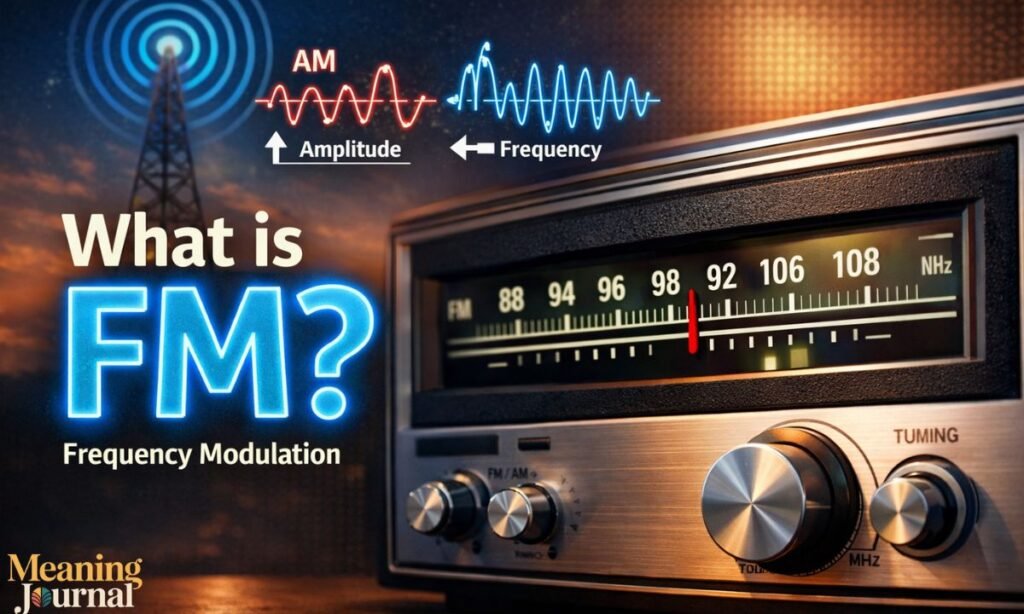
FM in Physics (Frequency Modulation) This is probably the most globally recognized use of FM. Frequency Modulation is the process by which the frequency of a carrier wave is varied in accordance with a signal. It’s the technology that powers FM radio — which we’ll get to shortly — and it’s known for producing clearer, higher-quality audio than AM (Amplitude Modulation). FM signals are less susceptible to noise and interference, which is why music stations overwhelmingly prefer FM broadcasting.
FM in Medicine (Fibromyalgia) In medical contexts, FM is a standard abbreviation for Fibromyalgia, a chronic condition characterized by widespread musculoskeletal pain, fatigue, and often cognitive difficulties (sometimes called “fibro fog”). Healthcare professionals use FM as shorthand in notes, charts, and clinical discussions. It’s a condition that affects millions globally, and if you ever see FM on a medical document, this is almost certainly what it refers to.
FM in Aviation (Flight Manual) In aviation, FM stands for Flight Manual — the official document that contains all the information a pilot needs to operate a specific aircraft. It includes performance data, emergency procedures, limitations, and normal operating checklists. Aviation uses precise abbreviations to reduce communication errors, and FM is embedded in that language.
Three completely different fields. Three completely different meanings. Same two letters.
FM and Radio — Why This Association Runs So Deep
When most people over 30 hear “FM,” their brain immediately goes to the radio dial. And that’s not without reason.
FM radio has been around since the 1930s, invented by Edwin Howard Armstrong, and it became the gold standard for music broadcasting throughout the 20th century. When you tune to 98.7 FM or 104.5 FM, you’re accessing a station broadcasting via Frequency Modulation on a specific frequency in the radio spectrum.
The reason FM radio sounds better than AM is rooted in the physics of how the signal is encoded. FM varies the frequency of the wave, not its amplitude, which makes it naturally more resistant to static, interference, and signal degradation. Music sounds richer, cleaner, and more dynamic.
Even in the age of Spotify and podcasts, FM radio remains widely used — especially for local news, traffic updates, and community broadcasting. So this meaning of FM isn’t going away anytime soon.
A Unique Angle: The Emotional Function of FM in Digital Language
Here’s something that most articles completely miss — and it’s actually fascinating from a linguistics perspective.
FM isn’t just an abbreviation. In digital communication, it functions as an emotional placeholder. Think about it: when something happens that’s too big, too weird, or too overwhelming to describe in full, people reach for short, intense expressions. FM fills that gap.
Linguists who study internet language call this a pragmatic shorthand — a term that carries emotional weight without requiring full grammatical structure. When you type FM, you’re not just abbreviating words. You’re signaling an emotional state in real time, with almost zero effort.
This is why FM thrives in fast-moving platforms like TikTok comments or WhatsApp group chats. Speed matters. Emotional authenticity matters. FM delivers both at once.
It’s also worth noting that FM works because of its ambiguity. The exact word it stands for is implied rather than stated, which gives it a kind of social buffer. You’re expressing something intense without technically saying it. That plausible deniability is part of its appeal, especially in semi-public spaces like Instagram comments.
Things People Often Get Wrong About FM
There are a few misconceptions that keep circulating, and it’s worth clearing them up directly.
Misconception 1: FM always means frustration. Not true. As we’ve seen, FM can express amazement, admiration, disbelief, or even affection depending on the conversation.
Misconception 2: FM is exclusively Gen Z slang. FM has roots that go back much further — both as technical terminology (radio, physics) and as informal digital language that predates TikTok by years. It’s multi-generational in different contexts.
Misconception 3: If someone sends FM, they’re upset with you. This one causes the most misunderstandings. FM is almost never directed at someone as an insult. It’s usually a reaction to a situation. If someone texts you “FM” after you share news, they’re reacting to the news — not criticizing you.
Misconception 4: FM is the same as WTF. They’re in the same family, but not identical. WTF often implies confusion or disbelief with a slightly more questioning tone. FM tends to lean more toward pure emotional overwhelm — surprise, awe, or exasperation — without the interrogative quality.
How to Respond When Someone Sends You FM
Getting an FM and not knowing what to say back is genuinely awkward. Here’s a practical breakdown.
If the context is clearly emotional or negative (they’re venting, something went wrong), the best response is empathy first. Something like “I know, that’s rough” or even a simple “😭 same” works well. You don’t need to over-explain or match their intensity.
If the context is playful or sarcastic, match their energy. Throw back a “right?? 💀” or a meme. FM in playful contexts is an invitation to joke around together.
If you’re genuinely unsure of the tone, a quick “lol what happened??” is totally fine. It’s natural and opens the door for them to explain without making things awkward.
And if FM is being used as a compliment toward you (like “FM you’re so talented”), just receive it gracefully. A laughing emoji or “haha thanks 😂” keeps things light and easy.
FM at Its Funniest — The Comedic Side of This Slang
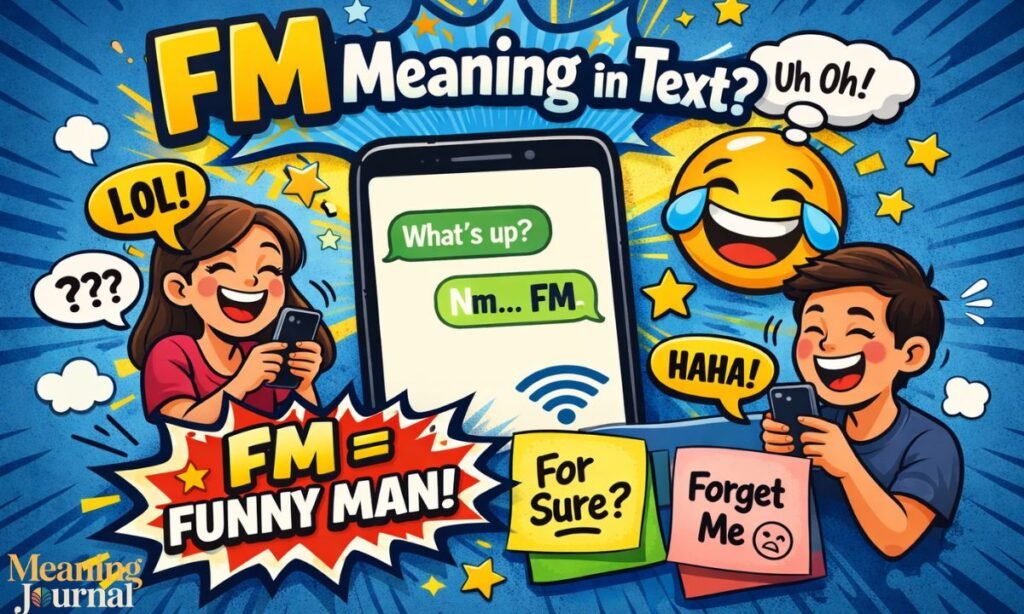
Let’s be honest: part of why FM sticks around is because it’s just funny in the right situation.
The internet has fully embraced FM as a comedic tool. You’ll see it in meme captions, in response to absurd life moments, and as a punchline in itself. The humor comes from the mismatch between the brevity of the word and the enormity of the emotion it’s supposed to carry.
Picture someone posting a video of their carefully arranged tower of snacks collapsing right before they reach it. The caption? Just “FM.” That single abbreviation communicates a whole dramatic arc — the hope, the anticipation, the collapse, the devastation — in two letters. That’s comedic compression at its finest.
People also use FM ironically for completely minor inconveniences, which makes it funnier. “Dropped my pen. FM.” That deliberate overreaction is a whole comedic genre in itself online.
FM vs. Similar Terms — Where It Fits in the Slang Ecosystem
| Term | Full Form | Emotional Tone | Typical Use |
| FM | F**k Me | Overwhelm, disbelief, admiration | Texting, TikTok, Instagram |
| WTF | What the F**k | Confusion, shock | Universal across platforms |
| SMH | Shaking My Head | Disappointment, disbelief | Twitter, Facebook |
| OMG | Oh My God | Surprise, excitement | All platforms |
| FML | F**k My Life | Self-directed frustration | Texting, Reddit |
| NGL | Not Gonna Lie | Honesty signal | Casual conversation |
FM sits in a unique space — it’s more intense than OMG, more versatile than FML, and less questioning than WTF. It’s the slang equivalent of a sharp inhale.
FM in Online Dating and Dating Apps
Dating apps have their own communication culture, and FM has carved out a small but notable space there.
In dating app conversations, FM tends to appear when someone is genuinely caught off guard in a positive way. If someone on Hinge or Bumble responds to your photo or bio with “FM you’re actually hilarious,” that’s a strong positive signal. It’s expressive without being over-the-top, and it reads as authentic rather than scripted.
Using FM in dating contexts signals that you’re comfortable with casual, natural language — which many people find more attractive than formal or overly polished communication. It says: I’m real, I’m unfiltered, and I’m genuinely reacting to you.
That said, context still matters. FM in early conversation between strangers needs supporting tone — emojis, follow-up messages, or clear body language cues (in video chats) — to land correctly.
FAQs About FM in Text
Is FM always a bad word?
Not necessarily. FM abbreviates a strong expression, but it’s used so commonly in digital slang that it’s largely lost its shock value. The tone of the conversation determines how it lands.
Can FM mean something totally different in a work email?
In professional contexts, FM is almost never slang. In a work setting, it likely stands for something industry-specific — like Facility Management, Financial Model, or Frequency Modulation. Always check the context.
Is it okay to use FM with someone I just met?
Probably not. FM is comfortable slang for established relationships or casual, digital-native spaces. In new or formal relationships, it can come across as abrasive or odd.
What’s the difference between FM and FML?
FM is a reaction to something external — a situation, a person, news. FML (F**k My Life) is self-directed — expressing that your own circumstances are frustrating or unlucky.
Does FM mean the same thing in every country?
The slang meaning is most common in English-speaking, Western digital communities. In non-English contexts, FM is far more likely to refer to FM radio or Frequency Modulation. Slang doesn’t always translate across borders.
Key Insights — Wrapping It All Up
FM is one of those beautiful examples of language being genuinely alive. It started as a technical term in physics and broadcasting, migrated into everyday digital speech as emotional shorthand, and now lives across platforms, generations, and conversations — shifting its meaning with every new context it enters.
Whether someone’s texting you FM after a wild piece of news, a TikTok creator is captioning a disaster video with it, or a doctor is abbreviating Fibromyalgia in a chart — it’s all FM. Same letters. Different worlds.
The next time it lands in your inbox, you’ll know exactly what to look for: the platform, the tone, the relationship, and the conversation around it. That’s really all it takes to decode it.
Language isn’t just about words — it’s about the moment those words live in. And FM, in all its forms, captures that better than most.
