

You’ve probably spotted the acronym STTM floating around in a text message, a Reddit thread, or maybe even a project management tool — and you’re here because it left you scratching your head. Don’t worry. By the time you finish reading this, you’ll know exactly what STTM means, where it comes from, when to use it, and when to absolutely avoid it.
Let’s break it all down — no filler, no fluff.
So, What Does STTM Actually Stand For?
In everyday texting and online chat, STTM most commonly stands for “Stop Talking To Me.” It’s a blunt, direct abbreviation used when someone wants to end a conversation — or shut one down before it even gets going.
Think of it as the digital equivalent of walking away mid-conversation. It’s short. It’s clear. And depending on the tone, it can sting.
But here’s where it gets interesting: STTM isn’t a one-meaning acronym. Depending on the context — whether you’re managing a software project, browsing a medical forum, or reading a physics paper — STTM can mean something completely different. We’ll cover all of those angles.
Quick Answer for Featured Snippet: STTM in text messaging stands for “Stop Talking To Me.” It is used to express frustration, disinterest, or a desire to end communication. In other contexts, it may stand for “Stop The Thyroid Madness” (medical), “Short-Term Traffic Model” (technical), or other field-specific terms.
Where Did STTM Come From? The Origin Story
Most internet slang doesn’t have a single inventor or a clear birthday — and STTM is no different. It evolved organically, the way most text abbreviations do.
In the early 2000s, SMS texting had character limits. People were paying per message. So naturally, language compressed. Long phrases became short codes: LOL, BRB, GTG, TTYL. STTM fits neatly into that same tradition — born from the need to say more with fewer characters.
By the mid-2010s, even though character limits were mostly gone, the culture of short abbreviations had already taken hold. Platforms like Twitter (now X), Snapchat, and Instagram DMs kept the tradition alive. STTM became a shorthand that felt natural in those environments.
It’s worth noting that “Stop Talking To Me” isn’t exactly a gentle phrase — so the acronym carried emotional weight from the start. It wasn’t casual chat slang like “lol” or “brb.” It was always a bit charged.
The Emotional Weight Behind Three Letters
Here’s something that most articles on STTM miss entirely: the psychology of saying it.
When someone types STTM, there’s almost always an emotion driving it — annoyance, overwhelm, heartbreak, or even playful teasing between close friends. The same three letters can mean wildly different things based on who sends them and why.
Consider these emotional states:
Frustration: “I’ve told you this three times already. STTM.” Boundary-setting: A person exhausted by repeated unwanted contact using STTM as a firm emotional wall. Playfulness: Two friends mock-arguing, where one drops STTM followed by a laughing emoji — now it’s a joke. Social anxiety: Someone who finds online interaction draining uses STTM to retreat from a conversation that’s become too much.
The fascinating thing about STTM is that it communicates emotional closure. It doesn’t explain. It doesn’t negotiate. It simply ends things. That kind of bluntness carries psychological power — and it’s why the term lands differently depending on tone and relationship.
STTM in the Wild: Real-Life Conversation Examples
Reading definitions is one thing. Seeing a term in action is another. Here are some real-style conversational examples across different platforms:
Text Message Exchange:
Friend 1: “Okay but hear me out — pineapple on pizza is genuinely good.” Friend 2: “STTM. We’re not having this conversation again.”
In this case? Totally playful. The friendship is obvious, and the caps don’t feel aggressive.
Instagram DM Scenario:
Stranger: [third unsolicited message in a row] User: “STTM please. I’m not interested.”
Here STTM is a boundary. Polite-ish, but firm.
Twitter/X Interaction:
Reply to a controversial opinion: “STTM with these takes 😭”
Casual, almost meme-like. The crying emoji softens it completely.
Online Gaming Chat:
After a bad play: “Bro sttm and just play 💀”
Here it’s practically a term of endearment between gamers. Context is everything.
STTM Across Different Platforms — It Doesn’t Mean the Same Everywhere
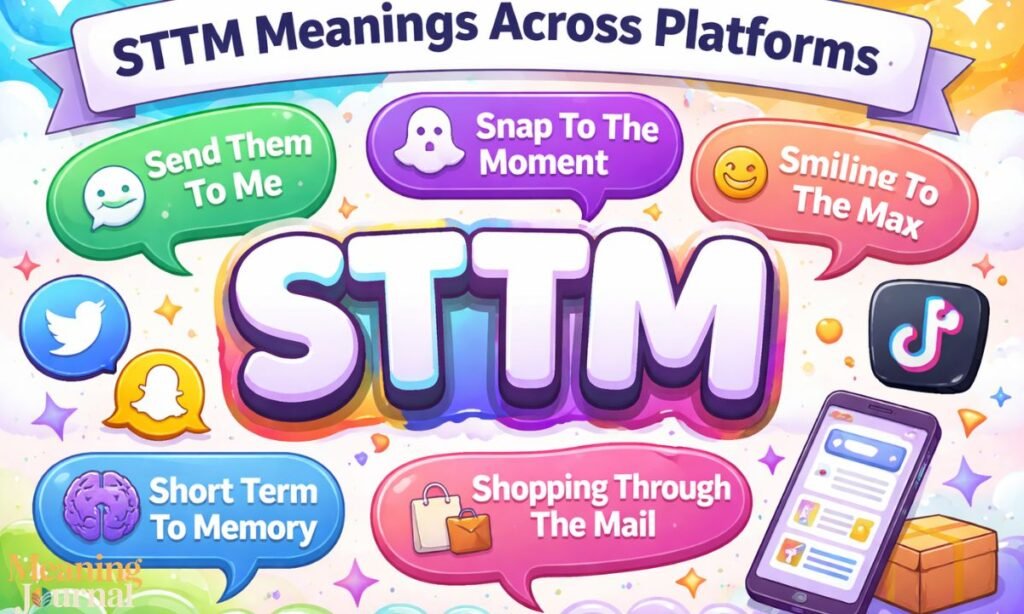
This is where things get genuinely interesting. The meaning of STTM shifts depending on where you encounter it.
On Snapchat and Instagram DMs, STTM is almost always the “Stop Talking To Me” abbreviation. It’s personal, direct, and emotionally loaded.
On Reddit, you might see STTM in a completely different context — especially in health-related subreddits. Here, STTM stands for “Stop The Thyroid Madness,” which is also the name of a well-known patient advocacy book and website focused on thyroid health. In r/Hypothyroidism or r/thyroid, STTM is practically household vocabulary.
On LinkedIn or professional platforms, STTM is unlikely to appear in its slang form. If it does appear, it’s more likely to be a company acronym, a project management abbreviation, or an industry-specific shorthand.
On Discord gaming servers, it functions more like banter — used loosely, often followed by emojis that neutralize any real aggression.
The platform context determines the meaning almost as much as the words themselves do.
STTM in Project Management — A Completely Different World
Switch your context to a corporate or technical environment, and STTM takes on an entirely new identity.
In project management and operations, STTM can refer to:
- Standard Task Time Management — a method of estimating how long standardized tasks should take in workflow planning.
- Short-Term Traffic Model — used in transportation engineering and logistics planning.
- System-to-System Transfer Model — in IT infrastructure discussions involving data migration or API integrations.
If you’re in a meeting and your project manager drops “we need to look at the STTM for this sprint,” they are definitely not telling you to stop talking to them. They’re referencing a framework or model relevant to the project at hand.
This is why context is everything with acronyms. The same four letters can mean “go away” in a text message and “let’s analyze workflow efficiency” in a boardroom.
The Medical Meaning: Stop The Thyroid Madness
This one deserves its own section because it has a genuinely large and passionate community behind it.
“Stop The Thyroid Madness” (STTM) is a patient-led movement and resource that began as a book written by Janie A. Bowthorpe. It challenges what many patients describe as inadequate thyroid treatment — specifically the over-reliance on synthetic T4 medication (like Synthroid) and TSH-only testing.
The STTM community advocates for:
- Natural desiccated thyroid (NDT) treatment
- More comprehensive thyroid testing (Free T3, Free T4, Reverse T3)
- Patient-centered care that goes beyond standard lab ranges
If you search STTM on health forums, Facebook groups, or Reddit’s thyroid communities, this is often what people mean. It’s a loaded term in that world — people feel strongly about it. It represents a shift toward patient autonomy in managing complex hormonal conditions.
Knowing this alternate meaning could save you from some serious confusion if you stumble into a thyroid health discussion.
Technical and Scientific Uses of STTM
Beyond health and project management, STTM also appears in more technical and scientific domains:
Physics and Engineering: In signal processing and systems engineering, STTM can refer to Short-Time Transfer Matrix — a mathematical tool used to analyze how signals propagate through systems over short time intervals.
Aviation and Aircraft: In aerospace documentation, STTM sometimes appears as a shorthand within technical manuals, though it varies significantly by manufacturer and context. Always verify with the specific source document.
Traffic and Urban Planning: As mentioned earlier, Short-Term Traffic Model is a legitimate technical acronym used by transportation engineers to predict traffic flow over short time horizons — useful in smart city planning, GPS routing algorithms, and infrastructure development.
These aren’t common everyday uses, but they’re important to know if you work in these fields or come across the acronym in professional documentation.
Common Misconceptions People Have About STTM
Let’s clear up a few things that tend to trip people up:
Misconception 1: STTM always means “Stop Talking To Me.” Not even close. As you’ve seen, the meaning changes dramatically based on context. Assuming the text meaning in a medical forum will get you very confused very fast.
Misconception 2: STTM is always aggressive or rude. In casual conversations between friends, it’s often playful — especially with emojis. Intent matters more than the literal words.
Misconception 3: It’s a widely recognized universal abbreviation. Unlike LOL or OMG, STTM hasn’t crossed into mainstream universal recognition. Many people genuinely don’t know what it means, which means using it with someone unfamiliar can cause real misunderstanding.
Misconception 4: The medical STTM and the slang STTM are related. They’re completely separate in origin and usage. The thyroid movement chose the phrase because it was evocative — not because it had any connection to internet slang.
How Offensive Is STTM? Reading the Room
This is the kind of question that doesn’t have one clean answer.
Is STTM offensive? It depends entirely on three things: who says it, to whom, and in what tone.
Between close friends who communicate in internet shorthand, STTM might be the conversational equivalent of rolling your eyes at a bad joke — harmless, maybe even affectionate. Add a laughing emoji, and the sting evaporates entirely.
But if a stranger sends it to you out of nowhere? Or an ex after a difficult message? That’s a different story. The bluntness of “Stop Talking To Me” — even abbreviated — is a hard stop. It doesn’t leave room for response. It’s designed to close a door.
In professional settings, sending STTM would be wildly inappropriate. Even if you mean it. Especially if you mean it.
In online dating apps specifically, STTM has become a known boundary-setter. It’s more assertive than “I’m not interested” and less confrontational than a block (sometimes). Some people prefer it because it’s direct without being a full confrontation. Others find it unnecessarily cold.
The rule of thumb: know your audience before you use it.
Sttm meaning in technology
STTM stands for Spin-Transfer Torque Memory, a type of non-volatile computer memory that stores data using electron spin rather than an electric charge. It works by passing a spin-polarized current through a magnetic layer to flip a memory cell between two states, which lets it hold data even after the power turns off.
You’ll mainly see STTM mentioned in semiconductor and chip design discussions, since it offers lower power use and better scalability than older memory types like traditional MRAM. It’s still more common in research and specialized hardware than everyday consumer devices, but it’s a term worth knowing if you follow tech and hardware news.
Is STTM Actually a Popular Slang Term? What the Data Suggests
Compared to acronyms like “NGL,” “IMO,” or “IYKYK,” STTM sits in a smaller, more niche category of slang.
It has a dedicated presence on:
- Urban Dictionary (multiple definitions submitted over the years)
- Slang-tracking websites like Slang.net and Cyber Definitions
- Reddit threads (both the slang version and the thyroid community version)
However, it doesn’t trend on social media the way viral slang terms do. You won’t see STTM dominating TikTok comment sections or showing up in mainstream news coverage of internet culture. It exists — and it’s used — but it hasn’t broken into the top tier of widely-known abbreviations.
That said, niche recognition can matter more than mainstream fame. If you’re in a community where STTM circulates, it can feel completely normal and frequently used. Context, again, shapes perception of popularity.
Similar Terms You Might Come Across
If you’re learning STTM, it helps to know the surrounding vocabulary. Here are some related expressions and how they compare:
STFU — “Shut The F*** Up.” Far more aggressive than STTM, and more widely recognized. STTM is milder by comparison.
LMK — “Let Me Know.” Opposite energy entirely — open and inviting rather than closing off conversation.
TTYL — “Talk To You Later.” A polite conversation ender, far gentler than STTM.
GTG — “Got To Go.” Neutral exit from a conversation. No emotional charge.
DNR (in social contexts) — “Do Not Reply.” Similar intent to STTM but used in slightly different settings, more commonly in email contexts.
Leave Me Alone / LMA — A close synonym in spirit, though LMA is less established as an acronym.
What separates STTM from all of these is the directness of its emotional signal. It’s not saying “I’m busy” or “I’ll talk later.” It’s saying: this conversation, specifically, needs to stop.
Grammar and Linguistic Breakdown of STTM
From a purely linguistic perspective, STTM is interesting.
It’s an imperative sentence compressed into an acronym. “Stop Talking To Me” is a command — second person, present tense, direct address. There’s no subject stated; the “you” is implied. That’s what gives it such punchy, immediate force.
Linguists who study computer-mediated communication (CMC) note that internet abbreviations often compress not just words but emotional registers — the tone, the power dynamic, the relationship expectation — all folded into a few letters.
STTM is case-insensitive in practice. You’ll see it as:
- STTM (emphatic, often feels stronger)
- sttm (casual, lower energy, less confrontational)
- Sttm (rare, somewhere in between)
Capitalization in digital communication is a paralinguistic cue — it adds tone where voice inflection would be in spoken language. All caps STTM hits differently than quiet lowercase sttm.
STTM in Dating Apps and Online Relationships — A Special Context
Dating apps have their own dialect of internet slang, and STTM has found a home there.
When someone on Tinder, Hinge, or Bumble sends STTM, it usually means one of two things:
- They’re setting a firm boundary after repeated unwanted messages. In this case, it’s a last resort before blocking — a final signal.
- It’s being used ironically or playfully in an early, flirty conversation where both people are clearly comfortable with each other’s humor.
The gap between these two uses is enormous, which is why misreading STTM on a dating app can be genuinely awkward. If someone sends it after your third unanswered opener, it’s not playful. If they send it after you jokingly defended a controversial opinion, it probably is.
One thing worth noting: using STTM on dating apps to reject someone is increasingly common among younger users (Gen Z especially) who prefer direct digital communication over prolonged polite deflection. It’s blunt, yes — but it’s also clear. No room for misinterpretation.
How to Respond When Someone Sends You STTM
Received a STTM and not sure what to do? Here’s a practical breakdown:
If it came from a friend in a joking context: Match the energy. Laugh it off, send a meme, or play along. “Okay okay I’ll stop 😂” works perfectly.
If it came from someone you’ve been messaging repeatedly: Respect it. This is someone setting a boundary. The right move is to stop messaging — not to respond asking “why?” or defending yourself. Accept it and give them space.
If it came out of nowhere and felt jarring: It’s okay to ask, once, for clarification: “Hey, did I say something wrong?” — but keep it brief and non-pressuring. If they don’t respond, that’s your answer.
If it came in a professional context: You’ve probably encountered the wrong acronym in the wrong place. Double-check what field-specific meaning STTM might carry in that setting before responding.
The general principle: when in doubt, respond with less rather than more. STTM is a signal to pull back, not push forward.
The Unique Angle: What STTM Reveals About Digital Communication Culture
Here’s something no other article on this topic is likely to explore:
The existence and use of STTM says something profound about how digital communication has changed the way we enforce personal space.
Before texting, ending a conversation required physical or vocal cues — walking away, hanging up, closing the door. These were unambiguous signals, but they also required a certain social courage.
STTM allows people — particularly those who struggle with confrontation — to assert a boundary without a real-time face-to-face moment. It’s low-risk in terms of immediate social discomfort, but high-impact in terms of message clarity.
This is part of a broader shift in digital communication where abbreviations have become emotional shorthand. We no longer just compress words — we compress entire emotional states, relationship dynamics, and social cues into letters. STTM is a tiny symbol of that massive cultural change.
Whether that’s a good thing is worth thinking about. Does STTM make boundary-setting easier, or does it make it too easy to dismiss others without real conversation? Probably both, depending on how it’s used.
FAQs About STTM
What does STTM mean in a text from a girl or guy?
It most likely means “Stop Talking To Me” — a direct request to end the conversation. Whether it’s serious or playful depends on the tone and your relationship with the person.
Is STTM rude?
It can be, yes. It’s a blunt, unfiltered statement. Between friends in a joking context, it’s harmless. Directed at a stranger or in a serious moment, it reads as dismissive or harsh.
What is STTM in the medical field?
In medical and health communities, STTM stands for “Stop The Thyroid Madness” — a patient advocacy movement and resource focused on thyroid disease treatment reform.
Can STTM mean something in business or project management?
Yes. Depending on the organization and industry, STTM can refer to “Standard Task Time Management,” “Short-Term Traffic Model,” or other technical/project-specific acronyms. Always check the context.
Is STTM the same as STFU?
No. STFU (“Shut The F*** Up”) is significantly more aggressive and vulgar. STTM is blunt but doesn’t carry profanity. They share a similar intent — ending communication — but land very differently.
Key Takeaways Before You Go
STTM is one of those rare acronyms that lives multiple lives at once. In a text thread between friends, it’s harmless shorthand. In a medical forum, it’s the name of a health movement. In a project meeting, it might refer to a modeling framework. And in a tense online exchange, it’s a firm, emotional door slam.
The smartest thing you can do with any acronym — STTM included — is resist the urge to assume you know the meaning before reading the room. The letters are the same. The context changes everything.
Now that you’ve got the full picture, you’re not just someone who looked up a slang term. You understand the language, the culture, the nuance, and the psychology behind it. That’s a different kind of literacy — and honestly, a more useful one.
