



If you’ve been scrolling through Discord servers, gaming lobbies, or even casual group chats lately, there’s a decent chance you’ve stumbled across the term IGL. Maybe someone called themselves an IGL. Maybe someone complained about their IGL making bad calls. Or maybe you saw it in a text conversation and had absolutely no idea what it meant.
You’re not alone — and you’ve come to the right place.
This guide breaks down everything you need to know about IGL: what it means, where it came from, how it’s used across different games and platforms, and yes — what you should actually say when someone drops it in conversation.
So, What Exactly Does IGL Mean?
IGL stands for In-Game Leader.
At its core, IGL refers to the player in a team-based game who takes on the role of primary shot-caller — the person who makes tactical decisions, calls strategies during matches, and coordinates the team’s overall approach in real time.
Think of it like a field general. While everyone else on the squad focuses on aiming, positioning, or executing, the IGL is the one reading the game, adapting strategies on the fly, and deciding what the team does next.
In its simplest form:
IGL = the player who leads and makes calls during gameplay
But here’s where it gets interesting — IGL has evolved beyond just a formal esports term. People now use it in casual gaming conversations, streaming chats, meme culture, and everyday texting between gamers. And in some contexts, it’s taken on slightly different flavors depending on the community.
Where Did This Term Come From? A Brief Background
The term IGL didn’t appear overnight. It grew alongside the rise of competitive esports, particularly in tactical shooter games where team coordination isn’t just helpful — it’s absolutely essential.
Games like Counter-Strike popularized the concept of having a dedicated leader within a team whose job was specifically about strategy and communication rather than raw mechanical skill. As esports started gaining mainstream recognition in the early 2010s, terms used by professional players and commentators began trickling down into everyday gamer vocabulary.
By the time PUBG, Valorant, Rainbow Six Siege, and Fortnite had built massive competitive communities, IGL had already become a standard term that any serious or semi-serious player knew. Streaming platforms like Twitch and YouTube accelerated its spread — when fans watched pro matches, they heard casters and analysts talking about who was IGLing, what their mid-round calls looked like, and whether a team’s IGL was performing well under pressure.
From there, it jumped into Discord, Reddit threads, and eventually casual texting between friends who game together. That’s the pipeline for most gaming slang — pro scene → streaming communities → forums → everyday chat.
IGL in the World of Competitive Gaming: More Than Just Calling Shots
Here’s something a lot of people get wrong: they assume the IGL is just the loudest person on the team, or the one with the best stats. That’s almost never true at a high level.
The role of an In-Game Leader in esports is genuinely complex. A good IGL needs to:
Read the game in real time. This means processing information from teammates, tracking enemy positions, and making quick decisions — often with incomplete information and under intense time pressure.
Manage team psychology. If the squad is on a losing streak, the IGL needs to keep morale from collapsing. If someone’s playing out of their mind, the IGL should know how to build plays around that momentum.
Prepare strategies before matches. This is the part casual players often don’t see. Professional IGLs spend hours in demo reviews and strategy sessions, building playbooks tailored to specific opponents or maps.
Adapt mid-match. A strategy that worked perfectly in round one might be completely countered by round five. The IGL’s job is to recognize this and pivot, not stubbornly stick to a plan that’s no longer working.
In the highest tiers of esports — think CS2 Major Champions or Valorant Champions Tour — the IGL is often considered the most important player on the team, regardless of their kill-death ratio. Teams with exceptional IGLs consistently outperform teams with better mechanical players but no clear leadership structure.
IGL Meaning in R6: How Rainbow Six Siege Uses This Role
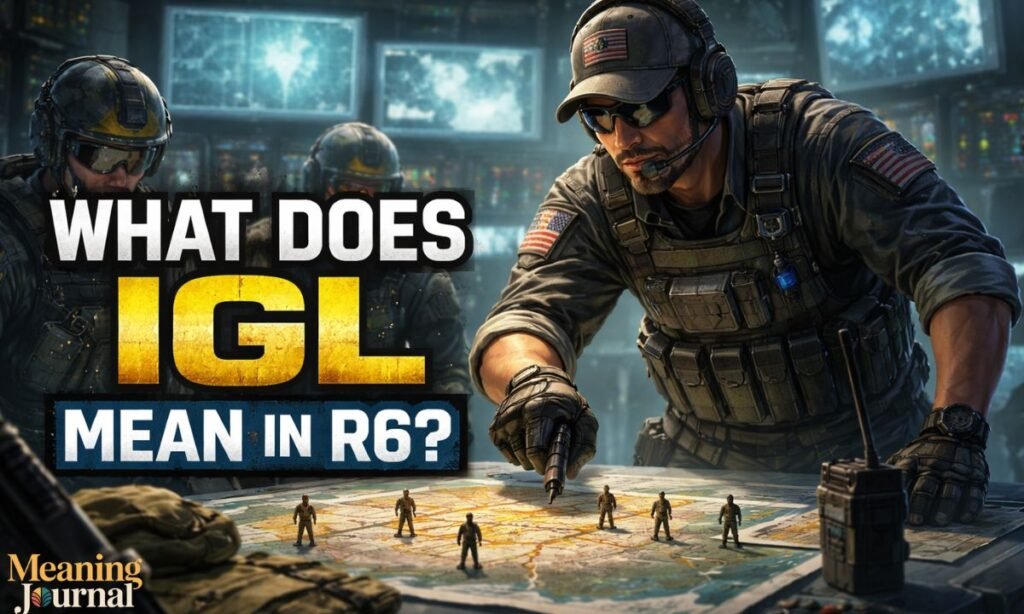
Rainbow Six Siege has one of the most structured in-game leadership cultures in all of gaming, and for good reason. Siege is arguably the most tactically complex shooter on the market.
In R6, IGL carries a very specific weight. Because Siege rounds are short, lethal, and heavily strategic — with drones, breach mechanics, vertical play, and operator abilities all changing the calculus — having a single designated caller is almost non-negotiable at any competitive level.
The IGL in Rainbow Six Siege is typically the person who:
- Designates entry points and calls the initial breach
- Tracks roamers and relays drone information to the team
- Adjusts the plan when the default play breaks down
- Coordinates hard breaches, soft destruction, and flank coverage
In Siege’s ranked and competitive communities, you’ll often see players asking in team chats: “Who’s IGLing this round?” — a sign that even at mid-level play, people understand the value of having one unified voice. Poor IGL quality in Siege typically shows up as teams that constantly split or fail to execute pushes because no one is on the same page.
It’s also worth noting that in R6 specifically, IGL and fragger roles are often clearly separated. The IGL might even have a below-average K/D because their attention is split between calling and playing. This is completely normal and even expected.
IGL Meaning in PUBG: Battle Royale Shotcalling
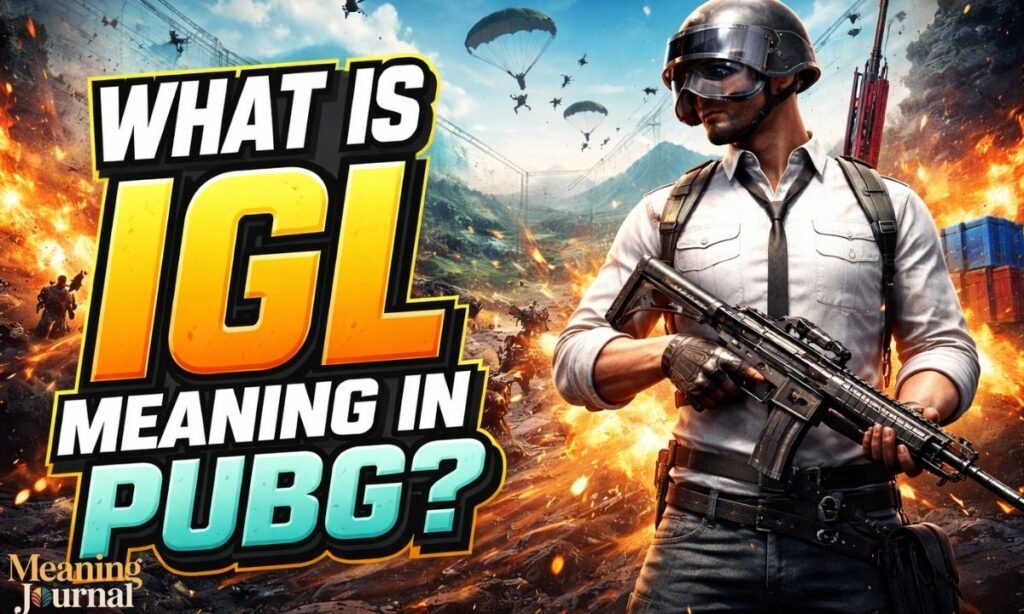
PUBG (PlayerUnknown’s Battlegrounds) popularized the battle royale genre, and with it came the need for strong team leadership — especially in squad mode.
In PUBG, IGL refers to the player who calls the team’s macro-level decisions: where to drop, which zone to rotate toward, when to engage vs. when to disengage, how to position for the final circle, and when to push vs. play defensively.
Because PUBG is slower-paced and more methodical than CS or Siege, the IGL here often operates more like a strategic advisor across an entire 30-minute match rather than making rapid-fire micro calls. It requires good map awareness, zone reading, vehicle coordination, and understanding of the risk/reward balance at any given point in the game.
PUBG’s IGL culture also bled into BGMI (Battlegrounds Mobile India), where the term is extremely commonly used in South Asian gaming communities — which we’ll touch on shortly.
IGL Meaning in Fortnite: Leadership in the Build-Fight Meta
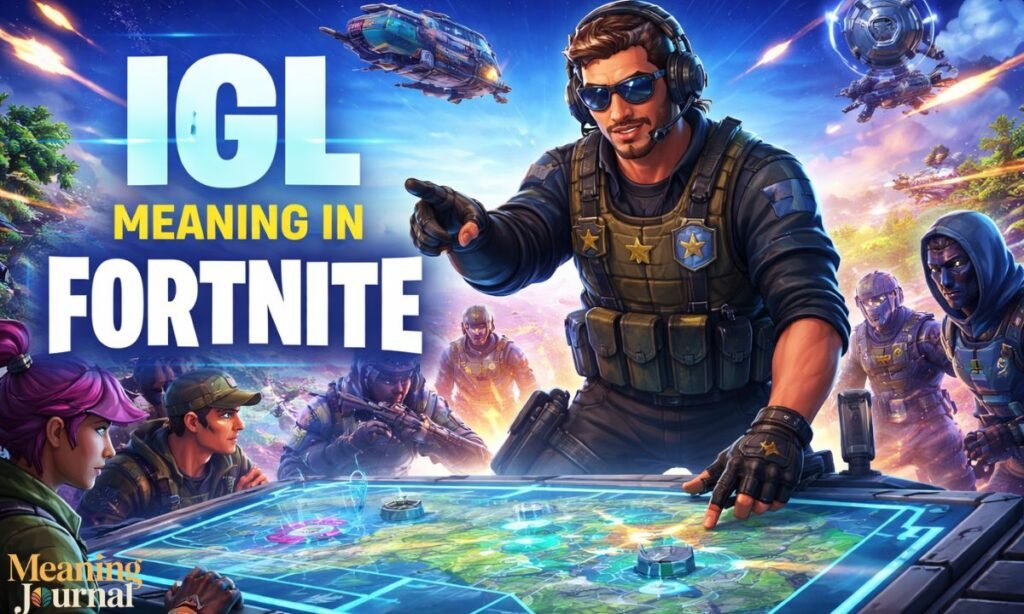
Fortnite introduced its own spin on team-based play, and IGL in Fortnite reflects the game’s unique mechanics.
In squad or duos Fortnite, the IGL typically calls:
- Drop location and early-game looting strategy
- Rotation timing (when to move, how to move, using vehicles or not)
- Storm decisions — a huge element in Fortnite where circle knowledge is game-deciding
- Engagement or avoidance calls during the mid-game
- Build/edit structure positioning during final circles
The Fortnite competitive scene — particularly through FNCS (Fortnite Champion Series) — has developed its own IGL culture, where designated callers often specialize in positioning and rotation while their squad handles the mechanical build-fighting.
In casual Fortnite squads, you’ll hear IGL used more loosely, often just meaning “the person deciding where we go and what we do.” But in competitive lobbies and scrimmage environments, it’s used with the same precision as any other esport.
How IGL Actually Influences Team Performance
This is where things get fascinating from a strategic standpoint.
Studies and observations from esports analysts consistently show that teams with strong IGLs outperform equally-skilled teams with poor leadership. It’s not even close. An IGL doesn’t just affect strategy — they affect team culture, communication efficiency, and mental resilience under pressure.
Here’s how it breaks down:
Communication clarity: A good IGL reduces comms chaos. Instead of five people talking over each other, there’s one primary caller and others supplementing. This means faster decision-making and fewer mistakes from miscommunication.
Adaptability: Teams without a clear IGL often stick too long to failing strategies. A capable IGL recognizes when a plan isn’t working and pivots before it costs them the round or match.
Confidence and trust: When teammates trust their IGL, they execute more cleanly. Hesitation disappears. Even if a call is wrong, clean execution often beats perfect strategy with messy execution.
Opponent preparation: At professional levels, opposing teams study each other’s IGLs. Understanding how a particular IGL patterns their calls — what they do in pistol rounds, how they react to losing a key player early — becomes part of the game itself.
It’s also worth saying: bad IGLs actively hurt teams. An IGL who makes chaotic calls, contradicts themselves mid-round, creates comms clutter, or micromanages other players is worse than having no IGL at all. The role carries significant responsibility.
A Misunderstood Role: Common Misconceptions About IGL
Let’s clear up a few things that people often get wrong.
Misconception #1: The IGL is the team captain. Not necessarily. The team captain might be the IGL, but the two roles can be separate. The captain handles organizational matters, represents the team externally, and may communicate with management. The IGL handles in-game decisions. Sometimes these are the same person — often they’re not.
Misconception #2: The best player should be the IGL. This is actually backwards in many cases. IGLing takes mental bandwidth away from raw mechanical performance. Many star players have stepped down from IGL roles specifically to focus on fragging, and they perform better as a result. The IGL needs great game sense and communication skills — not necessarily the highest ACS or KAST.
Misconception #3: IGL is only relevant in pro play. Even in casual ranked games, having someone take on the IGL role — even informally — dramatically improves team performance. You don’t need a formal designation. Someone saying “let’s take B site this round” and the team actually following it is IGL behavior in practice.
Misconception #4: IGL means the same thing in text conversations as it does in game. Sometimes people use IGL in text to simply mean “the person in charge” or “who’s leading this thing?” — not necessarily in a gaming context. Context matters, as always.
IGL in Online Communities, Social Media, and Discord
Outside of actual gameplay, IGL has taken on a life of its own in gaming communities online.
On Reddit, particularly in gaming subreddits like r/GlobalOffensive, r/VALORANT, r/R6SiegeroyaleBI, and others, you’ll find daily threads analyzing the IGL decisions of professional teams. Did the IGL make the right call on that eco round? Should they have changed their default? Did the mid-round aggression make sense given the scoreline?
On Twitter/X, IGL gets used during live tournaments — fans and analysts tweet hot takes about IGL performance in real time. After a big upset, you’ll often see discourse about whether the winning team’s IGL out-called the opponent.
On Discord, in gaming servers, IGL comes up in competitive team building: “Looking for IGL for ranked push” or “Our IGL just left the team, need a replacement.”
On TikTok and YouTube Shorts, IGL content has grown too — clips of pro IGLs making incredible mid-round calls go viral, and gaming creators often explain the role to newer audiences who haven’t encountered the term before.
What about dating apps? This one’s interesting. Some gamers use IGL in their bios or in conversation to signal that they’re serious about gaming — a kind of identity marker. “I IGL for a semi-pro Valorant team” reads very differently to another gamer than it would to someone completely outside the gaming world. It’s become a form of cultural shorthand that communicates competence, leadership, and dedication within gaming communities.
Regional and Cultural Differences in How IGL Is Used
The term IGL is pretty universal across English-speaking gaming communities, but there are some interesting regional nuances.
South Asia (India, Pakistan, Bangladesh): The IGL term is massively popular here, particularly driven by BGMI and PUBG Mobile’s enormous player bases. Indian esports communities — which are among the fastest-growing in the world — use IGL constantly, and local esports organizations emphasize the IGL role significantly in their team structures.
Southeast Asia: Hugely competitive gaming regions like South Korea, the Philippines, and Thailand have their own esports scenes where IGL equivalents exist, though the English term “IGL” is still commonly used even in non-English contexts because it originated in English-language gaming culture.
South America: Particularly in Valorant and CS communities in Brazil and Argentina, IGL is used regularly. Brazilian CS has produced several notable IGLs at the international level, making the term well understood in those communities.
Europe: CS2’s European scene essentially helped birth the IGL concept, so it’s extremely well-established. Terms like “in-game leader” and its abbreviation are used interchangeably without confusion.
One cultural difference worth noting: in some communities, IGL carries higher social prestige (it’s seen as a position of authority and intelligence), while in others, it’s sometimes viewed as an excuse for having a lower kill count. These perspectives say more about the community’s gaming maturity than about the role itself.
IGL vs. Similar Terms: What’s the Difference?
| Term | Meaning | Context |
| IGL | In-Game Leader — primary shot-caller | Team-based competitive games |
| Fragger / Entry Fragger | Player focused on opening kills | FPS games, especially CS2/Valorant |
| Shot-caller | General term for whoever makes calls | Can overlap with IGL; more casual usage |
| Captain | Team representative / organizational leader | Team structure (may or may not IGL) |
| Flex | Adaptable player who fills multiple roles | Role flexibility, not leadership |
| Support | Player who facilitates others | Utility/sacrifice role, not leadership |
The key distinction is that IGL is specifically about real-time strategic decision-making during gameplay, while terms like “captain” or “shot-caller” can mean different things depending on context. A shot-caller and an IGL are often the same person, but “shot-caller” is more informal and doesn’t carry the same strategic depth of meaning.
The Unique Skill Nobody Talks About: Information Management
Here’s something competitors and analysts don’t discuss enough — one of the most underrated IGL skills is information management.
In any given round, an IGL is receiving a constant stream of information: enemy positions from teammates, audio cues, utility usage, economy status, time on clock, map control held vs. lost. Processing all of this simultaneously and converting it into clean, actionable calls is genuinely cognitively demanding.
The best IGLs have developed what sports psychologists might call selective attention — they filter out irrelevant noise and focus on the few pieces of information that actually matter for the next decision. They know when to trust a piece of intel and when to play as if they don’t have it.
This is partly why some mechanical stars struggle when they try to IGL. Their brain is already working overtime on aim, movement, and positioning. Adding the cognitive load of information synthesis and strategic planning on top of that creates a bottleneck that shows up as worse performance in both areas.
It’s a unique cognitive skill — and it’s genuinely rare. Teams that have someone who can do this well are at a significant structural advantage.
What Does IGL Mean in Everyday Texting? (Outside of Gaming)
Outside of hardcore gaming contexts, IGL in everyday text messages usually appears in one of these situations:
Gamer-to-gamer conversation: The most common. “We need an IGL for tonight’s ranked session” or “Our IGL went offline mid-match, it was a disaster.”
Gamer identity signaling: Someone might describe themselves as an IGL in casual conversation to communicate that they’re the kind of person who thinks strategically about games.
Borrowed leadership metaphor: Occasionally, someone might use IGL jokingly to refer to whoever is organizing something — “You’re basically IGLing this group project, lol.” This is a metaphorical extension that works because the gaming meaning is understood.
Confusion or misuse: Some people encounter IGL without gaming context and genuinely don’t know what it means. If you receive a message with IGL and can’t figure out the meaning from context, it’s totally fine to ask. No shade in not knowing.
Is IGL suitable for professional communication? Generally, no — unless you work in the gaming or esports industry, where it’s completely standard. In a business email or formal report, stick to “in-game leader” written out fully if it’s relevant at all.
How to Respond When Someone Says “IGL” to You
The right response to IGL depends entirely on context:
If someone calls you an IGL: They’re recognizing your leadership and strategic contributions. A simple “yeah I try to call as best I can” or “appreciate that, it’s a tough role” works perfectly.
If someone asks who’s IGLing: They want to know who’s making the calls for the team, usually at the start of a session. Just answer honestly about who has the most experience or who wants to take the role.
If someone says “we need a better IGL”: This is usually venting after a tough match. They’re frustrated with whoever was calling. Engage empathetically — IGLing is genuinely difficult, and criticism comes with the role.
If you don’t know what IGL means in context: Just ask! “Sorry, what do you mean by IGL here?” — it’s always better to ask than to pretend you understand.
Frequently Asked Questions
What does IGS mean in a text message?
IGS typically stands for “I Guess So” in text messages — completely unrelated to IGL. It’s used to express reluctant agreement or a non-committal response. Context matters: if someone says “you wanna order pizza?” and the reply is “igs,” that’s basically “sure, I guess.”
What is the meaning of IGL?
IGL means In-Game Leader — the player who calls strategies, makes real-time decisions, and leads their team tactically during competitive gameplay. It’s used widely in esports and gaming communities.
What is the full form of IGL in Gen Z slang?
In Gen Z usage (especially among gamers), IGL is still almost always “In-Game Leader.” It hasn’t developed a widely accepted alternate meaning in Gen Z slang the way some other acronyms have. If a Gen Z person says IGL, they almost certainly mean it in the gaming sense.
What does it mean when someone says IGL?
If someone says “IGL” to you, they’re almost certainly using it in a gaming context — either referring to themselves, to a teammate, or asking about who’s leading the team strategically. If the message comes completely out of gaming context, ask for clarification.
Does IGL have any hidden or offensive meanings?
No widely known offensive or hidden meanings are associated with IGL. Unlike some acronyms that have been repurposed with negative connotations, IGL has remained fairly stable in its gaming-related meaning. Always consider context when encountering any acronym, but IGL is generally safe across gaming communities.
Wrap-Up: Why IGL Matters More Than You Might Think
IGL isn’t just a three-letter abbreviation that gamers toss around for fun. It represents something genuinely important about how teams function — the value of strategic leadership, clear communication, and adaptive thinking under pressure.
Whether you’re a pro player grinding ranked, a casual gamer coordinating with friends, or someone who just saw the term in a text and googled it, understanding IGL gives you a window into how competitive gaming actually works at a deeper level.
The role of the In-Game Leader is fascinating because it sits at the intersection of real-time decision-making, team psychology, preparation, and adaptability. It’s one of the few gaming roles where pure mechanical skill isn’t the defining factor — game intelligence is.
And beyond gaming? The IGL mindset — reading situations, making clear decisions, adapting when things go wrong, keeping your team coordinated — is honestly just good leadership in general. The games might be digital, but the skills transfer.
Next time someone drops IGL in your chat, you’ll know exactly what they mean — and probably a whole lot more about it than they expected.
