
You are typing your resume, cover letter, or LinkedIn bio. Everything looks polished. Then you stop and stare at one word. Did you just type “carrer”? Or is it “career”? Suddenly, a word you have used your whole life looks completely wrong. This guide settles the debate once and for all, gives you the correct spelling, explains the meaning, and makes sure you never second-guess yourself again.
Quick Answer — Carrer or Career: Which One Is Correct?
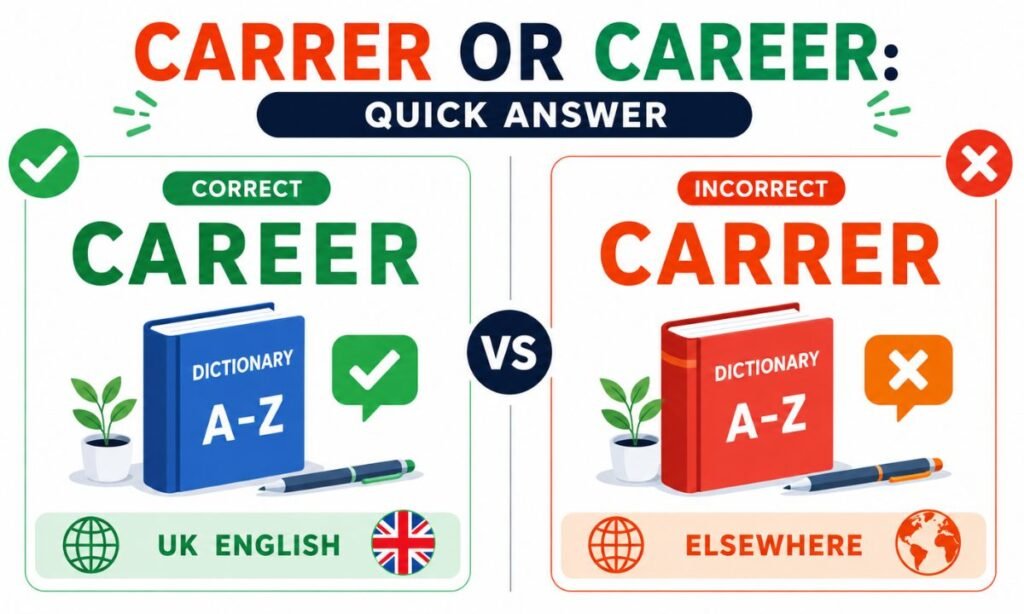
Career is the correct spelling. Always.
“Carrer” is a misspelling. It is not a recognized word in standard English dictionaries, and it has no accepted meaning in modern professional or casual writing.
The correct spelling is C-A-R-E-E-R, six letters, with two E’s sitting side by side in the middle.
If you typed “carrer” in your resume, you are not alone. Thousands of people make this exact mistake every week. The good news is that it takes about ten seconds to fix and this article will make sure it never happens again.
What Does “Career” Actually Mean? (Clear and Practical Definition)
A career is the long-term professional journey a person builds over their working life. It is not just a single job. It is the full arc of roles, skills, experiences, and growth that define someone’s professional identity.
Think of it this way: a job is a chapter, but a career is the whole book.
Career as a noun (most common use): She built a strong career in environmental law. His career in software engineering spanned three decades.
Career as a verb (most people miss this one): Here is a fun fact that competitor articles mostly skip. “Career” can also be a verb, meaning to move swiftly and without control.
The truck careered down the hill and crashed into the barrier.
This verb form is mostly used in British English and journalism. It rarely shows up in professional writing, which is why most people never encounter it. But now you know, and that makes you more informed than the average reader.
Synonyms for career (useful for resumes and writing variety):
- Profession
- Occupation
- Vocation
- Calling
- Professional journey
- Career path
- Work history
- Professional trajectory
Why Do People Write “Carrer” Instead of “Career”?
This mistake is not random. There are clear, logical reasons it happens, and understanding them helps you stop making it.
Fast typing drops the second E. When your fingers move quickly, your brain processes the word as a sound pattern, not a letter sequence. The word “career” sounds like “kuh-REER,” and your brain thinks one E is enough to represent that sound.
Similar words create interference. Words like “carrier,” “carer,” and “carriage” are stored near “career” in your memory. Their spelling patterns bleed into each other, and you end up writing a version that feels right but is not.
Double vowels feel unnecessary. English has many words with double letters, but double vowels feel redundant to many writers. Your brain quietly removes the extra E without asking you first.
Autocorrect does not always save you. Because “carrer” resembles real words in some spell-check databases, it sometimes slips through undetected. Do not trust autocorrect with this one.
Non-native English speakers face an extra layer of difficulty. In Catalan and some Spanish dialects, the word “carrer” actually exists and means “street.” If you grew up with that word in your vocabulary, your brain has a competing entry that makes the misspelling feel correct.
Carrer — Does It Mean Anything at All?
In standard English dictionaries, “carrer” has no recognized definition. It is classified as a misspelling of “career.”
However, here is something competitors do not fully explain: “Carrer” is a legitimate word in Catalan, where it means “street” or “road.” This explains why some multilingual writers and language learners feel the word looks familiar. Their brain is pulling from a different language’s vocabulary, not from a typo.
In English, the word you are looking for is always career, never “carrer.”
Also worth knowing: do not confuse “career” with “carer,” which is an actual English word. A carer is a person who looks after someone who is elderly, sick, or disabled. It is one letter shorter than “career” and means something completely different.
Career vs Similar Words — Avoid These Costly Mistakes
| Word | Correct? | Meaning |
| Career | Yes | Long-term professional journey or path |
| Carrer | No | Misspelling in English; means “street” in Catalan |
| Carer | Yes | Someone who provides care to another person |
| Carrier | Yes | Something or someone that transports or transmits |
| Careen | Yes | To tilt or sway while moving at high speed |
| Carreer | No | Misspelling with an extra R and extra E |
These words look alike but mean completely different things. Mixing them up in a formal document is the kind of mistake that makes a recruiter’s eyebrow go up in the wrong direction.
Easy Tricks to Remember the Correct Spelling of Career
Memory tricks beat grammar rules every single time. Here are the ones that actually stick.
Trick 1: Career contains “ear.” Look at the word. C-A-R-EAR. The word “ear” is hiding right inside “career.” You earn a living with your career, and you listen for opportunities with your ear. Connect those two ideas and the double-E placement locks into place.
Trick 2: Two E’s, two eyes on the prize. Your career needs both eyes open. The two E’s remind you to stay alert and focused, just like any successful professional path demands.
Trick 3: Spell it out loud once. C-A-R-E-E-R. Say it once with exaggeration. “Care. Care. R.” The double-E becomes obvious when you slow down and say each letter.
Trick 4: Use it daily for one week. This is what most articles miss. Knowing the correct spelling is not the same as owning it. Write the word correctly five times today. Your hand will remember it faster than your brain.
Real-Life Examples of “Career” in Sentences
Seeing a word used in context makes it stick better than any rule. Here are practical, realistic examples across different situations.
In a resume or cover letter: My goal is to build a long-term career in data science with a focus on machine learning applications.
In a professional conversation: She made a career change from finance to healthcare consulting at 35, and it was the best decision she ever made.
In academic writing: Career development programs at the university level improve graduate employment outcomes significantly.
In casual speech: His entire career has been in education, starting as a classroom teacher and ending as a school district superintendent.
In journalism: The scandal threatened to end the politician’s career before her second term even began.
Common Phrases Using “Career”
These are the phrases you will use most often in professional writing. Knowing them builds your vocabulary around the correct spelling automatically.
- Career path — the sequence of jobs that leads toward a professional goal
- Career development — the ongoing process of growing skills and experience
- Career growth — advancement in responsibility, pay, or influence over time
- Career change — switching from one professional field to another
- Career goals — the specific outcomes someone aims to achieve professionally
- Career advice — guidance given to help someone make better professional decisions
- Career objective — a short statement in a resume describing professional aims
- Career trajectory — the overall direction and momentum of someone’s work history
- Career milestone — a significant achievement or turning point in a professional journey
Using these phrases correctly signals fluency and professionalism. Using “carrer” in any of them signals the opposite.
Also Read This: To Bad vs Too Bad: Which Is Correct? Meaning, Usage, Examples & Common Mistakes (2026)
When Spelling Mistakes Can Hurt You (Real Impact)
This section is where spelling stops being a grammar lesson and becomes a career lesson, pun fully intended.
Resumes filtered by software. Over 90 percent of large companies now use Applicant Tracking Systems (ATS) to screen resumes before a human ever reads them. These systems search for specific terms, including the word “career.” If your resume says “carrer objective” instead of “career objective,” the ATS may fail to match your document to the job description. Your qualifications never even get reviewed.
First impressions with recruiters. Hiring managers scan dozens of applications in a single sitting. A single misspelling, especially one as common as “carrer,” signals a lack of attention to detail. In competitive hiring environments, that signal is often enough to move your application to the bottom of the pile.
Professional credibility online. LinkedIn profiles, professional bios, and personal websites with “carrer” in them quietly undermine the credibility of everything else on the page. Readers notice even when they do not consciously process it.
Academic submissions. Students submitting essays, applications, or scholarship materials with “carrer” risk losing marks or giving committee members a reason to question the overall quality of their work.
One letter. One extra E. The difference between looking polished and looking careless.
Quick Grammar Check Checklist for “Career”
Before you submit any professional document, run through this fast list.
- [ ] Does the word have exactly six letters: C-A-R-E-E-R?
- [ ] Are there two E’s next to each other in the middle?
- [ ] Is it spelled differently from “carer” (which has only five letters)?
- [ ] Did you use Ctrl+F to search your document for “carrer” and replace it?
- [ ] Did you check your resume summary, job titles, and career objective section specifically?
If every box is checked, you are good to send.
Career vs Carrer — Visual Comparison
CORRECT ✅ INCORRECT ❌
———– ————
C – A – R – E – E – R C – A – R – R – E – R
6 letters 6 letters
Double E in middle Double R (wrong)
Recognized in all Not in any English
English dictionaries dictionary
Used in resumes, Signals a typo or
bios, applications lack of proofreading
The confusion usually involves swapping the double-E for a double-R. One version earns you an interview. The other earns you a rejection.
Why English Spelling Feels So Confusing
Here is something that should make you feel better. English spelling is genuinely inconsistent, and it is not your fault that words like “career” trip people up.
The English language borrowed words from Latin, French, Old Norse, German, and dozens of other languages over centuries. Each donor language brought its own spelling rules, which English then refused to fully standardize. The result is a language where “career” has a double-E, “bread” has a short-E sound despite the EA combination, and “colonel” is somehow pronounced “kernel.”
The word “career” came into English from the Old French word carrière, which itself derived from the Latin carrus, meaning a wheeled vehicle or chariot. The original French meaning was “racecourse” or “road.” English adopted it in the 16th century to describe a fast, galloping run, and eventually the meaning evolved to describe the full professional path of a person’s working life.
That French origin explains the double-E. French words frequently carried vowel combinations that English preserved in spelling even when pronunciation simplified. So the next time you feel annoyed at the double-E in “career,” direct that frustration toward 16th-century French scribes.
How to Train Yourself to Never Misspell “Career” Again
Knowing a rule does not build a habit. Practice does. Here is a simple one-week routine that works.
Days 1 and 2: Write the word “career” ten times by hand each morning. Not on a phone or laptop. By hand. Physical writing creates stronger memory encoding.
Days 3 and 4: Use the word in three written sentences each day. Email a colleague, write a journal entry, or type a social media post. Use it in context, not in isolation.
Days 5 and 6: Search your existing documents for “carrer” using Ctrl+F. Fix every instance you find. This closes the loop between the old habit and the new one.
Day 7: Test yourself. Write the word without looking. If it comes out right, the habit is formed.
After one week of intentional practice, the correct spelling will feel automatic. You will stop pausing mid-sentence to second-guess yourself.
Expert Tip — How Recruiters Spot Careless Writing Instantly
Recruiters do not read applications the way teachers grade essays. They scan. Their eyes move across the page looking for patterns, keywords, and red flags.
A misspelling like “carrer” is a pattern interrupt. It breaks the visual flow of the document and forces a mental pause. That pause is involuntary. Even a recruiter who consciously decides to “overlook typos” has already registered the error subconsciously.
Research on hiring behavior consistently shows that spelling and grammar errors reduce a candidate’s perceived professionalism, even when all other qualifications are strong. The word “career” appears multiple times in a typical resume: in the objective statement, in section headers, in job descriptions. One misspelling in one location often signals others elsewhere.
The fix is simple: proofread, then proofread again, and then have someone else read it. A fresh pair of eyes catches what your own eyes have learned to skip.
Final Verdict — Carrer or Career?
Career. Every single time.
“Carrer” is not a word in English. It is a typo that millions of people make, and now you are not one of them.
The word is spelled C-A-R-E-E-R, it has French roots, it refers to your long-term professional journey, and it has absolutely no legitimate alternate spelling in any version of English, British or American.
Spell it right on your resume. Spell it right on your LinkedIn profile. Spell it right in every email, application, and bio you ever write. One small habit, practiced consistently, is the difference between a document that gets read and one that gets ignored.
Conclusion
The difference between “career” and “carrer” is a single letter, but the impact of that letter is anything but small. In professional writing, on resumes, and across digital platforms, correct spelling signals that you pay attention to the details that matter. And in a competitive job market, those details are often what separate a callback from silence.
You now know the correct spelling, the full meaning, the history behind the word, the common reasons people get it wrong, and several proven tricks to remember it. The only thing left is to use that knowledge every time you sit down to write.
Your career deserves to be spelled correctly.
