

Every writer — student, blogger, or professional — has paused mid-sentence and asked: Is it speach or speech? You type fast, hit send, and then wonder if autocorrect saved you. This guide gives you the clear, final answer — along with the meaning, history, examples, and tips to never confuse these spellings again.
Speach or Speech – Quick Answer
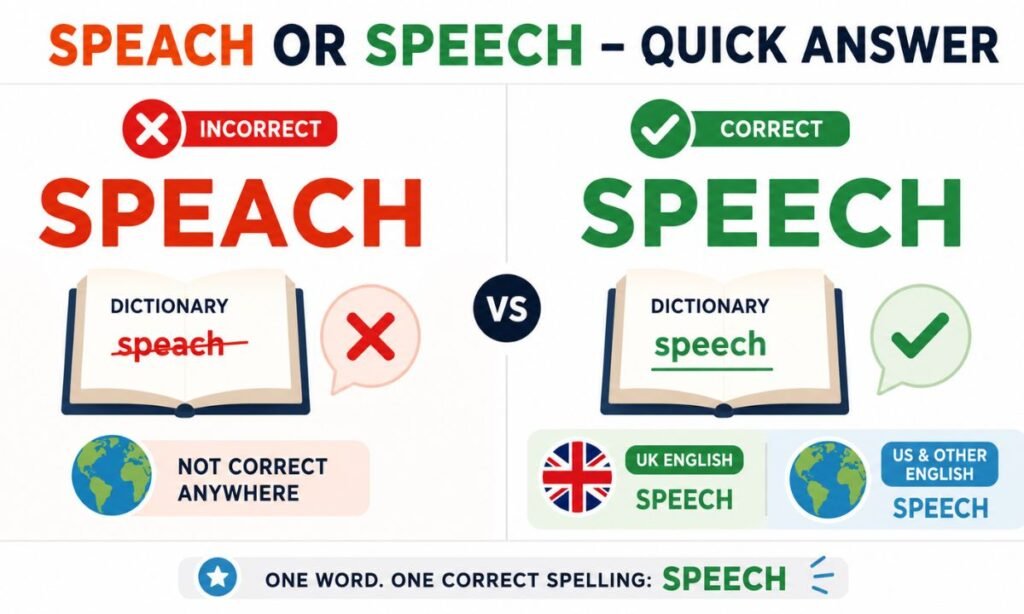
Speech is the correct spelling. Speach is a misspelling — it does not exist in any English dictionary, and no grammar authority recognizes it as a valid word.
✅ Correct: Speech
❌ Incorrect: Speach
Simple rule: whenever you mean spoken words, a formal address, or the human ability to talk — always write speech.
The Origin of Speech
Understanding where a word comes from makes it easier to remember how to spell it.
The word speech traces back to Old English “spǣċ” and the related form “sprǣc,” both meaning “the act or manner of speaking.” These forms evolved from Proto-Germanic roots (sprek- or spek-), which also gave rise to similar words in other Germanic languages:
| Language | Word |
| German | Sprache |
| Dutch | Spraak |
| Danish | Sprog |
| Old Saxon | Spraca |
| Old Frisian | Spreke |
Interestingly, the Old English form of the word did contain an “a” — which is probably why “speach” still feels intuitive to many people today. That vowel was gradually dropped, and by the 19th century the modern spelling speech became fully standardized.
The verb speak kept its “ea” (from Old English specan), but the noun moved in a different direction. That’s the source of the confusion — and why so many people write “speach” when they mean “speech.”
British English vs American English Spelling
One common reason people doubt a spelling is regional variation. Words like colour/color and organisation/organization are spelled differently across English dialects.
But speech is different.
There is no British vs American spelling difference for this word. Both varieties use the same spelling:
| Region | Correct Spelling |
| American English | Speech |
| British English | Speech |
| Canadian English | Speech |
| Australian English | Speech |
No matter where in the world you are writing, speech is the only accepted form.
Also Read This: Fiending or Feening: Which Spelling Is Correct? Meaning, Usage & Slang Explained (2026)
Which Spelling Should You Use?
Always use speech. There is no situation, context, or dialect where “speach” is acceptable.
Use speech when referring to:
- A formal presentation or public address (graduation speech, political speech)
- The human ability to produce spoken language (speech development, speech therapy)
- A period of dialogue or spoken communication (freedom of speech)
- A character’s spoken lines in a play or story (a famous speech from Hamlet)
Plural form: speeches
Related verb: speak
Related adjective: speechless
Common Mistakes with Speech
Why Do People Write “Speach”?
This is one of the most common English spelling errors. Here’s why it happens:
- Analogy with “speak” — The noun comes from the verb speak, which has an “ea” combination. Writers assume the noun follows the same pattern.
- Phonetic spelling — The word sounds like it could be spelled with “ea,” similar to teach, reach, beach.
- No autocorrect catch — Some devices and platforms don’t flag “speach” as a misspelling, so the error goes unnoticed.
- Fast typing — In casual writing, fingers follow memory rather than rules.
The “EA” vs “EE” Trap
Many English words ending in the -eech sound are spelled with ee, not ea:
| Word | Correct Spelling |
| Speech | ✅ ee |
| Beech (tree) | ✅ ee |
| Screech | ✅ ee |
| Leech | ✅ ee |
Words like teach, reach, beach use “ea” but end in a different sound. Speech belongs to the “ee” family.
Memory Tip
Try this: “Speech needs two E’s for Expression and Eloquence.”
Or simply remember: speech rhymes with screech — and both use “ee.”
Speech in Everyday Examples
Here are natural, publish-ready example sentences showing correct usage:
Formal/Academic Context:
- The president delivered a powerful speech at the United Nations summit.
- Her graduation speech left the entire auditorium in silence.
- Freedom of speech is protected under the First Amendment.
Professional Context:
- The CEO’s opening speech set the tone for the entire conference.
- His speech on workplace inclusion was widely praised.
Education & Development:
- The child began speech therapy at the age of three.
- Teachers often use speech exercises to build student confidence.
Casual/Everyday Context:
- Dad gave me the whole “work hard” speech again last night.
- I’m so nervous about my speech tomorrow — I’ve practiced it ten times.
Incorrect Examples (What to Avoid):
- ❌ She gave a brilliant speach at the event.
- ❌ His speach was hard to follow.
- ❌ Freedom of speach is a basic right.
Speech – Google Trends & Usage Data
Search data consistently shows that while both terms are searched, only speech appears in actual usage as a valid word. The term “speach” appears in search queries primarily because users are checking whether it is correct — not because they believe it is valid.
Key insights from search behavior:
- “Speach or speech” is a high-volume spelling-check query in 2025–2026
- Users also search: “how to spell speech,” “speech vs speach difference,” “is speach a word”
- Merriam-Webster and Oxford English Dictionary both list only speech — no entry exists for speach
- Grammar tools like Grammarly and ProWritingAid flag speach as a misspelling in every context
Comparison Table: Speech vs Speach
| Feature | Speech | Speach |
| Correct spelling | ✅ Yes | ❌ No |
| Found in dictionary | ✅ Yes | ❌ No |
| Valid in formal writing | ✅ Yes | ❌ No |
| Valid in casual writing | ✅ Yes | ❌ No |
| British English | ✅ Speech | ❌ N/A |
| American English | ✅ Speech | ❌ N/A |
| Accepted by grammar tools | ✅ Yes | ❌ Flagged as error |
| Historical usage | ✅ Centuries of documented use | ❌ Only as a typo |
Conclusion
The answer is clear and final: speech is the only correct spelling. “Speach” has never been a real English word — it is simply a common misspelling caused by the natural influence of the related verb speak.
Whether you are writing a college essay, a professional email, a blog post, or a formal report, always use speech. It holds the same spelling in British and American English, it is the only form recognized by major dictionaries, and grammar tools will flag any other version as an error.
Quick reminder: Think screech, beech, speech — they all use ee, not ea. Once that pattern clicks, you will never second-guess this spelling again.
