

Few grammar mix-ups appear as often as elses or else’s. Both words look like simple variations of “else,” yet only one of them is grammatically correct. This guide breaks down the rule in plain English, shows you exactly where the apostrophe goes, and clears up every common mistake people make with this word.
Elses or Else’s – Quick Answer
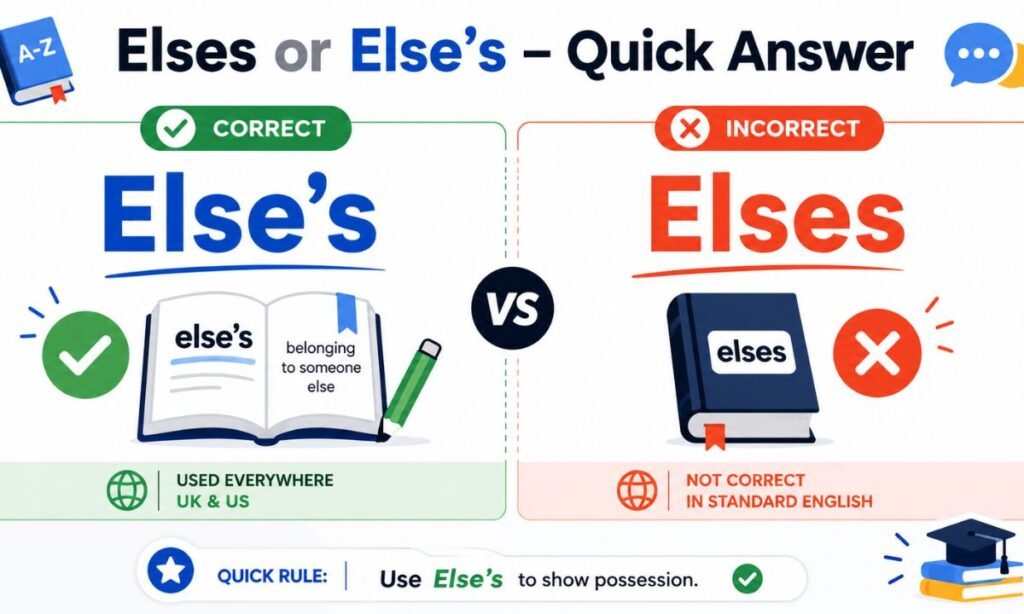
Else’s is correct. Elses is not a standard English word.
Else’s is the possessive form used to show that something belongs to an unspecified person, as in “someone else’s car” or “anyone else’s opinion.” There is no plural form of else, so elses never appears in correct English writing, no matter the context.
A simple way to remember it: if you’re showing ownership, the apostrophe always comes before the s.
The Origin of Elses or Else’s
The word else comes from Old English “elles,” meaning “otherwise” or “in addition.” It originally functioned as an adverb, not a noun, which is why it doesn’t behave like regular nouns when pluralized or made possessive.
Over time, else attached itself to indefinite pronouns like someone, anyone, everyone, and nobody to form compound expressions such as someone else, anyone else, and everyone else. When speakers needed to show possession with these phrases, English grammar placed the apostrophe at the end of the entire phrase rather than on the first word. That’s how someone else’s became the standard form, instead of someone’s else.
This single grammar shift is the root of nearly all confusion around elses or else’s today. Because else started life as an adverb describing “what else” or “who else,” English never developed a true plural form for it the way it did for ordinary nouns like “cat” or “book.” That missing plural is exactly why elses feels tempting to write but never actually exists in any English dictionary.
British English vs American English Spelling
There is no regional difference in this rule. Both British and American English follow the exact same structure.
| Style | Example Sentence |
| British English | That is someone else’s responsibility. |
| American English | This is nobody else’s decision. |
Whether you’re writing for a UK audience or a US audience, else’s remains the only correct possessive form. You don’t need to adjust spelling based on region for this particular word, unlike words such as “colour” versus “color.”
Which Spelling Should You Use?
Always use else’s when you’re showing possession or ownership. There is no situation in modern standard English where elses is the preferred or accepted spelling.
Use this quick check before you write:
- If you can rephrase the sentence as “belonging to someone else,” you need else’s.
- If you’re tempted to write elses to mean “more than one other thing,” rewrite the sentence using a word like “alternatives” or “other options” instead.
- If you’re unsure, read the sentence aloud. Spoken English often hides the apostrophe, but written English never should.
Else’s is safe to use in emails, academic writing, social media captions, news articles, and everyday conversation.
Quick Self-Check Before You Hit Publish
Run your sentence through these three checks before posting or submitting it:
- Does the sentence describe something belonging to a person? If yes, you need the apostrophe.
- Could you replace “else’s” with “other person’s” and have it still make sense? If yes, else’s is correct.
- Are you tempted to write elses because it “sounds plural”? That instinct is the most common trigger for this mistake, so pause and rewrite the sentence with else’s instead.
Also Read This: Pricy or Pricey: Which Spelling Is Correct? (2026 Guide)
Anyone elses or else’s
The correct form is anyone else’s, never anyone elses.
This follows the same possessive rule explained above. The apostrophe attaches to the full phrase “anyone else,” not just the word “anyone.”
- ❌ Did anyone elses notice the change?
- ✅ Did anyone else’s notice the change?
- ✅ Is this anyone else’s umbrella?
Whenever “anyone else” is followed by something that belongs to that person, anyone else’s is the only grammatically correct choice.
Common Mistakes with Elses or Else’s
Writers make a handful of repeated errors with this word. Here are the most frequent ones:
- Adding a plain “s” instead of an apostrophe + s. Example: “someone elses phone” instead of “someone else’s phone.”
- Placing the apostrophe on the wrong word. Example: “someone’s else phone” instead of “someone else’s phone.”
- Treating else as a regular noun that can be pluralized. Example: “there are many elses to consider,” which should instead say “there are many alternatives to consider.”
- Dropping the apostrophe entirely in casual writing. Example: “thats someone elses problem” instead of “that’s someone else’s problem.”
- Confusing else’s with elses’ as a plural possessive. Since else has no plural form, elses’ is never correct either.
- Mixing up else’s with the contraction “else is.” In casual texting, “else’s” can sometimes look like a shortened “else is,” so always check whether the sentence means possession or a verb before finalizing it.
Avoiding these six mistakes covers almost every real-world case of elses or else’s confusion.
Everyone else’s or else’s
The correct phrase is everyone else’s, not everyone elses or everyone’s else.
This pattern matches every other indefinite pronoun combination in English.
- ❌ Everyone elses ideas were better than mine.
- ✅ Everyone else’s ideas were better than mine.
- ✅ Stop worrying about everyone else’s opinions.
The same rule applies consistently across somebody else’s, nobody else’s, and something else’s. Once you learn the pattern with one pronoun, it transfers directly to all the others.
Elses or Else’s in Everyday Examples
Seeing the correct form in real sentences makes the rule easier to remember.
- Please do not touch anyone else’s files.
- The decision should not depend on anybody else’s opinion.
- I used someone else’s notes for the exam.
- This idea wasn’t anybody else’s. I came up with it myself.
- The credit belongs to someone else’s team.
- Does anyone else’s dog behave like this?
- Focus on your own goals, not someone else’s success.
- The findings rely heavily on someone else’s earlier research.
- I don’t want to be blamed for somebody else’s mistake.
Notice that the noun being owned can appear either right after else’s, as in “else’s notes,” or at the end of the sentence, as in “wasn’t anybody else’s.”
Elses or Else’s – Google Trends & Usage Data
Search data consistently shows that people look up “else’s” far more often than “elses,” which suggests most users are searching to confirm the correct spelling rather than to use the incorrect one intentionally.
Key patterns from search behavior:
- Interest in this query is highest among English learners, students, and content writers.
- Search demand tends to come from regions where English is a second language.
- Related searches include “is elses a word,” “anyone else’s or elses,” and “does else’s have an apostrophe.”
- Search volume for else’s is consistently several times higher than elses, showing that most people are checking the rule rather than defending an alternate spelling.
This data reinforces that elses or else’s is primarily a spelling confusion issue, not a regional or stylistic difference. Content writers, students preparing for English exams, and professionals proofreading emails make up the largest share of people searching this exact phrase.
Comparison Table: Elses vs Else’s
| Feature | Elses | Else’s |
| Grammatically correct | No | Yes |
| Used to show possession | No | Yes |
| Standard English word | No | Yes |
| Found in dictionaries | No | Yes |
| British English usage | Incorrect | Correct |
| American English usage | Incorrect | Correct |
| Example sentence | There are many elses to consider ❌ | This is someone else’s phone ✅ |
Conclusion
The rule behind elses or else’s comes down to one consistent principle: else is not a regular noun, so it never takes a plain “s” to show possession. Else’s is the only correct form, and it works the same way in British English, American English, formal writing, and everyday conversation.
Whenever you want to express that something belongs to an unspecified person, attach the apostrophe and s to the full phrase, such as someone else’s, anyone else’s, or everyone else’s. Keep this simple rule in mind, and you’ll never second-guess this small but common grammar point again.
