



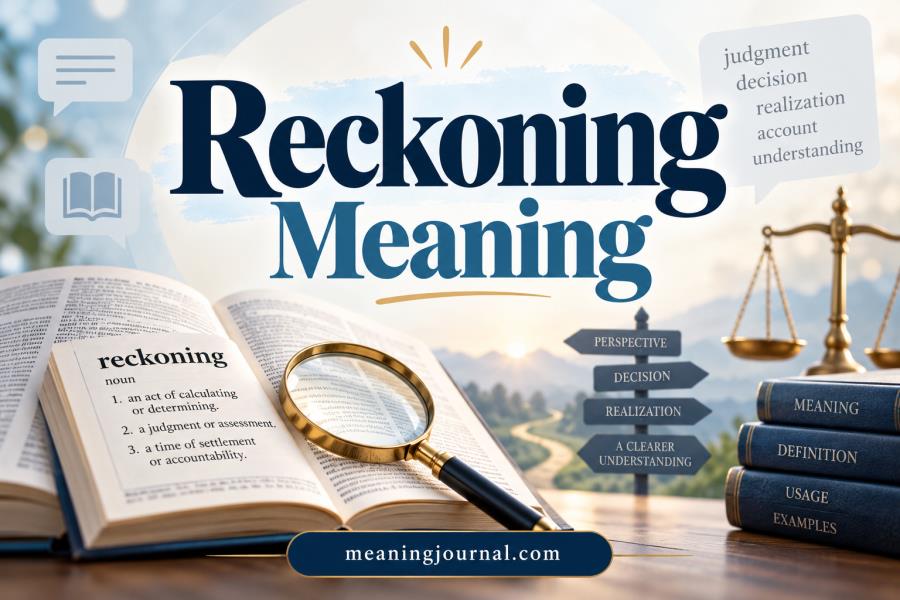
Reckoning Meaning: The term “reckoning meaning” generally refers to the point in time when one is expected to pay for the previous deeds done by him/her. However, it may also refer to the act of making a calculation or an estimate or settling accounts. In contemporary language usage, the term is used to convey the idea of judgment or consequences. It becomes clear through context analysis.
What Is the Reckoning Meaning?
The simplest reckoning meaning is “a time when actions are judged and consequences are faced.” It may describe personal responsibility, public judgment, financial calculation, or a major event that forces change.
For example:
- “The company faced a reckoning after years of poor management.”
- “By my reckoning, we should arrive before noon.”
- “He knew a reckoning would come after the truth was revealed.”
In the first sentence, the reckoning meaning is a moment of accountability. In the second, the reckoning meaning is a calculation or estimate. In the third, it refers to an expected time of judgment.
Quick Reckoning Meaning Fact Table
| Topic | Explanation |
| Main definition | A time of judgment, settlement, or consequences |
| Secondary definition | A calculation, estimate, or counting process |
| Part of speech | Noun |
| Pronunciation | REK-uh-ning |
| Common tone | Serious, formal, dramatic, or reflective |
| Common phrase | “A day of reckoning” |
| Simple synonym | Judgment |
| Practical synonym | Calculation |
| Example | “The scandal led to a public reckoning.” |
Reckoning Meaning in Simple Words
Saying it in simple words, reckoning meaning is the time when people need to pay the price for their actions. It is usually caused by mistakes made by people, bad decisions, ignoring warnings and unaddressed problems.
In other words, it could be said as the point when there is no possibility of avoiding the situation any more. It is the time of revealing the truth and taking responsibility for what has been done. There are some consequences of it.
However, reckoning does not only mean punishment. At times it could be the process of self-analysis when a person realizes what has to be changed in his/her life. Reckoning also could be used when analyzing failures of a company or looking at the previous injustice of society.
Read Also: Unc Meaning in Text: What Does Unc Mean in Slang? (2026)
Different Uses of Reckoning Meaning
The reckoning meaning changes slightly depending on the sentence. Here are the most common uses.
1. Reckoning Meaning as Judgment
This is the most common modern use. It describes a time when a person, group, or organization is judged for earlier behavior.
Example: “The election became a reckoning for the ruling party.”
Here, the reckoning meaning is a public judgment based on earlier actions.
2. Reckoning Meaning as Consequences
The word can also describe the results that follow a choice.
Example: “Years of overspending finally brought a financial reckoning.”
In this sentence, the reckoning meaning is the moment when the cost of past behavior must be faced.
3. Reckoning Meaning as Calculation
An older and still common use relates to counting or estimating.
Example: “By our reckoning, the project will take three weeks.”
Here, the reckoning meaning is an estimate based on available facts.
4. Reckoning Meaning as Settlement
The word can refer to settling accounts, debts, or disagreements.
Example: “The final reckoning showed that the business still owed money.”
In this case, the reckoning meaning is a final calculation or settlement.
5. Reckoning Meaning as Self-Reflection
A personal reckoning can happen when someone honestly reviews their choices.
Example: “The failure forced him into a painful reckoning with his priorities.”
The reckoning meaning here is a deep personal review that may lead to change.
What Does “A Day of Reckoning” Mean?
“A day of reckoning” implies a day when one has to face the judgment for some things that he has done before.
For example, “After years of concealing losses, the company’s day of reckoning came.”
The meaning of reckoning in the phrase does not mean just any other day; rather, it is the day when one cannot escape from his past deeds or actions.
It can be used in various areas such as politics, business, religion, movies, literature, and even ordinary talk.
Reckoning Meaning in a Sentence
Looking at sentence examples is one of the fastest ways to understand the reckoning meaning.
- “The report triggered a reckoning across the industry.”
- “By my reckoning, we have enough food for ten people.”
- “The team faced a reckoning after losing several key matches.”
- “Her illness led to a personal reckoning about work and family.”
- “The final reckoning revealed several unpaid bills.”
- “The public demanded a reckoning after the facts became known.”
- “He believed his day of reckoning was near.”
- “By their reckoning, the repair would cost less than expected.”
- “The crisis became a national reckoning.”
- “The court case brought a long-awaited reckoning.”
Each example shows a different shade of the reckoning meaning. Some focus on judgment. Others focus on calculation or reflection.
Reckoning Meaning in Modern English
The current reckoning meaning frequently refers to accountability. Newspapers will use this term if some company, government, person in the public eye, or some kind of industry comes under scrutiny due to what happened before.
For instance, the phrase “the company is going through the financial reckoning” means the previous decisions brought the company troubles that have to be dealt with now.
If the term is used as the cultural/political/personal reckoning, it means the long-accepted belief/beliefs, behavior/behaviors, system/systems have been questioned; the voters, politicians, institutions were judged; the person has analyzed his/her own past and its consequences.
The usage of the word in the current times provides the word with the connotation of changes. The reckoning meaning always brings an end to denial and starts accountability.
Reckoning Meaning in Literature and Movies
Writers often use the word because it creates tension. A reckoning suggests that an important confrontation is coming. A character may need to face an enemy, admit the truth, repay a debt, or accept the outcome of earlier choices.
In stories, the reckoning meaning may refer to:
- A final confrontation
- The exposure of a secret
- Justice after wrongdoing
- A character’s moral decision
- The collapse of a false belief
- The payment of an old debt
The word works well in titles because it promises conflict and resolution. When readers see “reckoning,” they often expect a serious turning point.
Reckoning Meaning in the Bible and Religion
In religious language, the reckoning meaning can refer to divine judgment or a time when people answer for their actions. The phrase “day of reckoning” is often connected with the idea of final judgment.
In general religious use, the word may suggest:
- Moral responsibility
- Judgment by God
- The weighing of actions
- Repentance
- Justice
- Final consequences
The exact meaning depends on the belief system and the passage. Still, the core reckoning meaning remains linked to accountability and judgment.
Reckoning Meaning in Business
In business, the reckoning meaning often refers to the point where poor decisions create clear financial or operational results.
Examples include:
- A debt reckoning
- A market reckoning
- A leadership reckoning
- A technology reckoning
- A workplace reckoning
The company can ignore solving its problem, but the expense can mount. When the problem becomes too much to ignore, a reckoning takes place. Business reckoning definition may comprise firing employees, losing money, getting sued, having a new management, or adopting a different plan.
The term can also be used neutrally, in terms of calculations. For example, a manager can state, “According to our reckoning, sales will increase next month.” In this case, the reckoning meaning is an estimation.
Reckoning Meaning in Relationships
In relationships, the reckoning meaning may describe a serious conversation about trust, honesty, or unresolved conflict.
Example: “The discovery led to a reckoning in their marriage.”
This does not always mean the relationship will end. It means the people involved must face what happened and decide what comes next.
A relationship reckoning may involve:
- Admitting mistakes
- Discussing broken trust
- Setting new boundaries
- Deciding whether to continue
- Accepting emotional consequences
The reckoning meaning here is closely connected to truth and responsibility.
Similar Words and Alternatives to Reckoning
| Word or phrase | Meaning | Example |
| Judgment | A decision about actions or behavior | “The public judgment was severe.” |
| Accountability | Being responsible for actions | “Leaders must accept accountability.” |
| Consequence | A result of an action | “The loss was a consequence of poor planning.” |
| Settlement | The final clearing of an account | “The settlement ended the dispute.” |
| Calculation | A mathematical or reasoned estimate | “Her calculation was correct.” |
| Estimate | An approximate judgment | “The estimate was close.” |
| Evaluation | A careful review | “The evaluation found several problems.” |
| Confrontation | A direct facing of a problem | “The confrontation ended years of silence.” |
| Turning point | A moment that changes events | “The ruling became a turning point.” |
| Day of judgment | A time when actions are judged | “He feared a day of judgment.” |
These alternatives may match part of the reckoning meaning, but not every synonym works in every sentence.
Reckoning vs. Judgment
Reckoning and judgment are related, but they are not always identical.
Judgment usually refers to the act of deciding whether something is right, wrong, good, or bad. Reckoning often includes both judgment and consequences.
Examples:
- “The court delivered its judgment.”
- “The ruling began a wider reckoning for the company.”
The first sentence focuses on the decision. The second focuses on the larger results that followed.
Reckoning vs. Calculation
The reckoning meaning can also match calculation, but only in certain contexts.
“By my reckoning” means “according to my calculation” or “based on my estimate.”
Example: “By my reckoning, the journey should take two hours.”
This use is less emotional. It has nothing to do with punishment or judgment. Context tells you which reckoning meaning is intended.
Reckoning vs. Accountability
Accountability means accepting responsibility. Reckoning is often the event or period that forces accountability.
Example: “The investigation created a reckoning, and the leaders were finally held accountable.”
So, accountability is the responsibility itself. A reckoning is the moment when that responsibility must be faced.
Common Phrases With Reckoning
By My Reckoning
“By my reckoning” means “according to my estimate.”
Example: “By my reckoning, we need five more chairs.”
Day of Reckoning
A “day of reckoning” means a time when consequences or judgment arrive.
Example: “The audit brought a day of reckoning.”
Final Reckoning
A “final reckoning” means the last settlement, calculation, or judgment.
Example: “The final reckoning showed a large debt.”
Personal Reckoning
A “personal reckoning” means a serious review of one’s choices, values, or behavior.
Example: “The experience caused a personal reckoning.”
Public Reckoning
A “public reckoning” means broad social or public judgment.
Example: “The scandal led to a public reckoning.”
These phrases show how flexible the reckoning meaning can be.
Is Reckoning a Positive or Negative Word?
Generally speaking, reckoning has a somber or negative connotation. This is because a reckoning generally occurs when issues, errors, and misconduct need to be addressed.
But this doesn’t mean that the outcome is always negative. A reckoning might bring about integrity, reforms, healing, and sound decision-making. Reckoning refers to the hard realization, not the outcome.
For instance, a personal reckoning might be unpleasant, but it could make an individual turn a new leaf. A public reckoning might highlight a failure, but it could also bring about improvements in the system.
Read Also: Elegy Meaning: Definition, Types, Examples & Uses (2026)
How to Use Reckoning Correctly
Use “reckoning” when you want to describe judgment, consequences, calculation, or a serious review.
Correct examples:
- “The organization is facing a reckoning.”
- “By my reckoning, we are on schedule.”
- “The event forced a personal reckoning.”
- “The final reckoning included all unpaid costs.”
Avoid using the word when a simpler term would be clearer. In casual writing, “estimate,” “review,” or “consequences” may be easier. In serious writing, reckoning adds weight and signals a major moment.
Why the Reckoning Meaning Depends on Context
The reckoning meaning depends heavily on the words around it. “By my reckoning” is about an estimate. “A day of reckoning” is about judgment. “A personal reckoning” is about self-reflection. “A financial reckoning” is about money problems and their results.
To find the right meaning, ask:
- Is someone calculating something?
- Is someone facing consequences?
- Is a debt or account being settled?
- Is a person reviewing past choices?
- Is a group being publicly judged?
The answer will reveal the intended reckoning meaning.
Final Thoughts
The definition of the reckoning meaning will be either a serious, practical, or contemplative one. The most common definition is that of a period during which one is accountable. It may also mean a calculation or an estimate. It all depends on context. “Day of reckoning” is an accountability period. “By my reckoning” is a personal estimation. “Personal reckoning” is a self-analysis of what one has done previously. Once these meanings become known, there will be no problem understanding the term’s definition.
FAQs
What is the basic reckoning meaning?
The basic reckoning meaning is a time of judgment, consequences, settlement, or calculation.
What does “day of reckoning” mean?
It means the time when someone must face the results of past actions.
Does reckoning mean revenge?
Not exactly. Reckoning means judgment or consequences, while revenge means deliberately causing harm in return.
Can reckoning mean calculation?
Yes. In the phrase “by my reckoning,” it means an estimate or calculation.
Is reckoning a negative word?
It often sounds negative or serious, but it can also lead to positive change.
What is a personal reckoning?
A personal reckoning is an honest review of your actions, values, choices, or priorities.
What is a public reckoning?
A public reckoning is a broad social judgment of a person, group, system, or past event.
What is another word for reckoning?
Possible alternatives include judgment, accountability, calculation, settlement, consequence, and evaluation.
How do you use reckoning in a sentence?
Example: “The investigation led to a reckoning for senior leaders.”
What does “by my reckoning” mean?
It means “according to my estimate” or “based on my calculation.”
