
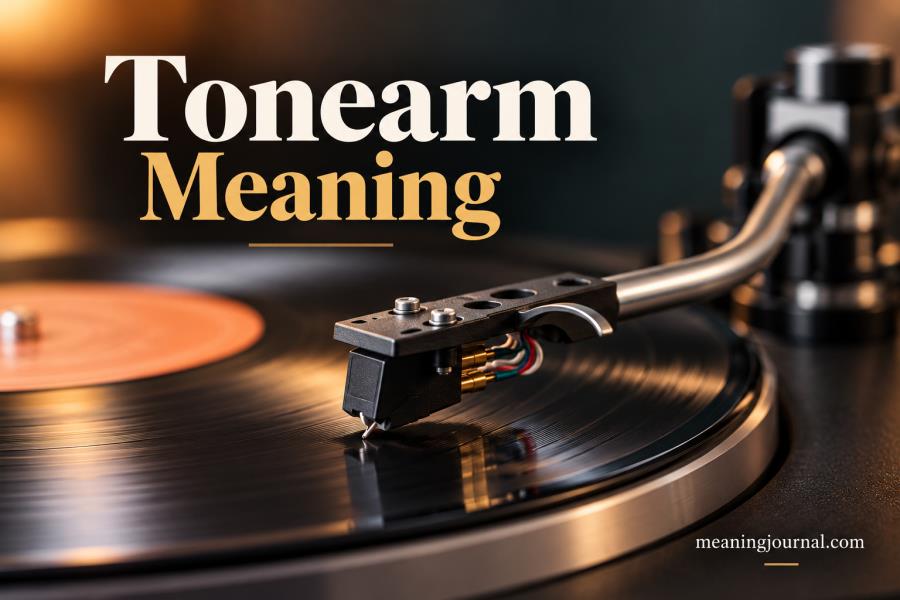
Tonearm Meaning: What It Means and Why It Matters for Vinyl Records
The tonearm meaning is easy to understand. The record player’s arm that moves the cartridge and stylus and pushes the needle through the grooves of a vinyl record. The stylus is not able to play the record properly or with a steady tone without a tonearm.
If you are a new vinyl listener, you may have heard all sorts of terms such as “cartridge,” “stylus,” “counterweight,” and “anti-skate. They might know what a turntable is but aren’t sure what the term means when used for the tonearm. One of the primary components that assists a record player to follow music from vinyl records is its tonearm.
The audio information is stored in the form of minuscule physical changes in a record groove. Those grooves are for the stylus to travel through. The tonearm helps in that process by ensuring the cartridge is kept on the record gently, balanced, and in an accurate position.
Knowing the meaning of “tonearm” can help you setup your turntable more accurately, prevent damage to the records, and spot issues early on.
Tonearm Meaning: Quick Definition
The tonearm meaning is the arm of a turntable that swings the cartridge and stylus over a vinyl record.
It slowly slips towards the middle of the record from the edge. When the stylus is pressed against the groove, the tonearm should maintain the proper angle and pressure for the playback to avoid distortion and bouncing.
Tonearm adjustment contributes to cleaner recordings and decreases unnecessary wear on stylus components and records. Initial setup and regular maintenance also include balancing the tonearm and adjusting for proper tracking force, Audio-Technica says.
Tonearm Meaning Fact Table
| Tonearm Feature | Simple Meaning |
| Main job | Holds the cartridge and guides the stylus across the record |
| Location | Usually sits on the right side of a turntable |
| Movement | Travels from the outer edge toward the center of the vinyl |
| Main parts | Arm tube, headshell, counterweight, pivot, lift lever, anti-skate control |
| Why it matters | Helps the stylus track the groove with proper balance and pressure |
| Common adjustments | Tracking force, anti-skate, cartridge alignment, tonearm height |
| Common issue | Poor setup can cause skipping, distortion, uneven sound, or record wear |
What Does a Tonearm Do?
Let’s start with the tonearm meaning and see what it does when it is used in playback.
A tonearm is not a source of sound. Rather, it holds the cartridge and stylus. The stylus comes into contact with the record groove. The cartridge converts the minuscule movements of grooves into an audio signal. During this process, the tonearm keeps the cartridge in place.
The basic tasks of a tonearm include:
- Holding the cartridge in place
- Holding the stylus while it is moving across the record to pick up sound.
- The stylus should remain at a constant angle while playing music.
- To apply the right tracking force
- Skating calmly on the record
- Reducing unwanted vibration
- Helping prevent skipping and distortion
Record tracking is strongly related to the tonearm meaning. A light tonearm can cause the stylus to jump or skip. In the case of too much weight, the stylus could be forced down too hard into the groove. In either case, it can impact sound quality.
A tonearm should glide but should not be loose. Must be sufficiently stable to hold the cartridge in place during spinning.
Read Also: LGH Meaning in Text: What Does LGH Mean in Slang & Chat? (2026)
Why the Tonearm Matters for Sound Quality
TThe tonearm meaning is important because the tonearm has an impact on the pick-up’s accuracy.
Mechanical playback is the process of vinyl playback. The stylus physically moves in a groove. Even slight set up issues can impact the sound of the music. A poorly adjusted tonearm can result in poor bass response, harsh sound, distortion, skipping, out of balance recording, or additional record wear.
A well set tonearm will ensure that the stylus is able to engage the groove in a controlled manner. It can enhance tracking and balance the sound.
The tonearm meaning likewise is significant in the case of upgrading a turntable. Some listeners listen only to the speakers or cartridges. The tonearm is important as well, because the arm holds up the cartridge for every second it’s playing.
It is helpful to have a stiff and stable tone arm to minimise unwanted movement from the pivot point to the stylus. Too much activity may disrupt the music signal.
Main Parts of a Tonearm
Knowing the parts makes the tonearm meaning much easier to remember.
Tonearm Tube
The tonearm tube is the long section that extends from the pivot area to the cartridge.
It carries the cartridge and helps control vibration. Tonearm tubes may be straight, curved, or shaped like an S. Different designs can affect cartridge compatibility, handling, and setup.
Headshell
The headshell is located at the front end of many tonearms. It is the part where the cartridge attaches.
Some turntables have removable headshells. This makes cartridge replacement easier. Other turntables have fixed headshells built into the tonearm.
The tonearm meaning often includes the headshell because it connects the cartridge to the arm.
Cartridge
The cartridge is attached to the headshell or front of the tonearm. It contains the stylus assembly and converts groove movement into an audio signal.
The cartridge is not the same as the tonearm. Still, both parts work together during playback.
Stylus
The stylus is the small needle that touches the record groove.
The tonearm meaning is linked to stylus control because the tonearm keeps the stylus positioned correctly as the record spins.
Counterweight
The counterweight sits near the back of the tonearm.
It balances the tonearm and helps set tracking force. On many turntables, you turn the counterweight to increase or decrease the downward pressure on the stylus. Audio-Technica identifies the counterweight as the part that balances the tonearm and adjusts the tracking force.
Pivot or Bearing
The pivot is where the tonearm moves.
It allows the arm to travel across the record while staying stable. Good bearings help the tonearm move smoothly with low friction.
Cue Lever or Lift Lever
The cue lever raises and lowers the tonearm safely.
Using the lift lever can help prevent accidental drops that could damage the stylus or scratch a record.
Anti-Skate Control
Anti-skate is a setting that helps balance the inward pull created while a record plays.
The tonearm meaning includes anti-skate because it helps the stylus sit more evenly in the groove. Many turntables use an anti-skate dial near the tonearm base.
How a Tonearm Works During Playback
The tonearm meaning becomes clear when you follow the playback process step by step.
First, you place a record on the platter. Then you start the turntable. The platter spins the record at the selected speed.
Next, you raise the tonearm with the cue lever and move it over the beginning of the record. When you lower the tonearm, the stylus touches the groove.
As the record spins, the groove pulls the stylus inward. The tonearm follows that movement slowly and smoothly. The cartridge reads the groove vibrations and sends an audio signal to the amplifier or speakers.
The tonearm meaning is not just “an arm that moves.” It is a support system that controls balance, pressure, alignment, and movement.
At the end of the record, the tonearm reaches the inner area. On manual turntables, you lift it yourself. On automatic turntables, the mechanism may return the tonearm to its resting position.
Common Tonearm Types
The tonearm meaning can change slightly depending on the tonearm style.
| Tonearm Type | Description | Example Use |
| Straight tonearm | A direct arm design with a straight tube | Common on many modern hi-fi turntables |
| S-shaped tonearm | Curved arm with an S-like shape | Often seen on DJ and classic turntables |
| J-shaped tonearm | Curved shape that looks like the letter J | Found on some vintage-style turntables |
| Pivoted tonearm | Swings inward from one fixed pivot point | Most common type for home turntables |
| Linear tracking tonearm | Moves straight across the record | Used on some specialty turntables |
| Fixed headshell tonearm | The cartridge mounts directly to the arm | Common on entry-level turntables |
| Removable headshell tonearm | The headshell can be detached | Helpful for quick cartridge changes |
The most common tonearm meaning relates to a pivoted tonearm. This type swings across the record in an arc. It is widely used because it is practical, reliable, and familiar to most vinyl listeners.
A linear tracking arm moves straight across the record instead of swinging in an arc. It can reduce tracking-angle differences, but it is usually more complex.
Tonearm Meaning vs Similar Turntable Terms
| Term | Meaning | Example |
| Tonearm | The arm that supports and guides the cartridge | The part you lift before placing the needle on a record |
| Cartridge | The device that converts groove movement into an audio signal | A moving magnet cartridge |
| Stylus | The needle that touches the record groove | The replaceable needle on many cartridges |
| Headshell | The front mounting piece for the cartridge | A removable headshell on a DJ turntable |
| Counterweight | Rear weight that balances the tonearm | The round weight behind the tonearm pivot |
| Anti-skate | Adjustment that helps balance sideways force | A dial set near the tracking-force value |
| Platter | The rotating surface that holds the record | The circular platform under the vinyl |
The tonearm meaning is often confused with the cartridge or stylus. The tonearm is the larger moving arm. The cartridge sits at the front of the tonearm. The stylus is the tiny needle attached to the cartridge.
How to Set Up a Tonearm
The tonearm meaning is useful in real life because tonearm setup affects playback.
Always check your turntable manual before adjusting anything. Every model can be slightly different.
Here is a basic process many turntables use:
1. Place the Turntable on a Stable Surface
Put the turntable on a level and solid surface.
Vibration can affect the tonearm and stylus. Keep speakers away from the turntable when possible because vibration can travel through furniture.
2. Balance the tonearm
Set anti-skate to zero if your manual recommends it.
Remove the tonearm from its rest while holding it carefully. Adjust the counterweight until the tonearm floats level. Do not let the stylus drop onto the platter.
A balanced tonearm should sit level before tracking force is added.
3. Set the Tracking Force
After balancing the tonearm, set the tracking-force dial to zero. Then turn the counterweight according to your cartridge’s recommended tracking-force range.
The tonearm meaning is closely tied to tracking force because that setting determines how firmly the stylus sits in the groove.
Do not guess the tracking force. Check the cartridge guide or turntable manual.
4. Adjust Anti-Skate
Many turntables suggest matching anti-skate to the tracking-force setting.
For example, if tracking force is set near 2 grams, anti-skate may also be set near 2. Follow your turntable instructions because designs can vary.
5. Check Cartridge Alignment
Cartridge alignment affects how the stylus sits in the groove.
The tonearm meaning includes alignment because the tonearm holds the cartridge in place. A badly aligned cartridge may create distortion, especially near the end of a record.
Signs Your Tonearm May Need Attention
The tonearm meaning also helps you spot problems early.
Look for these signs:
- The record skips often
- One audio channel sounds weaker
- The sound is distorted
- The stylus drifts across the record
- The tonearm drops too quickly
- The tonearm does not stay level
- The stylus looks tilted
- You hear extra noise near the inner grooves
- The tonearm feels stiff or loose
- The cartridge is not sitting straight
These issues do not always mean the tonearm is broken. Sometimes the cause is a dirty stylus, worn belt, warped record, incorrect tracking force, or poor cartridge alignment.
The tonearm meaning is useful because it helps you understand where to begin when troubleshooting.
Can a tonearm damage records?
A tonearm can contribute to record damage when it is set up incorrectly.
Too much tracking force can add unnecessary pressure to the groove. Too little tracking force can also cause problems because the stylus may bounce or skip. A worn stylus can create damage as well.
The best approach is to use the tracking-force range recommended by the cartridge maker. Do not force the tonearm down with your hand.
The tonearm meaning is about control. A good setup helps the stylus follow the groove with the right amount of pressure.
Read Also: TG Meaning in Text: What Does TG Mean? (2026)
Tonearm Meaning for Beginners
For beginners, the tonearm meaning can be remembered with one simple idea:
The tonearm is the part of a record player that carries the needle safely across the record.
That is the basic role. It holds the cartridge, guides the stylus, and helps control tracking force.
You do not need to become an audio expert to understand the tonearm meaning. Start by learning where the tonearm is, how to use the cue lever, and why the counterweight matters.
Once you understand those basics, using a turntable becomes much easier.
Final Thoughts
The tonearm meaning is simple but important. It is the moving arm that holds the cartridge and guides the stylus across a vinyl record.
A tonearm may look like a small part of a turntable, but it has a major job. It affects tracking, balance, record wear, cartridge performance, and sound quality.
Learning the tonearm meaning helps you use your record player with more confidence. Keep the tonearm balanced, use the right tracking force, handle the stylus carefully, and follow your turntable manual. Those small steps can help your records sound better and last longer.
FAQs
What is the tonearm meaning on a record player?
The tonearm meaning is the pivoting arm that holds the cartridge and guides the stylus across a vinyl record.
What does a tonearm do?
A tonearm supports the cartridge, controls stylus pressure, and lets the needle follow the record groove during playback.
Is the tonearm the same as the needle?
No. The tonearm holds the cartridge, while the stylus is the small needle that touches the record groove.
Why does a tonearm have a counterweight?
The counterweight balances the tonearm and helps set the proper tracking force for the cartridge and stylus.
What happens if tonearm tracking force is too low?
Low tracking force can cause skipping, weak sound, distortion, and unstable stylus movement in the record groove.
What happens if tonearm tracking force is too high?
High tracking force can increase groove pressure and may cause extra wear to records and the stylus.
Should anti-skate match tracking force?
Many turntables suggest a similar anti-skate and tracking-force setting, but always follow your specific turntable manual.
Can I move the tonearm by hand?
You can move it carefully, but using the cue lever is safer because it lowers the stylus gently onto the record.