

You typed “incode” and spellcheck flagged it. Now you are second-guessing yourself. Is it encode or incode? The answer is simple: encode is the correct word. “Incode” does not exist in any standard English dictionary. This article clears up the confusion once and for all, explains what encode actually means, and shows you exactly how to use it in writing, programming, and everyday contexts.
Quick Answer (No Confusion)
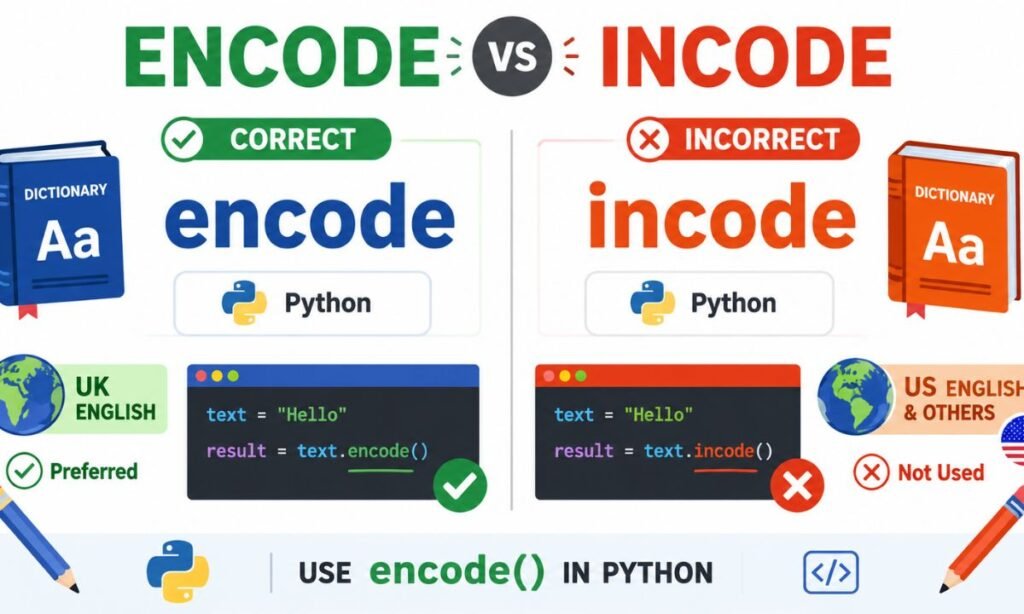
Encode is correct. Incode is not a real English word.
If you wrote “incode” anywhere, replace it with “encode.” There is no debate, no regional variation, and no exception. One word works. The other does not.
What Does Encode Mean? (Clear Definition + Core Idea)
To encode something means to convert it into a specific format using a system of rules. That format could be digital, symbolic, or linguistic.
Think of it this way: when you speak, your brain encodes thoughts into words. When a computer saves a file, it encodes data into binary. The core idea is always the same — you take something and convert it into another form using a defined system.
Encode functions as a verb. Its noun form is encoding, and its past tense is encoded.
What Does Encode Mean in Real Life?
Encoding happens all around you, even when you do not notice it.
- A QR code encodes a URL into a scannable image.
- DNA encodes biological instructions inside living cells.
- A ZIP file encodes data into a compressed format.
- Emojis are encoded characters that your device converts into tiny pictures.
Every time information changes form through a defined rule set, encoding is happening.
Types of Encoding (Essential Knowledge)
Encoding is not one-size-fits-all. Different contexts use different methods.
- Character encoding converts text characters into numeric values (like ASCII or UTF-8).
- Binary encoding represents data as sequences of 0s and 1s.
- Audio/video encoding compresses media files into formats like MP3 or MP4.
- URL encoding replaces special characters with percent-encoded values (a space becomes %20).
- Base64 encoding converts binary data into text-safe strings for transmission.
Each type serves a specific purpose, but all of them follow the same basic principle: take input, apply a rule, produce a new output.
Encode vs Incode Python
If you are searching for how to encode in Python, here is what you actually need.
Python uses the .encode() method on strings, not .incode(). There is no such method as .incode() in Python or any other programming language. Searching for it will return zero results because it simply does not exist.
Here is how encode works in Python:
text = “Hello”
encoded = text.encode(“utf-8”)
print(encoded) # Output: b’Hello’
The .encode() method converts a string into a bytes object using the specified encoding format. UTF-8 is the most common choice. If you type .incode() in Python, you will get an AttributeError immediately.
What Is Incode? (Honest Reality Check)
“Incode” is not a word. It is a misspelling of “encode.”
There is no definition for it. No grammar book includes it. No style guide references it. If you Google it, what comes back is either autocorrected to “encode” or returns results for a software company called Incode Technologies, which is a proper noun, not a common English word.
The word simply does not exist in general use.
Is Incode a Real Word?
No. “Incode” is not found in Merriam-Webster, Oxford, Cambridge, or any major English dictionary.
It appears in one narrow context: as a brand name for a biometric identity company. That is a proper noun, not a vocabulary word. Using “incode” in a sentence instead of “encode” is a spelling error, not a stylistic choice.
Why Do People Confuse Encode vs Incode?
The confusion usually happens for one of three reasons.
Prefix mix-up: English uses both “en” and “in” as prefixes. Words like “inside,” “input,” and “inline” use “in.” So it feels logical that “incode” might also work. It does not.
Typing speed: When writing quickly, fingers sometimes swap the “e” for an “i.” It is a common typo, not a real alternate spelling.
Other “in” words nearby: If you just wrote “inline” or “input” in the same document, your brain might carry the “in” pattern forward. Muscle memory is sneaky like that.
Encode vs Incode Difference (Side-by-Side Breakdown)
| Feature | Encode | Incode |
| Real English word | Yes | No |
| In dictionary | Yes | No |
| Used in programming | Yes | No |
| Correct spelling | Yes | No |
| Valid in formal writing | Yes | No |
| Common usage | Very common | Does not apply |
The table says everything. One word belongs in your writing. The other does not.
Encode vs Incode Grammar (Why Only One Works)
“Encode” follows a standard English word-building pattern. The prefix “en” means “to put into” or “to cause to be.” So “encode” literally means to put something into code.
Other “en” verbs follow the same pattern: encase (put into a case), enable (make able), encrypt (put into cipher). The structure is consistent and recognized.
“Incode” does not follow any recognized English word-formation rule. There is no grammatical basis for its existence. It is not a historical variant, not a dialectal form, and not an archaic spelling. It is simply wrong.
How to Use Encode Correctly in Writing
Use “encode” as a transitive verb. It needs an object.
Correct:
- “The system will encode the message before sending it.”
- “Developers must encode user input to prevent injection attacks.”
- “The file was encoded in UTF-8 format.”
Incorrect:
- “The system will incode the message.” (not a word)
- “Please encode it.” (technically correct but vague — add context)
When writing about the process itself, use the noun encoding: “The encoding process converts raw text into compressed data.”
Can You Use Incode in Any Context?
Only as a proper noun when referring to the company Incode Technologies. In that case, it is capitalized: Incode.
In no other context should you use “incode” as a common English word. It has no definition, no usage history, and no grammatical standing. If you are writing about computer science, linguistics, biology, or communications, the word you need is always encode.
Encoding in Programming (Deep Explanation)
In programming, encoding is one of the most fundamental operations. Before a computer can store, transmit, or display any data, it needs to know what format to use.
When you save a text file, your computer encodes each character as a number. The letter “A” in ASCII is encoded as 65. In UTF-8, it is still 65, but UTF-8 also supports over a million other characters, making it the global standard for web content.
Encoding also matters in security. Encoding is not the same as encryption (more on that shortly), but it is a required first step in many secure data pipelines.
Failing to encode data correctly is one of the most common causes of bugs in web applications, especially when handling non-English characters or special symbols.
Also Read This: Signer vs Signor: What’s the Difference? Meaning, Usage & Examples (2026)
Data Encoding Techniques (Technical Detail)

Different data types need different encoding strategies.
- ASCII handles 128 characters, enough for basic English text.
- UTF-8 handles over 1.1 million characters, covering virtually every human language.
- Base64 encodes binary data as plain text, making it safe to transmit in emails or JSON.
- Huffman encoding compresses data by assigning shorter codes to more frequent characters.
- Run-length encoding (RLE) compresses repeated data by storing the value and its count.
Each technique optimizes for a specific need: storage size, compatibility, speed, or security.
Character Encoding Examples
Character encoding converts text into a machine-readable format.
| Character | ASCII Code | UTF-8 Bytes |
| A | 65 | 0x41 |
| Z | 90 | 0x5A |
| Space | 32 | 0x20 |
| © | Not supported | 0xC2 0xA9 |
| 😊 | Not supported | 0xF0 0x9F 0x98 0x8A |
UTF-8 encodes more than ASCII ever could, which is why it became the dominant standard for all web pages and modern software.
Binary Encoding Explained Simply
Binary encoding is the most foundational layer of computing. Every piece of data, whether it is text, an image, a video, or a program, ultimately gets encoded as a series of 0s and 1s.
The number 5 in binary is 101. The letter “A” in binary is 01000001. A black pixel in an image might be encoded as 00000000, while a white pixel is 11111111.
Binary is the language computers actually speak. Every higher-level encoding system eventually converts down to binary. It is the bedrock underneath everything.
Encode vs Encrypt vs Decode (Important Distinction)
These three terms often get mixed up, but they mean very different things.
Encode converts data into a different format using a publicly known system. Anyone who knows the format can decode it. There is no secret key. The goal is compatibility or efficiency, not privacy.
Encrypt converts data using a secret key. Without the key, the data cannot be read. The goal is privacy and security.
Decode reverses encoding and returns data to its original form.
A useful analogy: encoding is like translating a sentence into Morse code. Anyone with a Morse code chart can read it. Encryption is like a locked safe. Only the person with the key can open it.
Text Encoding vs Encryption
| Feature | Text Encoding | Encryption |
| Purpose | Format conversion | Data protection |
| Reversible | Yes, easily | Only with the key |
| Secret key required | No | Yes |
| Example | UTF-8, Base64 | AES, RSA |
| Security goal | No | Yes |
If you need to protect sensitive data, encryption is what you want. If you need to store or transmit text across systems, encoding is the right tool.
Impact of the Mistake
Writing “incode” instead of “encode” has real consequences in professional contexts.
In technical documentation, it signals that the writer does not understand the subject. In code comments or README files, it raises doubts about reliability. In academic writing, it is marked as an error. In job applications for developer or content roles, it can hurt your credibility.
The fix takes one second. The damage from not fixing it can last much longer.
Common Mistakes to Avoid
Beyond the encode/incode confusion, a few related errors show up often.
- Writing “encode” when you mean “encrypt” (they are not the same).
- Using “encoding” and “compression” interchangeably (compression reduces size; encoding changes format).
- Writing “encoded with” instead of “encoded in” (you encode data in UTF-8, not with UTF-8).
- Forgetting to specify the encoding format, which causes errors when your software encounters unexpected characters.
Each of these is easy to avoid once you understand what encoding actually does.
Why Encode Is the Correct Word
The word “encode” has been in English since at least the early 20th century and became widely used alongside the development of computing and information theory. It comes from the prefix “en” (meaning “into”) and “code” (a system of signals or symbols).
It is listed in every major English dictionary. It appears in technical standards, academic papers, programming documentation, and legal contracts. It is the established, universal term.
“Incode” has none of that history. It never existed as a standard English word and was never accepted into common use.
Context Matters: Where Encode Is Used
“Encode” shows up across a surprisingly wide range of fields.
- Computer science: encoding data for storage or transmission
- Linguistics: the way language encodes meaning into sounds or symbols
- Biology: DNA encoding genetic instructions
- Communications: encoding signals for radio or satellite transmission
- Psychology: the process by which the brain encodes memories
No matter the context, the word is always “encode.” Never “incode.”
Encoding Examples in Real Life
Here are five real-world examples of encoding in action.
- When you send a text message, your phone encodes it into digital packets before transmitting it.
- When you scan a barcode at a grocery store, the scanner decodes information that was encoded into black and white lines.
- When Netflix streams a video, it uses video encoding to compress the file so it loads faster.
- When you fill out a web form and press submit, your browser URL-encodes the input before sending it to the server.
- When scientists store genetic data digitally, they encode DNA sequences as text strings using a four-letter alphabet: A, T, C, and G.
Quick Practice (Lock It In)
Fill in the blank with the correct word. The answer is the same every time.
- “The software will _______ the file before uploading.” → encode
- “Please _______ the message using Base64.” → encode
- “This function _______s the text into UTF-8.” → encode
- “The data was _______d incorrectly, causing display errors.” → encode
If you found yourself writing “incode” in any of those, now you know the fix.
Key Takeaways (Simple and Clear)
- Encode is the correct word. Incode does not exist in English.
- To encode means to convert data or information into a specific format using a defined rule system.
- Encoding is used in programming, biology, communications, and linguistics.
- Encoding is not the same as encrypting. Encoding is about format. Encrypting is about security.
- The .encode() method in Python is real. .incode() does not exist and will cause an error.
- Using “incode” in professional writing is a credibility risk. It is easy to fix.
Final Thoughts
Language is full of words that look like they should exist but do not. “Incode” is one of them. It follows a pattern that feels right, which is exactly why people type it without thinking. But feeling right and being right are two different things.
Encode is the word. It always has been. It works in every context, from Python scripts to psychology papers to biology textbooks.
The next time your fingers reach for “incode,” let them keep going. There is a perfectly good “e” waiting right at the start.
