

If you have ever typed “my teacher tought me” or wondered whether to write “taught” or “thought,” you are not alone. These two words look similar, sound a little alike, and confuse even fluent English speakers. This guide breaks down the difference clearly so you never mix them up again.
Tought or Taught – Quick Answer
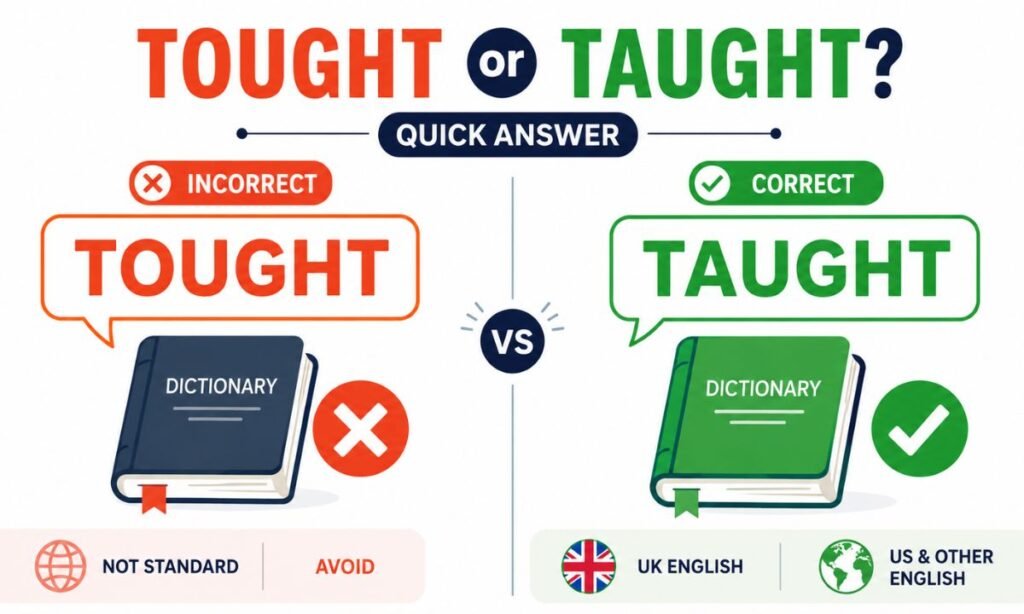
“Tought” is not a real English word. It is simply a misspelling of “taught.” The only correct spellings you need to know are:
- Taught = past tense of teach (to give instruction)
- Thought = past tense of think (to use the mind)
If you meant to write about instruction or education, use taught. If you meant to describe a mental process or belief, use thought.
The Origin of Taught
The word taught comes from Old English tǣhte, which was the past tense of the verb tǣcan (to show, to instruct). As English evolved through Middle English and the Norman period, the spelling settled into “taught,” keeping its irregular past tense form.
This is why “taught” does not follow the standard -ed rule. Instead of “teached,” English kept the older, irregular form: teach → taught.
The word thought has a different Old English root: þōhte, from þencan (to think). Despite both words ending in “-ght,” they come from completely separate verb families.
British English vs American English Spelling
Both taught and thought are spelled and used identically in British and American English. There is no regional variation here. Whether you are writing for a UK audience or a US audience, the rules are the same:
- Past tense of teach = taught (both dialects)
- Past tense of think = thought (both dialects)
The only spelling variation you might encounter is “learnt” vs “learned” (British vs American), but that is a separate discussion entirely.
Which Spelling Should You Use?
Ask yourself one question: What verb are you working with?
| Root Verb | Past Tense | Example |
| teach | taught | She taught French for twenty years. |
| think | thought | He thought the answer was correct. |
Use taught when someone gave knowledge, skill, or instruction to another person.
Use thought when someone had a belief, idea, or mental process.
If you are ever unsure, replace the word with “instructed.” If the sentence still makes sense, use taught. If not, use thought.
Also Read This: Licence or License: Which Spelling Is Correct? Meaning, Usage & Differences (2026)
Taught and Thought Pronunciation
Despite their visual similarity, these two words are pronounced differently.
Taught is pronounced /tɔːt/ — rhymes with caught, bought, and taut.
Thought is pronounced /θɔːt/ — rhymes with sought, brought, and fought.
The key difference is the opening sound:
- Taught begins with a hard /t/ sound
- Thought begins with the soft /θ/ sound (like the “th” in the)
Say them out loud a few times. Once you can hear the difference, mixing them up becomes much harder.
Common Mistakes with Taught
Here are the most frequent errors writers make:
Mistake 1: Writing “tought” instead of “taught” “Tought” does not exist in English. It is always taught.
- Wrong: My father tought me to drive.
- Right: My father taught me to drive.
Mistake 2: Using “thought” instead of “taught” People sometimes swap these because both relate loosely to learning.
- Wrong: She thought me everything I know about cooking.
- Right: She taught me everything I know about cooking.
Mistake 3: Using “taught” instead of “thought” The reverse error also happens.
- Wrong: I taught the meeting was at 3 PM.
- Right: I thought the meeting was at 3 PM.
Mistake 4: Confusing “taught” with “taut” These are homophones — they sound identical. Taut means pulled tight (a taut rope). Taught is the past tense of teach.
Taught or Thought – Past Tense
Both words are irregular past tense forms, which is part of why they cause confusion.
| Base Verb | Simple Past | Past Participle | Example |
| teach | taught | taught | She has taught here for a decade. |
| think | thought | thought | They have thought about it carefully. |
Notice that for both verbs, the simple past and the past participle are the same word. This is typical of irregular verbs in English.
Taught in Everyday Examples
Seeing these words in real sentences is the fastest way to solidify the difference.
Examples with “taught”:
- My grandmother taught me how to bake bread from scratch.
- The professor taught advanced calculus at the university.
- History has taught us that patterns tend to repeat.
- He was taught to always respect his elders.
- Swimming was taught to me at age five.
Examples with “thought”:
- I thought the concert started at seven, not eight.
- She thought deeply about her next career move.
- They thought the project would take a week.
- He was thought to be the best candidate for the role.
- I never thought I would live abroad.
Taught – Google Trends & Usage Insight
According to Google Trends and corpus data, “taught” consistently outperforms “tought” in search volume because users actively search for the correct spelling after making the error. Searches like “is it taught or tought” and “taught vs thought meaning” spike steadily, reflecting how commonly this pair confuses writers globally.
In Google’s Ngram Viewer, “tought” shows virtually zero usage across centuries of English literature, confirming it has never been an accepted spelling. Meanwhile, “taught” maintains steady, high frequency in published works dating back hundreds of years.
This tells us something useful: if you are writing content, using the correct form matters not just for grammar but for credibility and SEO.
Comparison Table: Taught vs Common Confusions
| Word | Part of Speech | Meaning | Example |
| Taught | Verb (past tense of teach) | To have instructed or educated | She taught biology for 10 years. |
| Thought | Verb / Noun (past tense of think) | A mental process or idea | He thought it was Friday. |
| Tought | Not a word | N/A – misspelling of “taught” | Never use this. |
| Taut | Adjective | Pulled tightly; not slack | The rope was pulled taut. |
| Tough | Adjective | Strong, difficult, or resilient | It was a tough exam. |
Conclusion
The difference between taught and thought is straightforward once you connect each word back to its root verb. Taught = past tense of teach (instruction). Thought = past tense of think (mental activity). And “tought”? That one does not belong in your writing at all.
Keep this simple rule handy: if you can replace the word with “instructed,” use taught. If you can replace it with “believed” or “considered,” use thought. With a little practice, this distinction becomes second nature.
