

You typed the word, stopped, stared at it, and suddenly it looked completely wrong. Is it receive or recieve? Both versions seem weirdly convincing for a split second. That moment of spelling doubt has tripped up millions of writers, students, and professionals worldwide. The good news is there is one correct answer, one simple rule, and one trick that makes this spelling stick forever.
The correct spelling is always “receive.” The version “recieve” is always a misspelling, with zero exceptions.
Receive / Recieve – Quick Answer
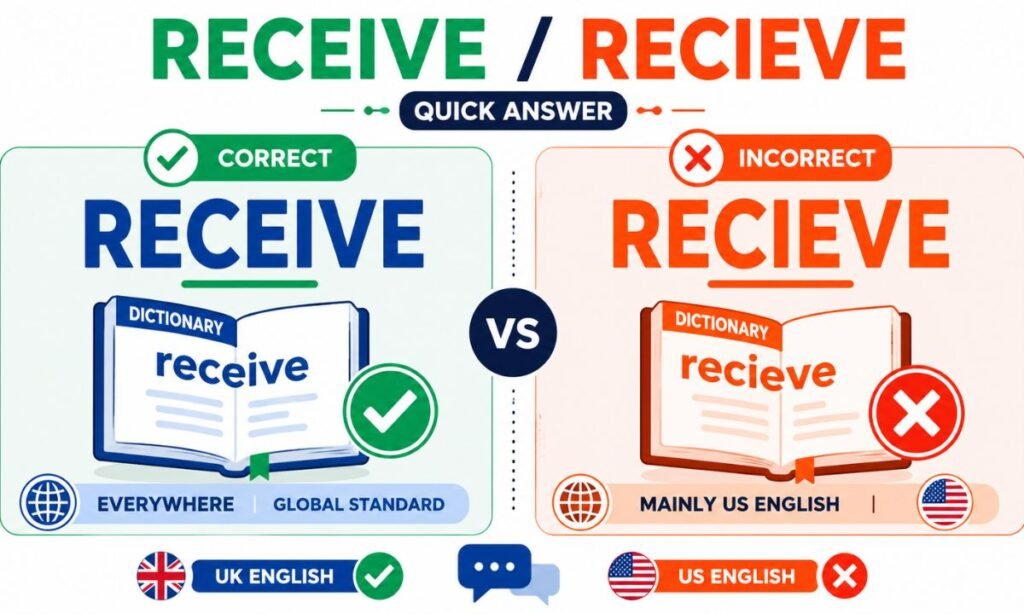
Receive is correct. Recieve is wrong. Always.
The word receive is a verb that means to get, accept, or be given something. You receive a gift. You receive an email. You receive news (good or bad).
The spelling confusion happens because of one tricky vowel pair: ei vs ie. Most people know “I before E” as a default, and their brain auto-fills the “ie” version before the rule kicks in. The fix is simple:
After the letter C, flip the rule. It becomes E before I.
So “receive” is spelled r-e-c-e-i-v-e, with “ei” after the “c.” That is the rule. That is the answer.
The Origin of Receive / Recieve
Words do not just appear out of nowhere, and the origin of receive actually explains its spelling perfectly.
The word entered English around 1300 AD from the Old North French word receivre, meaning “to seize, take hold of, or accept.” That French word came directly from the Latin word recipere, which is built from two parts:
- re = back
- capere = to take
So recipere literally meant “to take back” or “to take in.” Latin also gave us conceive, deceive, and perceive, all of which share the same “-ceive” ending and the same “ei after c” spelling pattern.
When English borrowed recipere through Old French, the “ei after c” vowel pattern came along with it. The spelling has not changed in over 700 years, which is why every dictionary, every grammar guide, and every spell checker agrees: it is receive, not recieve.
Incidentally, the word receipt follows the exact same rule. Both share Latin roots. Both use “ei after c.” Both trip people up for the same reason.
British English vs American English Spelling
Here is something most spelling guides completely skip: does British English spell it differently from American English?
No. Both British and American English spell it receive. This is one of those refreshingly uncomplicated cases where the Atlantic Ocean created zero drama.
While British English prefers colour over color, and realise over realize, the word receive is spelled identically on both sides. The “-ceive” family of words, including deceive, perceive, and conceive, also stay consistent across both dialects.
So whether you are writing an email in New York, a report in London, or a message in Sydney, the spelling is always the same: receive.
Also Read This: Accross vs Across: Which Is the Correct Spelling?
Which Spelling Should You Use?
There is only one answer here: always use “receive.”
No dialect, no informal style, no creative writing convention, and no autocorrect justification makes “recieve” acceptable. It is not a simplified spelling. It is not a regional variant. It is simply a misspelling.
The two tricks that make this stick forever:
Trick 1: The “I before E, except after C” rule This classic mnemonic has been taught in schools for generations. When the “ee” sound follows the letter C, the E always comes before the I. Compare:
- believe (no C before the vowel pair → I before E)
- receive (C before the vowel pair → E before I)
Trick 2: The CEO shortcut Think of the phrase: “The CEO will reCEIve the report.” The letters C, E, I appear in that exact order in both CEO and receive. Once your brain makes that connection, the spelling locks in permanently.
Receive or Recieve Examples
Here are correct examples showing receive in action:
- She will receive her exam results next week.
- Did you receive my message yesterday?
- The charity will receive a large donation.
- He received a standing ovation after the performance.
- We are receiving strong signals from the satellite.
- The president received foreign delegates at the White House.
- I expect to receive a reply within 48 hours.
In every single one of those sentences, swap in “recieve” and it becomes an error. No version of that spelling is ever correct.
Common Mistakes with Receive
Knowing the correct spelling is one thing. Avoiding all the traps around it is another. Here are the most frequent errors writers make with this word:
Misspelling it as “recieve” is the big one, obviously. But there are a few other common slip-ups worth flagging:
- Confusing receive with receipt — These two share the same Latin root and the same “ei after c” pattern, but people sometimes spell receipt as “reciept.” Both words follow the same rule.
- Misspelling related forms — Received, receiving, and receiver all keep the same base spelling. If you know how to spell receive, you know all three.
- Trusting autocorrect blindly — Some older platforms and mobile keyboards have been known to let “recieve” slip through without flagging it. Autocorrect is not foolproof. Your own awareness is more reliable.
- Mixing up the “-ceive” family — After correctly spelling receive, some writers then misspell perceive as percieve or deceive as decieve. The rule applies to all of them equally: E before I after C, every time.
A smart habit: whenever you write a word with the letter C followed by a vowel pair, slow down and double-check. The “cei” cluster is where most people stumble.
Receive in Everyday Examples
The word receive shows up constantly in real-world writing, from casual texts to formal documents. Here is how it naturally appears across different contexts:
Professional settings:
- “Please confirm once you receive the invoice.”
- “The board will receive the quarterly report on Friday.”
Academic writing:
- “Students who complete the program will receive a certificate.”
- “The research team received additional funding in 2025.”
Personal communication:
- “I received your voicemail and will call you back.”
- “She received the best birthday surprise of her life.”
Biblical and historical use: The phrase “Ask, and you shall receive” from the King James Bible is one of the most widely quoted lines in the English language. Across every edition and translation of the Bible published in English, including the King James Version, the New International Version, and others, the word has always been spelled receive. Not once, across centuries of meticulous editorial work, was it spelled recieve. That kind of historical consistency is as strong a confirmation as you can get.
Receive – Google Trends & Usage Data
Interest in the search query “receive or recieve” remains consistently high on Google, particularly among students, non-native English speakers, and professionals proofreading formal documents. It ranks as one of the most commonly searched spelling confusion queries in the English language category.
According to Ginger Software’s misspelling data, roughly 23.4% of people who look up this word initially spell it as “recieve.” That means nearly one in four writers gets it wrong at some point, which is why this query keeps generating search traffic year after year.
The word receive itself also appears in high-frequency vocabulary lists for business English, academic writing, and standardized tests like the IELTS and TOEFL, making correct spelling especially important for learners preparing for formal assessments.
Related words people frequently search alongside receive: receipt, receiving, received, perceive, deceive, conceive, and receiver.
Comparison Table
| Form | Correct Spelling | Common Misspelling |
| Base verb | receive | recieve |
| Past tense | received | recieved |
| Present participle | receiving | recieving |
| Noun (person) | receiver | reciever |
| Related noun | receipt | reciept |
| Related verb | perceive | percieve |
| Related verb | deceive | decieve |
| Related verb | conceive | concieve |
Every word in the left column follows the same rule: E before I after the letter C. Master receive, and you automatically fix your spelling of the entire “-ceive” family.
Conclusion
The spelling debate between receive and recieve ends here, and it ends simply. Receive is the only correct spelling. It has been for over 700 years, across Latin, Old French, Middle English, and every modern English dictionary ever published.
The rule is easy: C flips the default. After the letter C, the E always comes before the I. Once that clicks, the whole “-ceive” family of words, receive, deceive, perceive, conceive, becomes effortless to spell.
Next time that moment of doubt creeps in, remember the CEO trick: “The CEO will reCEIve the report.” Those three letters, C, E, I, appear in that exact order in both words. Lock that in, and you will never second-guess this spelling again.
