

If you have ever typed “todays meeting” or “todays date” and wondered whether that looks right, you are not alone. The confusion between todays and today’s is one of the most common apostrophe mistakes in English. The good news? The rule is simple once you understand it.
This guide breaks it all down with clear examples, usage tables, and quick answers you can apply right away.
Todays or Today’s – Quick Answer
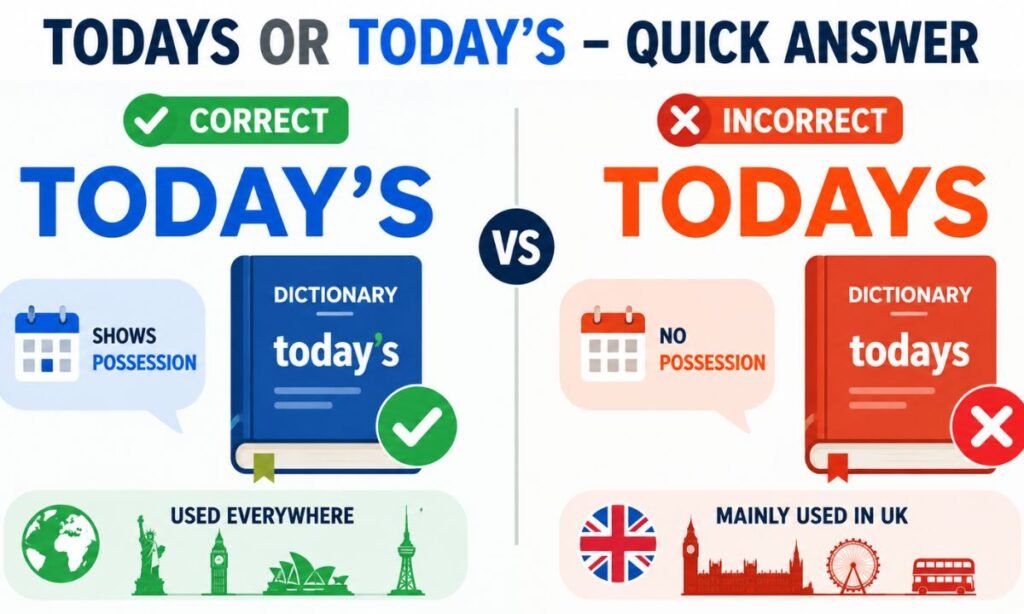
Today’s (with an apostrophe) is almost always the correct form.
The apostrophe in today’s signals possession, meaning something belongs to or is associated with the present day. For example, “today’s agenda” means the agenda that belongs to today.
Todays (without an apostrophe) is technically the plural of “today,” but it is rarely used and is considered incorrect in everyday writing. Since there is only one present day at a time, pluralizing it does not make much practical sense.
Quick rule: If you can replace “today’s” with “of today” and the sentence still reads correctly, you need the apostrophe.
- “Today’s news” = “The news of today” (correct)
- “Todays news” = incorrect in standard usage
The Origin of Todays / Today’s

The word “today” comes from Old English “tō dæġe,” meaning “on [the] day.” Over centuries, as Modern English evolved, the form simplified into the single word we use now.
Because “today” functions as both a noun (referring to the present day) and an adverb (describing when something happens), it can carry a possessive form. Adding ‘s to a noun to show ownership is a standard English grammar rule, and “today” follows the same pattern.
Today or today’s class – which is right? When you say “today class,” there is no grammatical connection between the two words. Using “today’s class” makes the relationship clear: the class that belongs to today. Always use the possessive form when a noun follows.
British English vs American English Spelling
Here is one area where you do not need to worry about regional differences. Both British English and American English follow the same rule for possessive apostrophes.
| Feature | British English | American English |
| Correct form | today’s | today’s |
| Incorrect form | todays | todays |
| Apostrophe rule | Same | Same |
| Contracted form | today’s (= today is) | today’s (= today is) |
There is no spelling variation between the two dialects on this point. Whether you are writing for a UK audience or a US audience, today’s is always correct.
Also Read This: Encode vs Incode: Which Word Is Correct? Meaning, Usage & Examples (2026)
Which Spelling Should You Use?
Use today’s in nearly every situation. Here is a simple breakdown:
Use today’s when:
- Something belongs to the present day (possessive form) – “today’s weather”
- You are contracting “today is” in informal writing – “Today’s a great day”
- You are linking a noun to the current day – “today’s prices,” “today’s schedule”
Use todays only when:
- You are referring to multiple “present days” in a poetic or philosophical sense – “We must cherish our todays”
- It appears in a brand name or stylistic context (very rare)
Today or today’s activity – if you are describing an activity happening on the present day and a noun follows, use today’s. “Today’s activity is a group project.” If “today” is used as an adverb with no following noun, use it without the apostrophe. “We will do the activity today.”
Common Mistakes with Todays / Today’s
These are the errors that appear most often in everyday writing, emails, and social media:
Missing the apostrophe before a noun
- Wrong: Todays meeting has been rescheduled.
- Right: Today’s meeting has been rescheduled.
Adding an apostrophe where it is not needed (adverb use)
- Wrong: I will finish it today’s.
- Right: I will finish it today.
Treating “today” as a regular plural noun
- Wrong: The todays of this week have been exhausting.
- Right: The days this week have been exhausting.
Confusing the contraction with the possessive
- “Today’s the deadline” = Today is the deadline (contraction, correct)
- “Today’s deadline is at 5 PM” = The deadline of today (possessive, correct)
Both uses of the apostrophe are valid; the context tells you which meaning applies.
Todays / Today’s in Everyday Examples

Here are real-world sentences across different contexts to show how today’s is used correctly:
In business writing:
- Please review today’s agenda before the call.
- Today’s market fluctuations are affecting stock prices.
In education:
- Today’s lesson covers apostrophe usage.
- Did you complete today’s assignment?
In journalism:
- Today’s top headlines include a major policy update.
- Today’s report shows a rise in consumer spending.
In casual conversation:
- Today’s the last day to register.
- Have you seen today’s weather forecast?
In social media:
- What is your take on today’s trending topics?
- Today’s episode was the best one yet.
Todays or today’s meeting – the correct phrase is always today’s meeting. The possessive apostrophe connects “meeting” to the current day. “Todays meeting” without an apostrophe is a punctuation error.
Todays or Today’s – Google Trends & Usage Data
Search data consistently shows that people search for “today’s” far more than “todays” in proper writing contexts. The variant without an apostrophe mostly appears in search queries where people accidentally omit punctuation, not in published or formal content.
Grammar checking tools like Grammarly and ProWritingAid flag “todays” as an error in virtually every context except rare plural or branding use cases. Major style guides, including the Chicago Manual of Style and AP Stylebook, confirm that today’s is the standard possessive form.
Todays or today’s meeting – Google autocomplete and search engine data both favor “today’s meeting” as the grammatically standard phrase. The apostrophe-free version appears primarily as a search typo.
Keyword Comparison Table
| Phrase | Correct Form | Usage Type | Example |
| Todays date | Today’s date | Possessive | Today’s date is June 19. |
| Todays meeting | Today’s meeting | Possessive | Today’s meeting is at 3 PM. |
| Todays class | Today’s class | Possessive | Today’s class was canceled. |
| Todays activity | Today’s activity | Possessive | Today’s activity is a quiz. |
| Todays news | Today’s news | Possessive | Today’s news covers the summit. |
| Todays lesson | Today’s lesson | Possessive | Today’s lesson was helpful. |
| Todays schedule | Today’s schedule | Possessive | Check today’s schedule online. |
| Today’s going to be great | Today’s going to be great | Contraction | Informal, today is going to be great. |
Conclusion
The difference between todays and today’s comes down to one small mark: the apostrophe.
Today’s is the correct form in almost every situation. Use it when you want to show that something belongs to the current day (possessive) or when you are shortening “today is” (contraction). Todays without an apostrophe is the plural form of today, which is so rarely needed that using it will almost always read as a mistake.
A quick test: if “of today” fits in the sentence, you need today’s. Apply this to common phrases like today’s meeting, today’s date, today’s class, and today’s schedule, and you will never get it wrong again.
