

Choosing between has and have is one of the most common grammar struggles in English. The good news: the rule is simple once you see the pattern clearly. This guide covers every situation you’ll face — names, questions, negatives, collective nouns, and tricky words like everyone and none — with quick examples you can use right away.
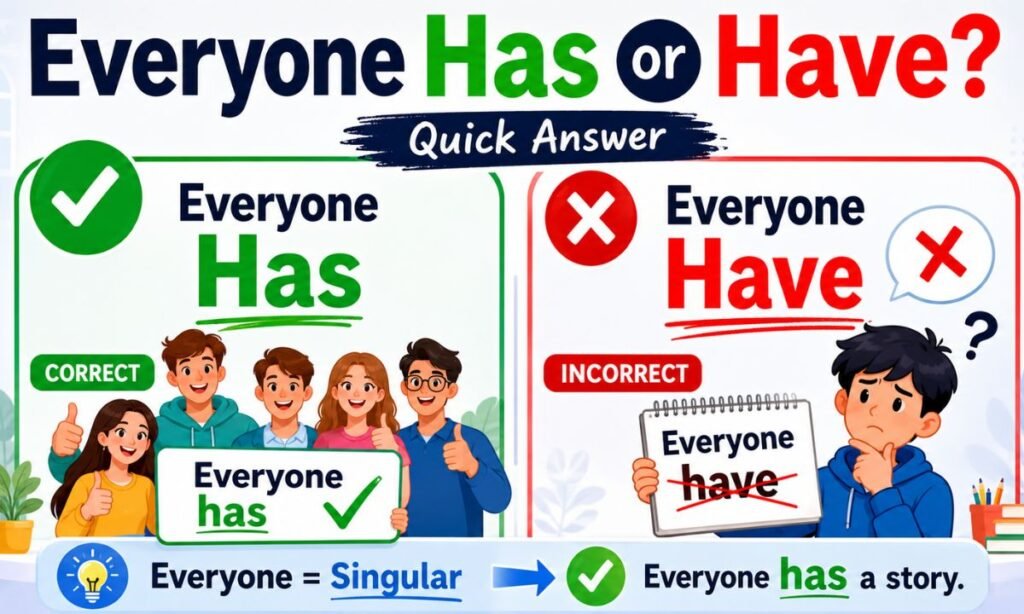
Has or Have: Quick Answer
| Subject | Correct Verb | Example |
| I, You, We, They | have | They have a meeting today. |
| He, She, It | has | She has a meeting today. |
| Singular noun/name | has | Sarah has a new phone. |
| Plural noun | have | The students have homework. |
Simple rule: Use has with singular subjects (he, she, it, one name). Use have with plural subjects and with I/you/we/they.
Grammar Rules Explained
Has and have are both present-tense forms of the verb “to have.” The form changes based on subject-verb agreement:
- Has → third-person singular (he, she, it, or one person/thing)
- Have → first person (I, we), second person (you), third-person plural (they), and all plural nouns
Example: He has a car. vs They have a car. Same meaning, different subject, different verb form.
Why People Make Mistakes With Has or Have
Most errors happen because of these reasons:
- Long subjects — by the time the verb appears, the writer forgets if the subject was singular or plural.
- Collective nouns — words like team or family look singular but feel like a group.
- Indefinite pronouns — words like everyone sound plural but are grammatically singular.
- Translation habits — non-native speakers often translate sentence structure directly from their first language.
- Speed of speech — in casual conversation, people default to have out of habit.
Has or Have in Real Life Usage
In daily conversation and writing, the choice depends entirely on the subject right before the verb, not the overall sentence meaning:
- My brother has two dogs.
- My parents have two dogs.
- The company has a new policy.
- The employees have new contracts.
Has or Have With Name
A proper name follows the same rule as he/she — it’s singular, so use has.
- ✅ Michael has a new laptop.
- ❌ Michael have a new laptop.
If two or more names are joined with “and,” treat them as plural and use have:
- ✅ Michael and Sara have a new laptop.
Has or Have Singular or Plural
| Type | Verb | Example |
| Singular subject | has | The dog has a bone. |
| Plural subject | have | The dogs have bones. |
| Singular + singular (joined by “and”) | have | Tom and Jerry have a show. |
| Either/or, neither/nor (singular) | has | Neither John nor Mary has the key. |
British and American English Usage
The core rule (he/she/it = has, others = have) is identical in both British and American English. The difference appears mainly with collective nouns:
- American English: treats the group as one unit → The team has won.
- British English: often treats the group as individuals → The team have won.
Both are correct in their respective dialects — just stay consistent within one piece of writing.
Has or Have Worksheet
Test yourself with these fill-in-the-blank sentences:
- She ___ a meeting at 5 PM.
- They ___ finished the project.
- The cat ___ green eyes.
- We ___ no time left.
- Everyone ___ a different opinion.
- The children ___ a new teacher.
- He ___ never been to Paris.
- My friends ___ a surprise for me.
Answer key: 1. has 2. have 3. has 4. have 5. has 6. have 7. has 8. have
Which One Should You Use
Ask yourself one question: Is the subject singular (he/she/it/one name) or plural (they/we/multiple names)?
- Singular → has
- Plural or I/you → have
This single check resolves over 90% of has-vs-have confusion.
Common Mistakes and Corrections
| Incorrect | Correct | Why |
| She have a car. | She has a car. | “She” is singular. |
| They has a car. | They have a car. | “They” is plural. |
| He don’t have time. | He doesn’t have time. | Use “doesn’t” with he/she/it. |
| I has a question. | I have a question. | “I” always takes “have.” |
| Everyone have a seat. | Everyone has a seat. | “Everyone” is singular. |
Has or Have in Questions
In questions, the auxiliary verb changes based on the subject, while the main verb stays as “have”:
- Does he have a car? (not “Does he has”)
- Do they have a car?
- Have you finished? (present perfect)
- Has she finished? (present perfect)
Has or Have in Negative Sentences
Negatives follow the same pattern as questions — the auxiliary carries the agreement, not the main verb:
- He doesn’t have time.
- They don’t have time.
- I haven’t seen it. (present perfect)
- She hasn’t seen it. (present perfect)
Has or Have in Present Perfect Tense
Present perfect uses has/have + past participle to describe actions connecting the past to the present.
- He has finished his homework.
- They have finished their homework.
- I have lived here for ten years.
- She has lived here for ten years.
Has or Have With Collective Nouns
Collective nouns (team, family, staff, group, committee) can take either form depending on meaning:
- As one unit: The family has a tradition. (preferred in American English)
- As individuals: The family have different opinions. (common in British English)
Pick one interpretation and stay consistent throughout your writing.
Also Read This: Todays or Today’s: Which One Is Correct? Meaning, Usage & Easy Examples (2026)
Has or Have With Everyone and Everybody
Indefinite pronouns like everyone, everybody, someone, anybody, nobody are grammatically singular, even though they refer to multiple people in meaning.
- ✅ Everyone has arrived.
- ✅ Everybody has a chance to win.
- ❌ Everyone have arrived.
Has or Have With None and Some
These words are trickier because the verb depends on the noun that follows them:
| Word | With singular/uncountable noun | With plural noun |
| None | None of the milk has spilled. | None of the students have arrived. |
| Some | Some of the cake has gone. | Some of the apples have gone. |
Has or Have in Everyday Examples
- I have a headache.
- She has a headache.
- We have plans tonight.
- The boss has approved the leave.
- My sisters have the same birthday.
Common Patterns to Remember
- He, She, It, one name/noun → has
- I, You, We, They, plural nouns → have
- Questions and negatives → auxiliary changes (do/does, don’t/doesn’t), main verb stays have
- Present perfect → has/have + past participle
- Indefinite pronouns (everyone, someone, nobody) → has
Related Grammar Confusions
These follow similar subject-verb agreement logic:
- Is or Are — singular vs plural subjects
- Was or Were — past tense agreement
- Do or Does — auxiliary verb agreement
- This or These — singular vs plural demonstratives
Practice Exercises
Choose the correct word:
- My uncle (has/have) a farm.
- The dogs (has/have) been fed.
- Neither of them (has/have) called.
- You (has/have) a great idea.
- The committee (has/have) decided. (both acceptable depending on meaning)
Has or Have in Professional Communication
In emails and reports, accuracy matters for credibility. Common professional examples:
- The team has completed the deliverables. (unit)
- Our department has updated the policy.
- Management has approved the budget.
Incorrect agreement in professional writing can undermine trust, so always double-check subject and verb before sending.
Has or Have in Academic Writing
Academic style favors formal, consistent agreement, especially with collective nouns treated as singular:
- The research has shown significant results.
- The data has/have been analyzed. (treat “data” as singular in most modern style guides)
- The committee has reviewed the proposal.
Has or Have in Spoken English
Native speakers often use contractions in casual speech:
- I’ve = I have
- She’s = She has
- They’ve = They have
- He’s got = He has (got)
Contractions are appropriate in conversation and informal writing but should be avoided in formal documents.
Memory Tricks
- “He, She, It — Has fits.” All three end in vowel-friendly singular sounds matching “has.”
- Picture HAS = He, She, plus one — a quick visual cue for singular subjects.
- If you can replace the subject with “they” and it still sounds natural, use have.
Conclusion
The has-or-have rule comes down to one simple check: singular subjects take has, plural subjects (and I/you) take have. Special cases like collective nouns, indefinite pronouns, and questions follow predictable patterns once you know what to look for. Keep this guide handy, run through the worksheet occasionally, and the right choice will soon become automatic.
