

If you’ve ever typed “kindergarden” and wondered whether it’s right, you’re not alone. This is one of the most common spelling mistakes in the English language — and the confusion is completely understandable. This guide clears it up once and for all.
Kindergarten or Kindergarden – Quick Answer
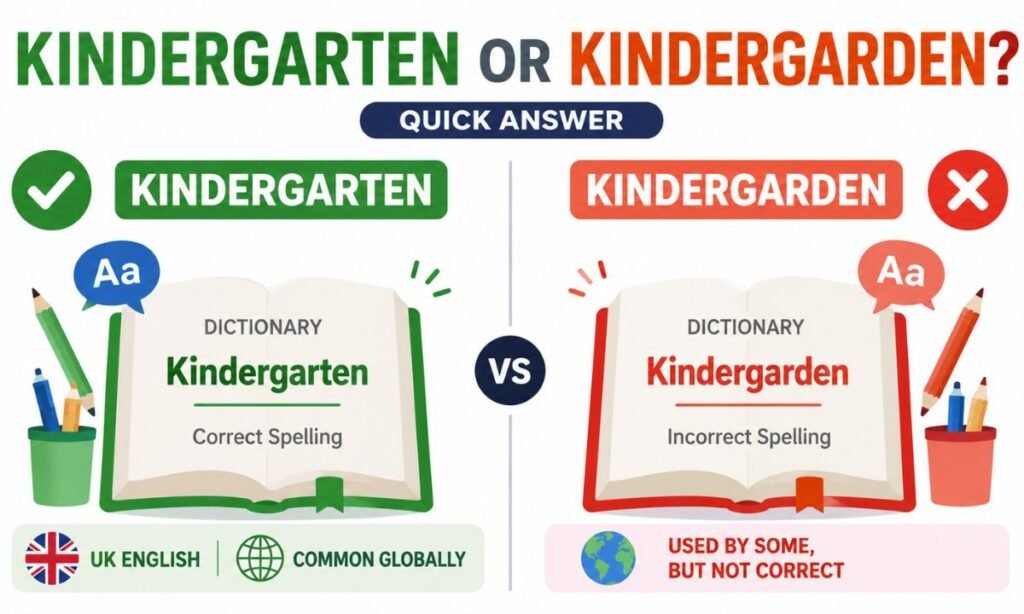
Kindergarten is the only correct spelling. Kindergarden is a misspelling and does not appear in any dictionary — not Merriam-Webster, not Cambridge, not Oxford.
✅ Correct: kindergarten ❌ Incorrect: kindergarden
The reason people get confused is simple: the word sounds like it ends in “garden,” but it actually comes from German — where the correct spelling is Garten, not garden. More on that below.
The Origin of Kindergarten
Understanding why it’s spelled kindergarten (not kindergarden) becomes easy once you know its history.
The word was coined in 1840 by German educator Friedrich Fröbel, who founded the first school for young children in Blankenburg, Germany. He originally called it the Child Nurture and Activity Institute, but later renamed it Kindergarten — a German compound word made of two parts:
- Kinder = children
- Garten = garden
So kindergarten literally means “children’s garden” — a place where young children grow and flourish like plants. Fröbel believed children should be nurtured the same way a gardener tends to plants, which is where this beautiful metaphor came from.
When English adopted the word, it kept the original German spelling intact — including Garten instead of the English garden. That’s why the correct form is kindergarten, with a T, not a D.
British English vs. American English Spelling
A common question is whether British and American English spell it differently, the way they do with words like colour/color or labelling/labeling.
The answer: No. Both use the same spelling.
| Region | Correct Spelling |
| American English | kindergarten |
| British English | kindergarten |
| Australian English | kindergarten |
| Canadian English | kindergarten |
There is no regional variation here. Whether you’re writing for a US school website, a UK nursery brochure, or an Australian parenting blog, the correct word is always kindergarten.
Note: In the UK and Australia, kindergarten sometimes refers to what Americans call nursery school or preschool — the age group differs slightly, but the spelling is always the same.
Which Spelling Should You Use?
Simple: always use kindergarten.
Whether you’re:
- Filling out school enrollment forms
- Writing an email to a teacher
- Publishing a blog post about early childhood education
- Creating a school website or brochure
…the correct, professional spelling is kindergarten. Using kindergarden in formal writing reduces credibility and signals a lack of attention to detail.
Common Mistakes with Kindergarten
Beyond the kindergarden misspelling, here are other common errors people make with this word:
| Wrong Spelling | Correct Spelling |
| kindergarden | kindergarten |
| kindergaten | kindergarten |
| kindegarten | kindergarten |
| kindergarton | kindergarten |
| kindergarten’s (wrong plural) | kindergartens |
According to spelling data, 67.1% of misspellings of this word are kindergarden — making it by far the most common error. The second most common is kindergaten at just 2.5%, which shows how dominant the D-for-T confusion really is.
Kindergarten or Kindergarden Pronunciation
Here’s where the confusion starts. Most English speakers pronounce kindergarten as:
KIN-der-gar-ten or KIN-der-gar-den
Both pronunciations are considered acceptable in spoken English. The “garden” sound is so natural that many speakers naturally gravitate to the D pronunciation — and then assume the spelling follows suit.
It doesn’t.
Pronunciation and spelling can diverge, especially with loanwords from other languages. In this case, English borrowed the word directly from German and kept the German spelling even as the pronunciation adapted.
IPA (International Phonetic Alphabet): /ˈkɪndəˌɡɑːrtən/
The key takeaway: say it however feels natural, but always write it with a T.
Kindergarten in Everyday Examples
Here are correct and incorrect uses in real sentences:
✅ Correct sentences:
- My son starts kindergarten this September.
- She has been a kindergarten teacher for over ten years.
- The school offers both preschool and kindergarten programs.
- Kindergarten admission requirements vary by state.
❌ Incorrect sentences:
- My son starts kindergarden this September.
- She has been a kindergarden teacher for over ten years.
Also Read This: Dammit or Damnit: Which Spelling Is Correct? Meaning, Usage & Examples (2026)
Why Is It Kindergarten and Not Kindergarden?
This question gets searched thousands of times every month, so here’s a direct answer:
Because the word comes from German, not English.
In German, Garten (garden) is spelled with a T. When English borrowed Kindergarten as a loanword in the 19th century, it preserved the original German orthography. Unlike fully anglicized words that adapt to English spelling rules, kindergarten was adopted wholesale — T and all.
Think of it like other German loanwords in English:
- Kindergarten (not kindergarden)
- Gesundheit (not gesundheid)
- Zeitgeist (not zietgeist)
Loanwords retain the spelling of their source language unless English specifically adapts them — and kindergarten never was adapted.
Memory Tips: How to Always Spell It Right
Here are a few reliable mnemonics to lock in the correct spelling:
- Think of the T in Teacher — Every kindergarten has a teacher, and teacher starts with T. So does kindergarten.
- German roots — Remember Garten (German for garden). The G-A-R-T-E-N pattern carries directly into kindergarten.
- Break it down — Kinder + Garten = KinderGarten. Say it as two German words, and the T becomes obvious.
- Kinder chocolate — The popular Kinder chocolate brand is named for the German word for children. It’s spelled Kinder, not Kinder-d. Same logic applies.
Google Trends & Usage Data

Search data confirms that kindergarten dominates global usage:
| Term | Search Volume | Usage |
| kindergarten | Very high | Correct spelling — universal usage |
| kindergarden | Low | Almost always misspelling searches |
| kindergarten meaning | High | People looking for definitions |
| how to spell kindergarten | Moderate | Spelling confirmation searches |
People searching for “what is kindergarden” are almost always looking for the correct spelling of kindergarten — not a separate concept. There is no word called kindergarden.
Comparison Table – Keyword Variations
| Keyword Variation | Correct? | Notes |
| kindergarten | ✅ Yes | Always correct |
| kindergarden | ❌ No | Common misspelling |
| kindergartens | ✅ Yes | Correct plural form |
| kindergartener | ✅ Yes | A child attending kindergarten |
| kindergarten teacher | ✅ Yes | Correct compound noun |
| kindergarden teacher | ❌ No | Incorrect — avoid in all writing |
| pre-kindergarten | ✅ Yes | Hyphenated; refers to pre-K programs |
| kindergarten age | ✅ Yes | Typically 5–6 years old |
Conclusion
The answer is clear: kindergarten is always correct, and kindergarden is always a mistake. The word comes from German — Kinder (children) + Garten (garden) — and English kept the original spelling when borrowing it in the 19th century.
There’s no British vs. American distinction here. No regional variation. No alternative form. Just one right answer: kindergarten, with a T.
Next time you write it, remember: every kindergarten has a Teacher — and so does the word itself.
