

If you have ever typed this word and paused mid-sentence wondering which spelling is right, you are not alone. “Dammit” and “damnit” look almost identical, but only one of them is correct. This guide clears up the confusion once and for all, with real examples, etymology, and usage tips.
Dammit or Damnit: Quick Answer
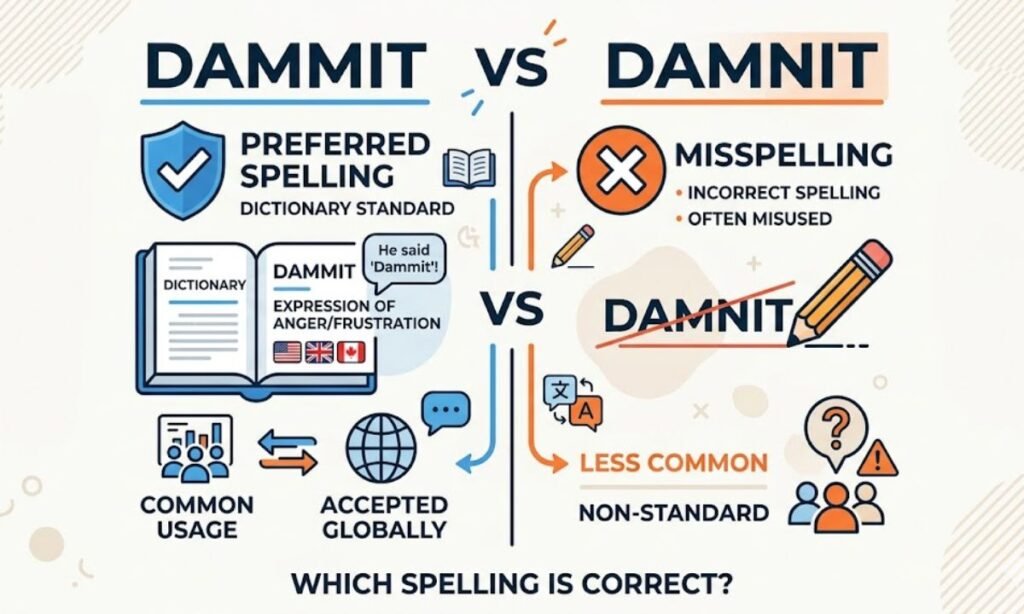
Dammit is the correct spelling. It is the widely accepted, dictionary-recognized form of the informal interjection derived from “damn it.”
Damnit is a common misspelling. While people use it in casual texts and social media, it is not recognized by Merriam-Webster, the Oxford English Dictionary, or any major style guide. If spelling accuracy matters even a little, dammit is always the right choice.
One-line rule: When “damn” and “it” merge into a single word, the N drops and the M doubles. Damn + it = dammit, not damnit.
The Origin of Dammit
The word “damn” traces back to the Latin damnare, meaning “to condemn” or “to cause loss.” It moved through Old French into Middle English, where it carried heavy religious weight, referring to divine punishment or spiritual condemnation.
Over time, the word lost much of its gravity and became a mild expletive used in everyday speech.
“Dammit” emerged in the mid-19th century as a phonetic contraction of “damn it.” As written communication expanded through the 20th century, and especially after text messaging became common, the one-word spelling caught on fast. It was simply quicker to type, and it matched how people actually said the phrase out loud.
The Oxford English Dictionary records “dammit” as an alteration of “damn it,” solidifying its status as a legitimate entry in the English lexicon.
British English vs American English Spelling
One common source of confusion is whether dammit or damn it is preferred by region.
| Variety | Preferred Form | Notes |
| American English | dammit | One word, widely accepted in casual writing |
| British English | damn it | Two words, seen as more formal |
| International English | dammit | Growing preference due to American media influence |
British English speakers have historically preferred the two-word form “damn it” because “dammit” was viewed as a colloquial Americanism. However, as American English continues to shape global usage through film, social media, and digital content, “dammit” has become broadly understood and accepted across all English-speaking regions.
Damnit is not a recognized spelling in either variety.
Which Spelling Should You Use?
Here is a straightforward breakdown based on context:
Use “dammit” when:
- Writing dialogue in fiction or creative writing
- Texting, messaging, or posting on social media
- Writing a casual blog post or informal email
- Expressing frustration in a conversational tone
Use “damn it” when:
- You want to add extra emphasis by separating the words
- Writing a script or dramatic piece where each word needs weight
- You prefer a slightly more formal presentation of the same emotion
Avoid “damnit” in all situations. It is not in any major dictionary and can make your writing look careless, even in informal settings.
Also Read This: Weird or Wierd: Which Spelling Is Correct? Meaning, Rules & Examples (2026 Guide)
Is Dammit a Bad Word?
Technically, yes. Dammit is a mild expletive, which means it is a word used to express strong emotion, usually frustration or irritation.
That said, it sits at the lower end of the profanity scale. It is nowhere near the strongest words in English, and most adults use it casually without much thought.
Where it is generally acceptable:
- Casual conversations with friends or family
- Fiction writing and dialogue
- Informal blogs, social posts, or texts
- Comedy writing
Where to avoid it:
- Professional emails and business communication
- Academic writing or school assignments
- Public-facing formal content
- Any setting where your audience includes children
A softer alternative is “darn it,” which carries the same emotional meaning with none of the edge.
Common Mistakes with Dammit or Damnit
Even native English speakers make these errors regularly.
Mistake 1: Writing “damnit” instead of “dammit” This is the most common error. Because people see the root word “damn,” they instinctively want to keep the N. But when the two words merge phonetically, the N disappears and the M doubles.
Mistake 2: Confusing “dammit” with “damn it” These are not the same in tone. “Damn it” (two words) carries slightly more emphasis and feels more deliberate. “Dammit” (one word) feels faster and more casual. Neither is wrong; they just serve different moments.
Mistake 3: Overusing it in writing Like any expletive, dammit loses impact when it appears too often. Use it sparingly for maximum effect.
Mistake 4: Using it in formal or professional contexts Even if the spelling is perfect, the wrong context for this word can hurt your credibility. Save it for creative or casual writing.
Dammit or Damnit in Everyday Examples
Expressing Frustration
- Dammit, I left my phone at home again.
- She slammed the car door and muttered, “Dammit.”
- He missed the train by thirty seconds. “Dammit!”
In Dialogue (Fiction Writing)
- “Dammit, James, I told you to check the locks!”
- “I love you, dammit,” she said, her voice breaking.
- “Dammit,” the detective whispered, staring at the empty room.
Showing Resolve or Emphasis
- I am going to finish this project on time, dammit.
- We deserve better service, dammit.
- She stood her ground. “I’m staying, dammit.”
Casual Texting Style
- Just spilled coffee all over my laptop. Dammit.
- Dammit, forgot to set an alarm again.
- Dammit! The game was today, not tomorrow.
Dammit or Damnit: Google Trends & Usage Data

Search data and historical usage both confirm that “dammit” dominates over “damnit.”
According to Google Ngram data, “damn it” has been the most popular written form since the mid-20th century, but “dammit” as a single word has been steadily growing in usage since the 1980s. The rise of text messaging in the 2000s accelerated this trend significantly.
Google Trends consistently shows higher search volume for “dammit” compared to “damnit,” which further reflects that “dammit” is the spelling most people recognize as correct.
“Damnit” does appear in searches, but often because users are trying to check whether it is right (it is not).
Comparison Table: Dammit vs Damnit vs Damn It
| Feature | Dammit | Damnit | Damn It |
| Correct spelling | Yes | No | Yes |
| Dictionary recognized | Yes (Merriam-Webster, OED) | No | Yes |
| Number of words | One word | One word | Two words |
| Tone | Casual, conversational | N/A (misspelling) | Emphatic, slightly formal |
| Use in fiction | Recommended | Avoid | Acceptable |
| Formal writing | Avoid | Avoid | Avoid |
| American English preference | High | Not used | Moderate |
| British English preference | Moderate | Not used | High |
Conclusion
The answer is simple: dammit is the correct spelling, full stop. It is dictionary-approved, phonetically logical, and widely accepted in casual and creative writing.
Damnit is a misspelling that looks plausible because of the root word “damn,” but it has no standing in standard English. Avoid it in all writing, even informal messages, if you want to look polished.
When you need emphasis and two words feel right, “damn it” is also perfectly acceptable. But between dammit and damnit, there is no contest. Stick with dammit and move on, dammit.
