

If you’ve ever paused mid-sentence wondering whether to write modeling or modelling, you’re not alone. Both spellings are correct — the difference comes down to American English vs. British English, not right vs. wrong. This guide breaks down the origin, the spelling rule behind it, and how to use the correct form in fashion, finance, data science, and everyday writing.
Modeling or Modelling – Quick Answer
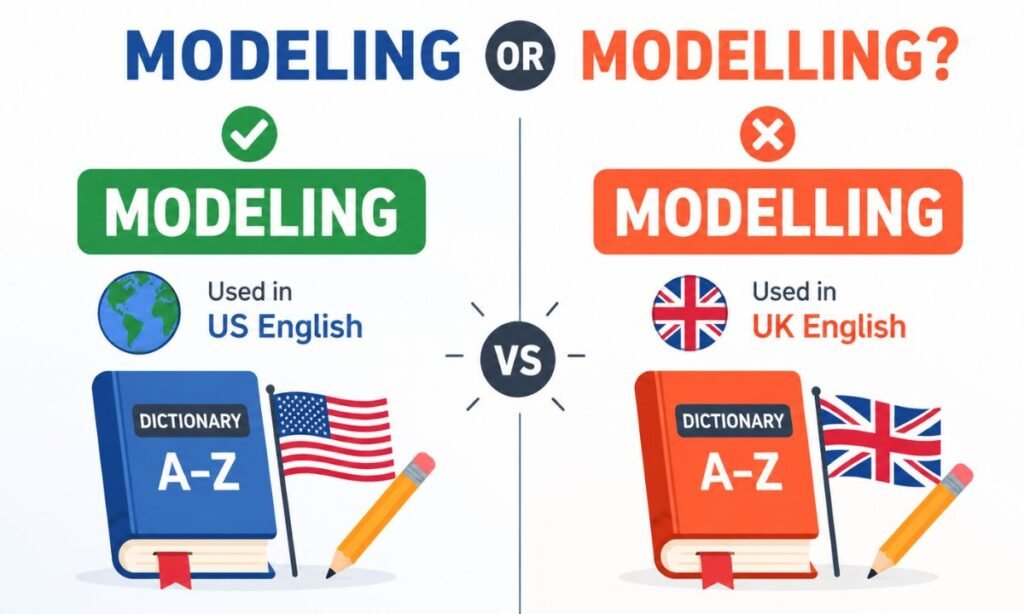
- Modeling (one “L”) = American English spelling
- Modelling (two “L”s) = British English spelling
- Both come from the verb “model” and mean the same thing
- Pick one spelling based on your audience and stay consistent throughout your document
- The same rule applies to related words: labeling/labelling, traveling/travelling, canceled/cancelled
| Spelling | Region | Example |
| Modeling | United States | She is modeling for a major brand. |
| Modelling | UK, Australia, Canada, New Zealand | She is modelling for a major brand. |
The Origin of Modeling / Modelling
Both words stem from the base verb “model,” which means to create a representation of something, shape a material, or display clothing/products. Adding “-ing” turns it into a present participle or gerund — but English spelling rules split here.
- British English follows the consonant-doubling rule: when a verb ends in a single vowel + consonant, the final consonant is doubled before “-ing,” regardless of stress. That gives us modelling.
- American English applies a stricter rule: the consonant is doubled only if the final syllable is stressed. Since “mo-del” is stressed on the first syllable, no doubling occurs — giving us modeling.
This same spelling pattern explains other word pairs like traveling/travelling and labeling/labelling, so once you understand the rule, it applies across many similar verbs.
British English vs American English Spelling
Spelling variation between British and American English isn’t random — it traces back to 19th-century dictionary standardization, particularly Noah Webster’s push to simplify American spelling.
| Feature | American English | British English |
| Spelling | modeling | modelling |
| Past tense | modeled | modelled |
| Noun (person) | modeler | modeller |
| Consonant doubling | Only on stressed syllables | Always doubled regardless of stress |
| Common in | US, Philippines | UK, Canada, Australia, New Zealand, India |
Canadian English typically leans British here, so modelling is more common in Canada despite Canada generally blending both spelling systems.
Modeling or Modelling Fashion
In the fashion and entertainment industry, this word appears constantly — runway shows, photoshoots, brand campaigns, and talent agencies all use it.
- US fashion publications: “She started her modeling career at age 16.”
- UK/Australian fashion publications: “She started her modelling career at age 16.”
Whether you’re writing about runway modeling, commercial modeling, or a modeling agency, the spelling should match the regional audience of your publication. Global fashion brands often pick one spelling for brand consistency, regardless of where individual readers are based.
Which Spelling Should You Use?
Choosing the right spelling depends on three factors:
- Your audience’s location — US readers expect “modeling,” UK/Commonwealth readers expect “modelling”
- Your style guide — many companies and publications mandate one spelling for consistency
- Your platform — academic, corporate, or SEO content should match the dominant English variant of the target market
| If you’re writing for… | Use this spelling |
| US-based audience or clients | Modeling |
| UK, Australian, Canadian, or Indian audience | Modelling |
| Global/mixed audience | Pick one and stay consistent site-wide |
| Academic papers (US journals) | Modeling |
| Academic papers (UK journals) | Modelling |
Financial Modeling or Modelling

In business and finance, this term refers to building a mathematical representation of a company’s performance — used in valuation, forecasting, and investment analysis.
- American usage: “The analyst built a financial modeling spreadsheet to forecast revenue.”
- British usage: “The analyst built a financial modelling spreadsheet to forecast revenue.”
Common related terms include predictive modeling, risk modeling, valuation modeling, and financial forecasting — all of which follow the same regional spelling pattern. Since most global finance content (Wall Street, investment banking) defaults to American English, financial modeling is the more widely used spelling in business contexts worldwide.
Common Mistakes with Modeling / Modelling
Even experienced writers slip up. Here are the most frequent errors:
- Mixing spellings in one document — using “modeling” in paragraph one and “modelling” in paragraph three
- Inconsistent past tense — writing “modeled” with the American present form but “modelling” elsewhere
- Wrong noun form — “modeler” vs. “modeller” should match your chosen spelling system
- Assuming one spelling is “incorrect” — both are grammatically valid; the issue is only consistency
- Ignoring brand or publication style guides — always check house style before publishing content
Also Read This: Pricy or Pricey: Which Spelling Is Correct? (2026 Guide)
Modeling or Modelling in Data Science
In tech and analytics, this word describes building algorithms, statistical structures, or simulations to represent real-world systems.
- Examples: data modeling, predictive modeling, machine learning modeling, statistical modeling, 3D modeling, climate modeling
- US tech companies and documentation (Python, AWS, Google Cloud) almost universally use modeling
- UK and European tech publications often use modelling
| Field | Common Term (US) | Common Term (UK) |
| Data Science | Predictive modeling | Predictive modelling |
| Engineering | 3D modeling | 3D modelling |
| Climate Research | Climate modeling | Climate modelling |
| Statistics | Statistical modeling | Statistical modelling |
Since most global tech documentation and coding frameworks originate from US companies, modeling is the dominant spelling in the data science and software industry — even outside the US.
Modeling / Modelling in Everyday Examples
Here’s how the word naturally appears in different contexts:
- The teacher is modeling/modelling good behavior for the students.
- Scientists use climate modeling/modelling to study global warming.
- He works as a freelance model, doing print and runway modeling/modelling.
- The architect created a 3D modeling/modelling of the building.
- She modeled/modelled the new spring collection at the show.
Notice that the meaning never changes — only the spelling shifts based on regional English.
Modeling or Modelling – Google Trends & Usage Data
Search behavior tends to mirror regional spelling habits:
- “Modeling” sees significantly higher search volume overall, largely driven by the size of the US audience and the dominance of American tech and business content online.
- “Modelling” remains the standard search term across the UK, Australia, Canada, and other Commonwealth nations.
- Global content platforms (especially in finance, data science, and SEO writing) skew toward modeling because most authoritative sources originate from American publishers.
If your content targets a global audience but most of your traffic comes from the US, modeling is generally the safer SEO choice for ranking visibility.
Keyword Comparison Table
| Keyword | Spelling Type | Region | Industry Use |
| Modeling agency | American | US | Fashion |
| Modelling agency | British | UK/AUS | Fashion |
| Financial modeling | American | Global business | Finance |
| Data modeling | American | Global tech | Data Science |
| Climate modelling | British | UK research | Science |
| Role modeling | American | US | Behavior/Education |
| 3D modelling software | British | UK/AUS | Design/Engineering |
Conclusion
Modeling and modelling are simply two correct spellings of the same word, split by American and British English conventions. There’s no grammar mistake here — only a regional preference.
The key takeaway: identify your audience, choose one spelling, and apply it consistently across your writing, whether you’re covering fashion, finance, data science, or everyday topics. Once you lock in the right version for your readers, you’ll never second-guess this spelling again.
