



You’re scrolling through your messages and someone just sent you “HU.” You stare at it for a second. Is this a typo? A name? Some new slang I missed? Don’t worry — you’re not alone. This two-letter combo confuses a surprising number of people, and the reason is simple: it means different things depending on where and how it’s used.
Let’s break it all down, clearly and honestly.
The Core Meaning: What “HU” Actually Stands For in Everyday Texting
At its most basic, “HU” stands for “Hook Up” in casual digital conversations. When someone texts you “HU,” they’re typically asking if you want to meet up, hang out, or — depending on the relationship and context — something more intimate.
It’s shorthand. People use it because it’s fast, low-effort, and somewhat vague by design. That vagueness is kind of the point.
Here’s the thing though: the meaning shifts dramatically based on who is sending it, where you’re reading it, and what platform you’re on. So context isn’t just helpful — it’s everything.
Where It Came From: The Rise of Two-Letter Texting Slang
Before smartphones, text messages cost money per character. People got creative with abbreviations — and that habit stuck even after unlimited texting became the norm. “HU” emerged from the same wave that gave us “lol,” “brb,” and “tbh.”
The term “hook up” itself has roots in American English slang dating back decades. But its digital shortening — “HU” — became more widespread in the early 2010s as dating apps, group chats, and social media DMs turned casual communication into an art form of speed and ambiguity.
By the mid-2010s, platforms like Snapchat, Instagram DMs, and early versions of Tinder had created an entirely new language around meeting people casually. “HU” fit perfectly into that ecosystem.
How “HU” Shows Up Differently Across Platforms
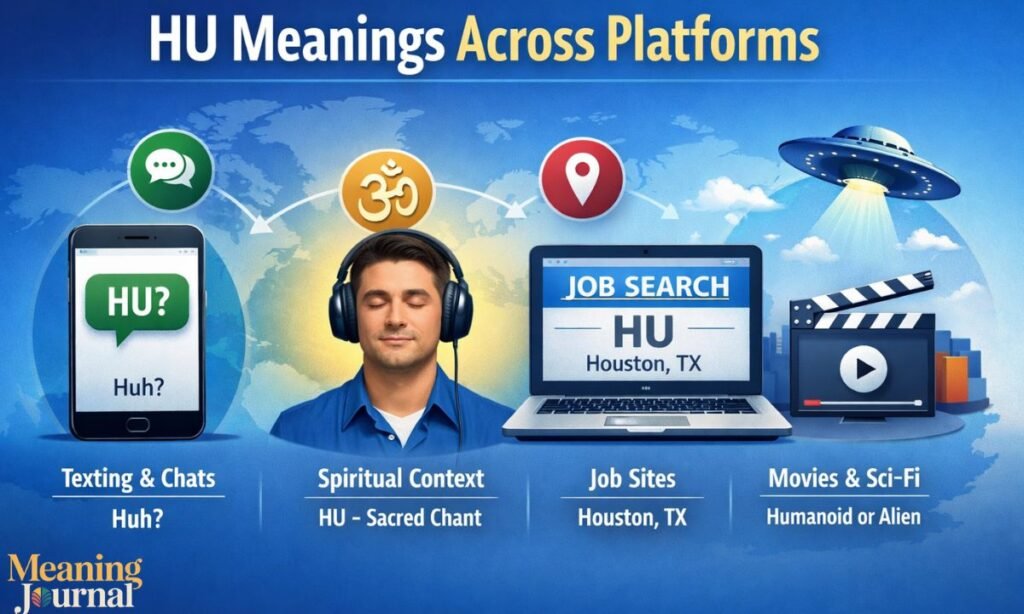
This is where it gets genuinely interesting. The same two letters carry different weight on different platforms:
On Dating Apps (Tinder, Bumble, Hinge): Here, “HU” almost exclusively means “hook up” in the romantic or physical sense. If someone matches with you and opens with “HU?” — they’re being direct about their intentions. No mystery there.
On Snapchat or Instagram DMs: It can still mean hook up, but it’s often used more loosely — sometimes just meaning “hang out” between friends. The tone of the conversation leading up to it matters a lot.
In Gaming Communities and Discord Servers: “HU” sometimes appears as shorthand for “heads up” — a warning to teammates about an incoming threat or important information. Completely different meaning, same letters.
In Formal or Academic Settings: You might see “HU” as an abbreviation for Howard University or Humboldt University — both well-known institutions that use “HU” officially in documents, sports coverage, and email domains.
So if your professor writes “HU conference next week,” they’re definitely not asking you to hook up.
What It Means When a Guy Texts You “HU”

Let’s get specific, because this is one of the most searched questions on the topic — and for good reason.
When a guy texts “HU,” it usually falls into one of three categories:
1. He’s interested, and being casual about it. Guys who text “HU?” are often testing the waters. It’s low-commitment phrasing — if you respond positively, great. If not, it’s easy to brush off. Think of it as a digital shoulder tap.
2. He means it literally — hang out, no pressure. Sometimes it really is just about hanging out. Friends use this abbreviation too. Don’t automatically assume there’s a romantic angle; look at the full conversation history and your existing relationship.
3. He’s using it on multiple people. On dating apps especially, “HU” can be a broadcast-style message. It’s quick to send to many people at once. This doesn’t mean it’s always disingenuous, but it’s worth being aware of.
The honest truth? Ask for clarification if you’re unsure. A simple “What do you mean by that?” gives them the chance to be more direct — and gives you real information to work with.
“HU” vs. Similar Terms: Clearing Up the Confusion
People often mix “HU” up with a handful of similar abbreviations. Here’s a quick comparison to keep things straight:
| Term | Meaning | Common Context |
| HU | Hook Up / Hang Out | Texting, Dating Apps |
| HMU | Hit Me Up | Social Media, Texting |
| WYD | What You Doing? | Casual Texting |
| DTF | Down to F*** | Dating Apps (explicit) |
| LMK | Let Me Know | General Messaging |
Notice how “HMU” (Hit Me Up) is often used in similar situations — it’s an open invitation. “WYD” is more of a conversation starter. “HU” sits somewhere between them: more direct than WYD, less explicit than DTF.
If someone says “HMU if you wanna HU,” they’re essentially saying “reach out if you’re interested in hooking up.” It’s a very common combination you’ll see on Snapchat stories and Instagram bios.
The “HU” Meaning Within Human Context (What Does ‘hu’ Mean in Human?)
This is a slightly different angle that deserves its own space.
In linguistics and informal writing, people sometimes write “hu” as a shortened version of “human.” You’ll see this in tech communities, AI discussions, and even casual blog writing — especially when contrasting humans with bots, AI, or machines.
Example: “Is this account a bot or an actual hu?”
It’s niche, but it’s real. Online spaces that discuss artificial intelligence, roleplaying games, or sci-fi topics use “hu” this way more often than you might expect. It’s not mainstream slang — it’s more of a community-specific shorthand — but it’s worth knowing.
A Moment People Don’t Talk About: The Emotional Weight Behind “HU”
Here’s the section you won’t find on most websites covering this topic — and honestly, it’s the most important one.
The way “HU” is used reveals a lot about modern communication culture. It’s part of a broader pattern of intentional vagueness in digital interactions. People use abbreviated, ambiguous messages because they lower the emotional risk of rejection.
Think about it: texting “HU?” is far less vulnerable than texting “I like you and want to spend time with you.” If the other person says no, or doesn’t respond, you can always claim it was casual — “oh I just meant hang out.”
This ambiguity protects feelings, but it also creates misunderstandings. Someone might interpret “HU” as romantic interest when the sender meant it platonically, or vice versa. It’s one reason why relationship coaches and communication experts increasingly encourage people to be more direct — even in text — especially when intentions matter.
So while “HU” is simple on the surface, it’s actually a small window into how people navigate vulnerability and connection in the digital age.
Common Mistakes and Misconceptions About “HU”
Mistake #1: Assuming it’s always sexual. Not every “HU” is about intimacy. Between close friends, it’s often just shorthand for hanging out. Context matters enormously here.
Mistake #2: Confusing it with “huh.” “Huh” is an expression of confusion or surprise. “HU” is an abbreviation. They’re written differently and mean completely different things — but autocorrect sometimes blurs the line.
Mistake #3: Thinking it’s outdated slang. Some people assume short-form texting slang is dying out. Actually, abbreviations like “HU” are still widely used, especially among Gen Z users on Snapchat and TikTok’s comment sections.
Mistake #4: Ignoring platform context. Reading “HU” in a Discord gaming server and reading it in a late-night DM from someone you matched with on a dating app are entirely different experiences. Don’t assume one meaning fits all situations.
How to Respond to “HU” — Practical Advice That Actually Helps
Getting this message and not sure what to say? Here are some genuine approaches depending on your situation:
If you’re interested and the feeling seems mutual: Keep it simple. “Sure, when?” or “Yeah, what are you thinking?” moves the conversation forward without overcomplicating things.
If you’re unsure what they mean: Ask directly. “Do you mean hang out or something more?” It sounds bold, but it saves a lot of confusion later. Most people actually appreciate the directness.
If you’re not interested: “Not really feeling it right now, but thanks” is honest and kind. You don’t owe anyone an explanation, but a clear response prevents follow-up messages.
If it came from a close friend: Probably just respond normally — “Sure, what time?” unless you have reason to think there’s something more behind it.
The golden rule: match your response energy to what you actually want, not to what you think they want to hear.
Relevance in Online Dating Culture and App Conversations
Dating apps have reshaped the vocabulary of romantic interest entirely. “HU” exists comfortably in a landscape where brevity signals confidence and long messages can feel overwhelming on a first message.
On apps like Tinder and Bumble, users often develop their own shorthand quickly. “HU” is particularly common in opener messages or as a follow-up after a few exchanges. It’s casual enough to not feel like a big commitment, but clear enough to signal intent.
Interestingly, research into digital communication patterns shows that ambiguous openers tend to get more responses than overly direct ones — which explains why “HU?” has staying power. It creates a low-friction entry point for conversation.
That said, the dating landscape is shifting. Many users — especially on apps like Hinge, which is marketed around genuine connection — report preferring more personalized openers. So while “HU” works in some spaces, it might fall flat in others.
How Popular Is “HU” Right Now? Trends Worth Knowing
Search interest in “HU meaning in text” has remained consistently high since around 2015, with spikes typically correlating with the rise and mainstream adoption of new social platforms.
Google Trends data shows that searches for “what does HU mean” peak particularly among users aged 16–30 — which tracks with the demographic most active on Snapchat, Instagram, and dating apps.
On TikTok, short videos explaining texting slang have millions of views, and “HU” appears regularly in comment sections and reaction videos. It’s become part of the broader internet literacy that younger users absorb almost automatically — but older users and newcomers to digital spaces often find genuinely confusing.
The abbreviation isn’t going anywhere. If anything, as texting culture continues to influence even workplace communication and social media captions, short-form slang like “HU” is likely to evolve rather than disappear.
FAQ’s
Does “HU” always mean hook up?
No. It can mean hang out, heads up (in gaming), or refer to a university abbreviation like Howard University. Context determines the meaning.
Is “HU” appropriate to use with someone you just met?
It depends entirely on the context and your relationship’s tone. On a dating app where the conversation is already flirty, possibly yes. In a professional or neutral setting, it could come across as presumptuous.
What’s the difference between “HU” and “HMU”?
“HMU” (Hit Me Up) is an open invitation for someone to contact you. “HU” (Hook Up/Hang Out) is a direct question about meeting or spending time together. HMU is passive; HU is active.
Can “HU” be used in a friendly, non-romantic way?
Absolutely. Among close friends, “HU tonight?” often just means “want to hang out tonight?” without any romantic implication at all.
Why do people use abbreviations like HU instead of just saying what they mean?
Speed is part of it, but the bigger reason is emotional safety. Abbreviated, vague language reduces the perceived risk of rejection in social interactions — a very human behavior adapted to digital communication.
Key Insights Before You Go
“HU” is one of those small pieces of internet language that carries more complexity than its two letters suggest. It can mean hook up, hang out, heads up, or even shorthand for “human” — all depending on where you are and who’s sending it.
The most important takeaway: never assume. Read the room, consider the platform, and when in doubt, ask. Clear communication is always more valuable than clever shorthand, especially when feelings or expectations are involved.
And if you’re on the sending end of an “HU” — consider whether the abbreviation is actually serving you. Sometimes saying what you mean directly gets you further than leaving someone guessing.
Language evolves, slang shifts, and digital communication keeps reinventing itself. But the need for genuine human connection — with or without the “human” spelled out — stays constant.
