

You’ve probably seen it dozens of times without even thinking about it. Someone texts you “omg ppl are so annoying today” or you scroll through Instagram and see “why do ppl always do this??” — and you just… get it. But here’s the thing: PPL means a lot more than just “people.”
Depending on where you see it — a gym post, a business contract, a physics textbook, or a TikTok comment — PPL can stand for something entirely different. And if you’ve ever been confused or curious, you’re not alone.
This guide breaks it all down, from the casual slang definition to the surprisingly technical ones.
So What Does PPL Actually Mean?
At its most basic level, PPL is an abbreviation for “people.” That’s the version most of us use every day in texts, tweets, and social media comments. It’s a shorthand born out of the internet age — fast to type, easy to read, and universally understood across platforms.
But “people” is just the beginning.
PPL is what linguists would call a polysemous abbreviation — one acronym with multiple distinct meanings depending on the field or context. Think of it like the word “bark.” Same spelling, completely different meanings depending on whether you’re in a forest or at a dog park.
Here’s a quick snapshot of what PPL stands for across different domains:
| Context | PPL Stands For |
| Texting / Social Media | People |
| Aviation | Private Pilot Licence |
| Business / Marketing | Pay Per Lead |
| Physics | Photopolarimetry |
| Medical | Pars Plana Laminotomy |
| Gym / Fitness | Push Pull Legs |
| Music / Entertainment | Plays (streams) |
PPL in Everyday Texting and Social Media
Let’s start where most people encounter it — their phones.
In casual conversation, PPL is just a quicker way to write “people.” You might see it used like this:
- “Why do ppl never text back?”
- “Some ppl really got nothing better to do lol”
- “I love how ppl just make stuff up online”
It fits perfectly in the rhythm of informal digital communication — where every keystroke saved feels like a win. On WhatsApp, it shows up in group chats constantly. On Instagram, it’s all over comment sections and captions. On TikTok, creators use it in their text overlays and comment replies almost reflexively.
The interesting thing? Most people don’t even consciously choose to type PPL. It just flows naturally, the same way “u” replaces “you” or “bc” replaces “because.”
PPL on TikTok and Instagram Specifically
On TikTok, PPL appears in a very particular way — usually tied to relatable frustration or commentary. Captions like “ppl really be lying to themselves” or “why do ppl act like this” are practically a genre of content on their own.
Instagram uses it similarly, but you’ll also see it in longer captions where creators want to sound casual and approachable rather than formal. It signals authenticity. When a brand says “we love our people,” it sounds corporate. When they say “our ppl are everything,” it suddenly sounds human.
The Funny Side of PPL: How It’s Used in Memes and Humor
Here’s something most articles skip over — PPL has genuinely become a comedic device.
The way it’s used in meme culture and online humor is distinct from regular usage. It often carries an exasperated, eye-rolling tone. Phrases like:
- “Some ppl really wake up and choose chaos”
- “Ppl will do anything except mind their business”
- “Ppl are not real, I’m convinced”
These all use PPL as a kind of collective sigh directed at humanity. It’s not mean-spirited — it’s more of an ironic commentary. The humor comes from grouping all of “people” together as a chaotic, inexplicable force, while the speaker acts like a confused observer.
This style of humor is extremely common on Twitter/X, Reddit, and TikTok comment sections. If you’ve ever typed or laughed at one of these, congratulations — you’ve participated in the PPL comedic tradition.
PPL in Business: Pay Per Lead Explained
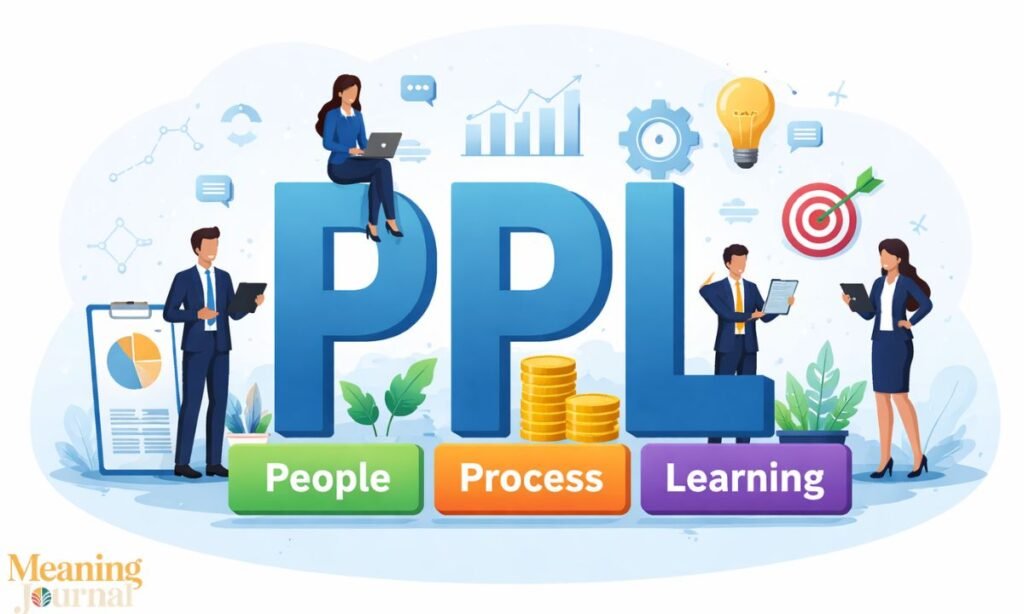
Switch gears entirely, and in the digital marketing and business world, PPL means something very different: Pay Per Lead.
Pay Per Lead is a performance-based marketing model where an advertiser pays a fixed amount every time a potential customer (a “lead”) completes a specific action — filling out a form, signing up for a trial, requesting a quote, etc. It’s a big deal in industries like insurance, real estate, education, and SaaS.
For example:
“Our PPL campaign generated 400 qualified leads last month at $12 per lead.”
This model is attractive for businesses because they’re paying for results, not just impressions or clicks. It’s more accountable than CPM (cost per thousand impressions) and often more affordable than CPC (cost per click) depending on the industry.
If you work in marketing, SEO, or run online ads, PPL is a term you’ll encounter regularly. Confusing it with “people” in a business meeting would be… an interesting moment.
Aviation: PPL as Private Pilot Licence
This one surprises a lot of people.
In the aviation world, PPL stands for Private Pilot Licence (or License, depending on your country’s spelling). It’s the foundational certification that allows someone to fly a small aircraft for personal use — not commercially.
Getting a PPL typically involves:
- A minimum number of flight hours (usually around 40–45 hours)
- Passing written knowledge exams
- A practical flight test with an examiner
- Medical fitness clearance
People often use PPL in sentences like:
“She just earned her PPL after six months of training.” “You need a PPL before you can work toward a commercial licence.”
In aviation forums, flying clubs, and pilot communities online, this acronym is used constantly. If you stumble into one of those communities thinking PPL means “people,” the context will quickly set you straight.
The Gym World: PPL as Push Pull Legs
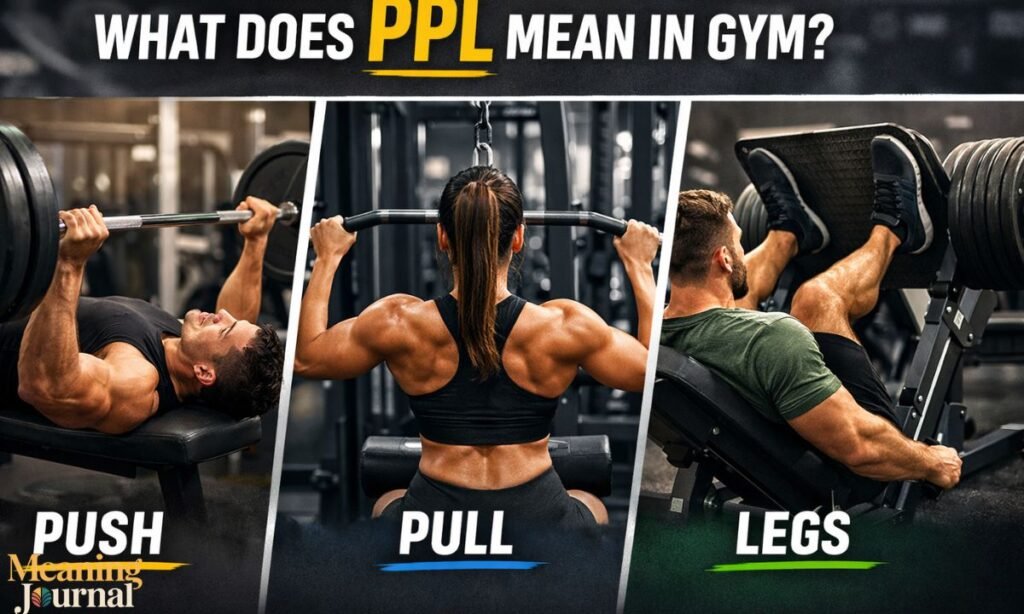
Anyone who’s spent time in fitness communities — Reddit’s r/Fitness, YouTube workout channels, or any serious gym forum — knows PPL as Push Pull Legs.
Push Pull Legs is one of the most popular workout splits in resistance training. Here’s the basic idea:
- Push days — chest, shoulders, triceps (muscles used in pushing movements)
- Pull days — back, biceps (muscles used in pulling movements)
- Legs days — quads, hamstrings, glutes, calves
The PPL split is loved because it’s efficient and allows for adequate muscle recovery while still training each muscle group frequently throughout the week. A common PPL schedule runs 6 days with one rest day, hitting each category twice per week.
You’ll see this in posts like:
“I’ve been running PPL for 8 weeks and my back gains are insane.” “Anyone else find PPL better than a bro split?”
This is a perfect example of how context completely changes the meaning. In a fitness forum, nobody’s talking about people. They’re talking about deadlifts.
PPL in Physics and Medical Terminology
These are the two most niche uses, but they’re worth knowing — especially if you work in or study technical fields.
Physics: Photopolarimetry
In astrophysics and optical science, PPL can refer to photopolarimetric measurements or photopolarimetry-related studies. This deals with measuring the polarization of light from celestial objects or during laboratory experiments. It’s highly specialized and you’d only encounter it in academic papers or scientific databases.
Medical: Pars Plana Laminotomy
In neurosurgery and spinal medicine, PPL sometimes refers to Pars Plana Laminotomy — a surgical procedure involving the spine’s laminar arch. It’s used in certain decompression surgeries.
Medical literature also occasionally uses PPL as shorthand for other procedural terms depending on the specialty. If you see PPL in a medical context, always verify it against the document’s glossary or surrounding context — it’s not a universally standardized abbreviation in medicine.
PPL in Tagalog: A Filipino Twist
Here’s something genuinely underappreciated: PPL meaning in Tagalog-speaking communities.
In Filipino internet culture — particularly on Facebook, TikTok, and Twitter — PPL is used the same way as in English (to mean “people”), but it often gets blended with Filipino slang and sentence structures. You might see:
- “Nako, ppl talaga nowadays 😭” (roughly: “These people nowadays…”)
- “Ppl be like ganyan na ganyan” (a mix of PPL with Taglish phrasing)
Filipino social media users are incredibly active online, and Taglish (Tagalog + English hybrid) blends seamlessly with abbreviations like PPL. The meaning stays the same, but the flavor and cultural expression around it are uniquely Filipino.
PPL in Relationships: What It Signals
When someone uses PPL in a relationship context, it usually falls into a few patterns:
Venting: “Ppl really don’t know how to communicate in relationships smh.” — Usually means the person is frustrated with relationship behavior they’ve observed or experienced.
Generalizing: “Why do ppl cheat and then act surprised when things fall apart?” — Used to talk about relationship patterns without calling out a specific person directly.
Seeking connection: “Do ppl even date seriously anymore?” — A soft, relatable question hoping others agree.
In dating apps like Tinder or Bumble, you won’t see PPL in professional profiles — but in messages and bios for casual platforms, it appears frequently. It signals a relaxed, unfiltered communication style. If someone texts you “ppl are wild” after a bad date story, they’re commiserating. It’s social glue dressed up as shorthand.
The Evolutionary Path of PPL: How Abbreviations Like This Take Over Language
Here’s the unique angle most articles completely ignore — the linguistic evolution of how an abbreviation like PPL becomes embedded in everyday language.
PPL didn’t start trending because of one viral post. It spread because it fulfilled a genuine communicative need: speed without sacrificing clarity. The internet rewarded brevity. Early SMS had character limits. Twitter had 140 characters. These constraints shaped an entire generation’s writing habits.
What’s fascinating is that PPL has gone through several stages of adoption:
- Utility phase — People use it simply to save time (early 2000s texting era)
- Normalization phase — It becomes standard enough that nobody questions it
- Cultural embedding phase — It takes on tone and nuance (the exasperated “ppl be like…” voice)
- Cross-platform standardization — It appears consistently across WhatsApp, Instagram, TikTok, Reddit, Twitter, Discord
- Generational signaling — Using PPL signals that you’re digitally fluent, not formal or stiff
This trajectory mirrors other internet abbreviations like “lol,” “tbh,” and “imo.” They started as shortcuts and became communicative identities. PPL is solidly in stage 4 and arguably reaching stage 5 for Gen Z users.
Understanding this helps explain why you shouldn’t use PPL in a formal email — not just because “it’s slang,” but because the register signals you haven’t adapted to the context.
Common Misconceptions About PPL
Let’s clear a few things up.
Misconception #1: PPL is only internet slang. Not true. As we’ve covered, PPL is a legitimate abbreviation in aviation, marketing, fitness, and scientific fields. Context is everything.
Misconception #2: Using PPL is unprofessional. In casual communication, using PPL is completely normal and even expected. It only becomes a problem when used in formal writing, official documents, or professional emails where full words are the standard.
Misconception #3: PPL is a new invention. The abbreviation has roots going back to early online chat rooms and SMS texting from the early 2000s. It’s not a Gen Z invention — it’s been around for over two decades.
Misconception #4: Everyone knows what PPL means in every context. A gym bro typing “starting PPL tomorrow” and a pilot saying “I got my PPL last year” are using the same three letters to mean completely different things. Assuming shared meaning without context is a real communication trap.
Similar Terms and How PPL Compares
PPL sits in a category with many other abbreviated slang terms that replace common words:
- Ppl → People
- Peeps → People (but warmer, more affectionate)
- Folks → People (more inclusive, formal-casual hybrid)
- Humans → Used ironically online (“why do humans do this”)
- Everyone → More inclusive than PPL, less slangy
The difference between PPL and “peeps” is subtle but real. “Peeps” feels warmer and more personal — “thanks to all my peeps” implies closeness. PPL is more neutral and observational — “ppl really be out here” implies distance and commentary.
Compared to “folks,” PPL is considerably more casual and digital-native. You’d use “folks” in a presentation. You’d use “ppl” in a text.
How to Respond When Someone Uses PPL
If someone texts you something using PPL and you’re unsure of the tone, here’s a simple guide:
If they say “ppl are the worst today” — they’re venting. Respond with empathy or humor. Something like “lmaooo what happened” or “ikr, can’t deal.”
If they say “you know how ppl are” — they’re being casually philosophical. Agree, add your take, keep it light.
If they use PPL in a professional context (like Pay Per Lead or Private Pilot Licence) — respond in kind using the professional register. Don’t mix it with casual slang.
The tone of the surrounding message almost always tells you how to respond. PPL rarely appears in emotionally ambiguous situations — it usually carries clear conversational energy with it.
FAQs About PPL
What does PPL mean in text?
In texting and casual digital communication, PPL stands for “people.” It’s one of the most widely used internet abbreviations across all major platforms including WhatsApp, Instagram, and TikTok.
Is PPL slang or an abbreviation?
It’s technically an abbreviation (shortened form of a word), but it functions as internet slang in casual contexts. In professional fields like aviation or marketing, it operates as a formal abbreviation with a different meaning entirely.
What does PPL stand for in aviation?
In aviation, PPL stands for Private Pilot Licence — the basic certification required to fly a small aircraft for personal, non-commercial use.
Is it okay to use PPL in formal writing?
No. In formal writing — essays, professional emails, official documents — you should always write “people” in full. PPL is appropriate only for informal, digital communication.
What does PPL mean on TikTok or Instagram?
On both platforms, PPL means “people.” It’s used in captions, comments, and text overlays, typically in a relatable or humorous tone.
Can PPL have other meanings in professional fields?
Absolutely. PPL means Pay Per Lead in marketing, Push Pull Legs in fitness, Private Pilot Licence in aviation, and has specialized uses in physics and medicine as well.
Final Takeaway
PPL is one of those rare abbreviations that lives in multiple worlds at once — the casual world of texting, the professional world of business and aviation, and the physical world of gym programming. Three letters, wildly different meanings, all dependent on where you see them.
The next time you read “ppl” in a text, you’ll know it means people. The next time you see it in a fitness subreddit, you’ll think Push Pull Legs. And if a pilot friend mentions their PPL, you’ll know they’re talking about their licence — not the group chat.
Language is never just about the words. It’s always about the context they live in. And PPL, in all its forms, is a perfect little example of that truth.
