

You got a text. It said something bold, maybe slightly insulting, maybe wildly dramatic. And then, at the end, three quiet little letters appeared: JSP. Now you are staring at your phone wondering whether to laugh, reply, or call a lawyer. Relax. JSP in text most commonly means “Just Playing” — a quick signal that the previous message was a joke and nobody is actually in trouble. Let us break down every meaning, every context, and every situation where this small abbreviation does a surprisingly big job.
What Does JSP Mean in Text, Exactly?
JSP stands for “Just Playing” in most everyday text conversations.
When someone sends a wild statement and then adds JSP, they are basically hitting an invisible “just kidding” button. It tells you the message before it was not serious, not a real opinion, and definitely not a reason to start an argument.
Here is a clean, direct answer for anyone who wants it fast:
JSP = Just Playing = “I was joking, do not take that seriously.”
That is it. That is the core. Everything else from this point is just helpful context that makes you look like a texting genius.
Why Does JSP Have More Than One Meaning?
Here is where things get slightly interesting — and slightly chaotic, because the internet loves chaos.
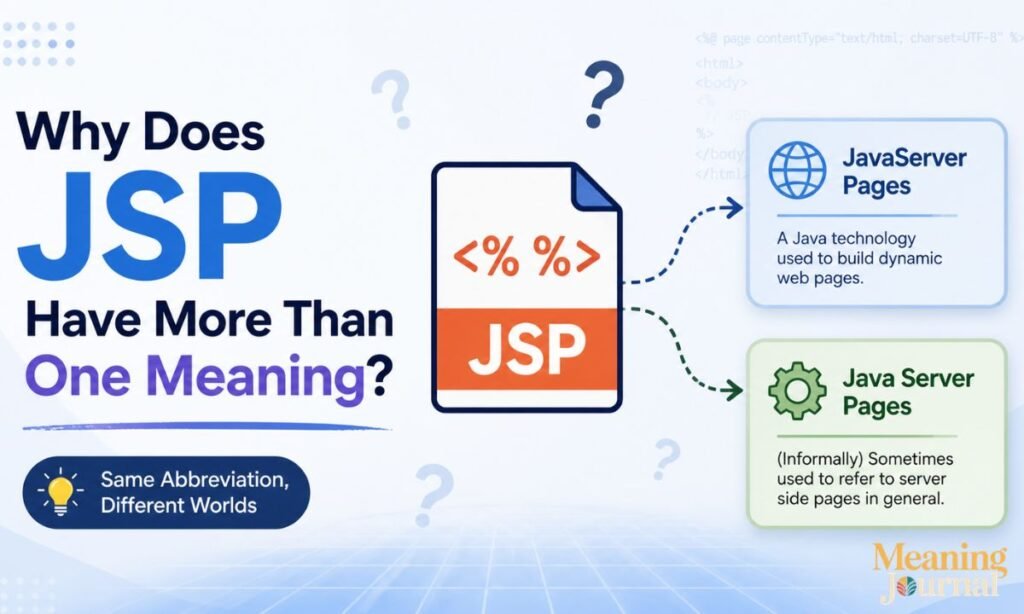
JSP does not have a single locked meaning. Depending on where you see it, who sent it, and what they were talking about, it can mean different things. The three most common meanings in English texting are:
1. Just Playing — the most widely used. Signals a joke or playful tease. 2. Just Saying — used to soften an opinion, like “I am just sharing my thoughts.” 3. Just Stop Playing — used when someone is frustrated and telling you to get serious.
And if you happen to be chatting with someone who speaks French, JSP means “Je Sais Pas” (which translates to “I don’t know”). So the same three letters can mean four completely different things depending on context.
No wonder people search for this.
A Quick Comparison Table: All JSP Meanings at a Glance
| Meaning | Used When | Tone | Example |
| Just Playing | After a joke or tease | Playful, light | “You eat way too much… jsp 😂” |
| Just Saying | Sharing an opinion gently | Casual, mild | “That outfit is not it, jsp” |
| Just Stop Playing | Wanting someone to be serious | Firm, real | “Im jsp right now, call me” |
| Je Sais Pas | French texting conversations | Neutral (French slang) | “Jsp encore” (I don’t know yet) |
| JavaServer Pages | Tech or programming chats | Technical | “The JSP file is throwing errors” |
How Did JSP Even Become a Thing?
Slang never comes from a committee. It grows organically, and JSP is no different.
The phrase “just playing” has existed in casual English speech for a long time. People would say something bold and follow it with “I am just playing” to keep the peace. As texting became faster and thumbs became more important than full sentences, “just playing” got shortened to JP, then picked up an extra S somewhere along the way.
The extra “S” in JSP does not officially stand for a specific word — people just added it naturally over time, similar to how other slang patterns evolve in texting culture.
JSP as a slang term grew significantly out of African American Vernacular English (AAVE) and Black internet culture — the same communities that gave the internet phrases like “stop playing,” “no cap,” and “on God.” From there, it spread across TikTok, Instagram, and Snapchat, and now it shows up in group chats worldwide.
Real-Life Examples of JSP in Text Conversations
Reading definitions is fine. Seeing actual examples is better. Here is how JSP looks in real conversations:
Example 1 (Just Playing after a roast):
“You literally have the worst taste in movies. Jsp bro, I watched it three times 😂”
The first sentence sounds like an attack. JSP immediately flips it into a compliment wrapped in humor. That is the beauty of it.
Example 2 (Just Saying as a soft opinion):
“Your ex already moved on btw. Jsp, just saw their post.”
Here JSP acts like a disclaimer. The person is not trying to start drama. They are simply sharing information while keeping their hands clean of the consequences.
Example 3 (Just Stop Playing in a serious moment):
“Im jsp right now, I need you to listen to me.”
This one carries real weight. The person is drawing a clear line and saying: this is not a game, I am being completely sincere. When someone says “I’m JSP,” they are making it clear this is not a joke and they mean every word.
Example 4 (French context):
“Tu fais quoi ce soir?” / “Jsp encore et toi?” (What are you doing tonight?) / (I don’t know yet, and you?)
Same letters, entirely different conversation.
JSP vs JK vs JP — Which One Should You Actually Use?
This is the question most guides completely skip over, and it genuinely matters.
Both JSP and JK mean “I was joking,” but JK is universally understood across all ages. JSP is more niche and feels most natural among Gen Z users on Snapchat and TikTok. If you are texting someone you just met, JK is the safer, cleaner choice. If you are deep in a group chat with close friends who live on social media, JSP lands perfectly.
Here is a simple breakdown of when to use each:
Use JSP when texting close friends, in casual group chats, or on social media platforms where Gen Z slang is the norm. It carries a slightly softer, more playful tone than JK in certain circles.
Use JK when you want to be understood by everyone, regardless of age or platform familiarity. JK has been around since the early 2000s and is practically universal.
Use JP if you want the shorter version of “just playing” with no ambiguity. It is clean, direct, and carries the same meaning.
Use “Just kidding” or “I was joking” when you are talking to someone who might not know internet slang, is older, or when the situation is even slightly formal.
The rule is simple: the closer you are to someone, the more slang you can safely use. The less you know them, default to clarity.
Where You Will See JSP the Most
JSP is not a random text rarity. Once you know what to look for, you will spot it constantly in specific digital spaces.
On TikTok, JSP shows up in comment sections, usually when someone cannot believe what they just watched. “The audacity… jsp 😭” is basically a TikTok staple at this point. JSP is being seen more and more commonly, especially on TikTok, where fast, punchy reactions are the whole culture.
On Snapchat, JSP almost always means Just Playing. It appears after teasing comments, playful roasts, or bold statements to signal the message was a joke, and it often shows up alongside emojis like 😂 or 😅 to make the humorous intent obvious.
On Instagram DMs and stories, JSP pops up in reaction messages. Someone posts something dramatic, and a friend replies with “JSP bro, I cannot believe this.”
In regular WhatsApp chats, JSP is used between close friends in the “just saying” sense — a way to voice an opinion while softening the delivery.
In tech spaces, JSP means something completely different: JavaServer Pages, a web development technology used to create dynamic websites. If you see JSP in a GitHub discussion or a developer forum, it has absolutely nothing to do with jokes. Context is everything.
The Psychology Behind Why People Use JSP

This is the section most articles miss, and it is genuinely fascinating.
Text messages strip away everything that makes tone clear in real life. No facial expressions. No voice pitch. No body language. When you send a sarcastic comment over text, there is a real chance the other person reads it as a sincere insult.
People use JSP to tease without hurting feelings. It acts like a safety net in conversations — saying something bold and then immediately softening it.
Think about it this way. In person, you can raise your eyebrows, grin, or use air quotes. In text, you have three letters: JSP. It does the exact same emotional work, just in digital form.
Linguists would call this tone-softening language — words and phrases that reduce the emotional impact of a statement. JSP belongs in the same family as “no offense but,” “I am just saying,” and “not to be rude.” The difference is that JSP does it faster and with less word count, which is the entire point of texting slang.
Common Mistakes People Make with JSP
Knowing what JSP means is one thing. Knowing how to use it without accidentally causing more confusion is another thing entirely.
Mistake 1: Using JSP after something genuinely hurtful. The most common JSP misuse is tagging a genuinely hurtful statement with “jsp” to make it seem like a joke. Receiving that reads as passive-aggressive, not playful. If something needs a real apology, write one. “You are the worst friend I have ever had, jsp” is not a good text, regardless of emoji placement.
Mistake 2: Using it with people who will not recognize it. Not everyone knows JSP. With someone you have just met, the joke may land as an insult if they do not recognize the abbreviation in time. When in doubt, spell it out.
Mistake 3: Using it in professional settings. JSP belongs in casual conversations. Sending “Your report was late again, jsp” to your manager is not a great career move. Save it for the group chat.
Mistake 4: Mixing up English JSP with French JSP. If the other person speaks French, your “Just Playing” JSP may be read as “Je Sais Pas” (I don’t know), creating real confusion. Spell it out when mixing languages.
Mistake 5: Overusing it. Anything used after every single message loses its impact. If JSP appears in 80% of your texts, it stops functioning as a tone signal and just becomes noise.
How to Reply When Someone Sends You JSP
Someone sent you JSP and you are staring at it wondering what the correct response is. The answer is simpler than you think.
Match the energy. If the message was light and playful, keep your reply light and playful. If it felt serious despite the JSP, it is okay to ask for clarity.
Here are some natural reply options depending on the situation:
When you want to play along:
“Lol I almost believed you 😂” “You got me for a whole second, not cool” “Haha okay okay I see you”
When you want to keep teasing back:
“Oh sure, jsp, sure 😏” “I am telling everyone what you just said. Jsp, but also maybe not.”
When you want to check if they were actually serious:
“Wait, were you being real or actually jsp?”
That last one is underrated. Sometimes JSP gets used in places where a person wants to say something real but feels nervous, so they add JSP as a safety exit. Giving them the option to be honest is a kind move.
When You Should Not Use JSP at All
Not every moment calls for a joke. And not every joke needs a safety disclaimer.
If someone is going through something serious — grief, conflict, or a personal crisis — this is not the moment for teasing slang. Read the room every time.
Beyond emotional timing, there are specific situations where JSP simply does not belong:
Formal writing of any kind. Emails, reports, academic papers, cover letters. None of these welcome internet slang.
First impressions. When you are meeting someone new, texting a new colleague, or talking to someone’s parents for the first time, slang signals immaturity to people who do not share your texting vocabulary.
Serious relationship conversations. If you need to have a real, honest conversation with someone, adding JSP at the end of your message sends mixed signals and reduces the credibility of what you said.
Customer service interactions. This should be obvious, but here we are.
The cleaner rule: if you are unsure whether JSP is appropriate, it probably is not. Use it freely with people who already know your communication style.
JSP and Similar Texting Slang You Should Know
Once you learn JSP, you will start noticing its whole family of related slang. These are the abbreviations that live in the same neighborhood:
JK — Just Kidding. The classic. Understood by essentially everyone with a phone.
JP — Just Playing. The shorter version of what JSP stands for, without the extra S.
NGL — Not Gonna Lie. Used before an honest, sometimes uncomfortable truth.
TBH — To Be Honest. Similar to NGL, used when sharing a genuine opinion.
IMO / IMHO — In My Opinion / In My Humble Opinion. More formal than JSP but serves a similar softening purpose.
JS — Just Saying. The minimal version, two letters instead of three.
JSYK — Just So You Know. Informational rather than playful, but shares the “just” family vibe.
The key difference between JSP and most of these alternatives is tone. JSP carries a playful, slightly mischievous energy that IMO or TBH simply do not have. JSP is the friend who says something outrageous at dinner and then grins. IMO is the friend who calmly shares a well-reasoned perspective. Both have a place. You just need to know which moment calls for which one.
Frequently Asked Questions
Is JSP rude?
No, not on its own. JSP is designed to soften and lighten messages, not to harm. However, if it is added after something genuinely mean, the JSP does not fix the meanness — it just makes the sender look evasive. Use it with good intentions and actual jokes.
Is JSP the same as JK?
They are close but not identical. Both signal that a message was not serious. JK is the more universally known abbreviation, while JSP carries a slightly more casual, Gen Z flavor and is most popular on platforms like TikTok and Snapchat. With someone new, JK is safer. With your inner circle, JSP fits perfectly.
Can JSP be used in formal settings?
Not recommended. JSP should generally be avoided with elders, professionals, supervisors, or in formal settings, as text abbreviations like JSP can confuse people unfamiliar with internet slang and may come across as unprofessional. Reserve it for casual conversations where the other person is already fluent in texting slang.
The Bottom Line on JSP Mean in Text
Three letters. Multiple meanings. One simple rule: read the context.
In most English text conversations, JSP means Just Playing, and it is doing quiet, important work — keeping jokes from turning into arguments, softening bold opinions, and adding a layer of warmth to conversations that could otherwise feel cold or harsh.
If someone sends it to you, they are almost certainly not looking for a fight. They are keeping things light, and the right response is to keep things light right back.
And if you are French, well, you already knew this one. JSP, right?
