

You’re scrolling through your messages, someone sends “you GMFU” — and you freeze. Is it a compliment? An insult? A cry for help? If you’ve ever had that moment of confusion, you’re definitely not alone. Internet slang moves fast, and GMFU is one of those acronyms that carries a lot of emotional weight underneath just four letters.
Quick Definition
GMFU stands for “Got Me F*ed Up.”** It’s an expression of strong disbelief, frustration, or emotional disruption — used when something or someone has pushed you to your limit, confused you deeply, or left you genuinely shaken. The asterisks are used here to keep it readable, but in real texts, the word is spelled out in full.
Where Did GMFU Come From?
GMFU didn’t appear out of nowhere. The phrase “got me f***ed up” has deep roots in African American Vernacular English (AAVE) and was used long before the internet even existed — as a way to express that someone has genuinely crossed a line or rattled your world.
The acronym version picked up steam in the early 2010s on Twitter and in hip-hop lyrics. Artists and fans started abbreviating it, and by the mid-2010s, it was everywhere — meme pages, rap verses, and everyday group chats. Fast forward to 2026, and it’s still very much alive, especially across TikTok comment sections and Instagram DMs.
What makes GMFU unique is that it doesn’t just mean “I’m mad.” It implies something deeper — a feeling of being rattled, thrown off, or genuinely messed with emotionally.
How GMFU Is Actually Used — Real Context Matters
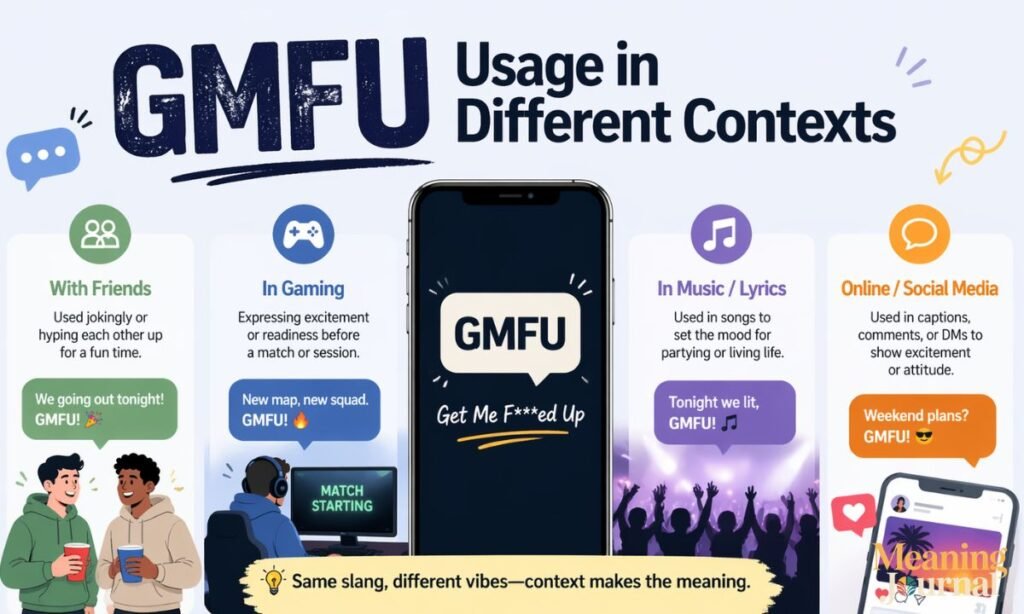
Context is everything with this one. GMFU can swing between raw anger, heartbreak, disbelief, or even playful exaggeration depending on who’s saying it and how.
Example — Frustration: “She said she ‘forgot’ about our plans again. She GMFU.”
Example — Disbelief: “This exam had questions from a chapter we never studied. This class GMFU fr.”
Example — Heartbreak: “He acted like everything was fine and then ghosted me. That really GMFU.”
Example — Playful / Funny: “Bro that jump scare GMFU I almost dropped my phone 💀”
See the range? Same acronym, four completely different tones. That’s what makes GMFU so versatile — and also why misreading it without context can lead to awkward misunderstandings.
“GMFU isn’t just a word — it’s a feeling. The feeling of being completely thrown off by something you didn’t see coming.”
GMFU Across Platforms — WhatsApp, Instagram, TikTok & More
The way people use GMFU shifts slightly depending on the platform. Here’s a quick breakdown of how it shows up across different spaces in 2026:
| Platform | How GMFU Appears | Typical Tone |
| In private chats, usually after something upsetting happened | Personal, emotional, serious | |
| Comments under relatable posts or DMs between friends | Casual, relatable, sometimes humorous | |
| TikTok | Comments, video captions, stitches about emotional situations | Dramatic, exaggerated, often funny |
| Twitter / X | Quote tweets, rants, reaction posts | Outraged, sarcastic, or genuinely hurt |
| Snapchat | Casual snaps or streaks — usually after venting | Informal, venting, Gen Z core |
What It Means When a Girl Says GMFU to You
This is one of the most searched questions about GMFU — and for good reason. Romantic and emotional dynamics are loaded with subtext, and this acronym is no exception.
If a girl texts you “you GMFU,” she’s almost certainly not complimenting you. It typically means you’ve done something that deeply frustrated, confused, or emotionally affected her. It could mean you let her down, said something that surprised her in a bad way, or treated her in a way she didn’t expect.
That said, tone and history matter. In a very close, playful friendship, “you GMFU” after a funny moment might just be lighthearted. But in a romantic or tense context? That’s a signal to pay attention — and probably have a real conversation.
The Emotional Spectrum Behind GMFU
Most slang guides treat GMFU as one flat emotion. But in practice, it maps across a whole range of inner states. This is what sets GMFU apart from simpler slang like “smh” or “wyd.”
Frustration — When someone repeatedly disappoints, ignores boundaries, or lets you down without remorse.
Disbelief — Something so absurd or unexpected happened that you genuinely can’t process it right away.
Hurt — Used after betrayal or emotional pain. Someone’s actions cut deep and left a mark.
Comic Exaggeration — Used humorously when something surprising but not genuinely harmful catches you completely off guard.
Common Misconceptions About GMFU
A lot of people stumble on this one — especially those encountering it outside their usual social circles. Let’s clear up a few common misreads.
Misconception #1: It always signals rage. Not true. GMFU can be used in moments of sadness, confusion, or even silly disbelief. Rage is just one end of the spectrum.
Misconception #2: It’s always directed at a person. Sometimes it’s directed at a situation — a bad grade, a broken phone, a frustrating movie ending. It’s about whatever “messed you up,” not necessarily a specific person.
Misconception #3: It’s dying out. Despite being years old, GMFU hasn’t faded the way many slang terms do. Its emotional depth keeps it relevant. As long as people feel genuinely rattled by things, the phrase will stick around.
Similar Terms and How GMFU Stands Apart
Think of it this way: if someone cancels on you last minute, you might text “smh” — a mild eye-roll. But if they cancel your wedding? That’s a full GMFU situation. The scale of emotional impact is what separates GMFU from softer alternatives.
Here are some related slang terms and how they compare:
SMH (Shaking My Head) — Mild disappointment or disapproval. Much softer than GMFU.
WTF (What The F*)** — Shock or confusion, but usually quick and reactive. GMFU implies lingering emotional disruption.
NGL (Not Gonna Lie) — An honesty marker, not really an emotional outburst at all.
Pressed — Being bothered or worked up over something. Overlaps with GMFU but lacks the same intensity.
Caught Feelings — Becoming emotionally invested unexpectedly. Sometimes used alongside GMFU in romantic contexts.
GMFU sits in its own lane because it combines intensity with personal impact. It’s not just “I’m surprised” or “I’m annoyed” — it’s “this thing genuinely shook me.”
How to Respond When Someone Says GMFU
Getting a “you GMFU” text can feel like a gut-punch — especially if you’re not sure what you did. Here’s how to handle it based on the situation:
If it’s emotional or serious: Don’t deflect or get defensive immediately. Ask what happened, listen fully, and acknowledge that they’re clearly affected. Something as simple as “I hear you — what did I do?” goes a long way.
If it’s casual or playful: Match the energy. If they’re clearly joking around, a “lmao sorry not sorry” or “you love it 😭” keeps the vibe light.
If you’re unsure: Just ask. A quick “are you okay or is that a joke?” removes all the guesswork and shows you actually care about the answer.
GMFU in Dating App Conversations and Online Relationships
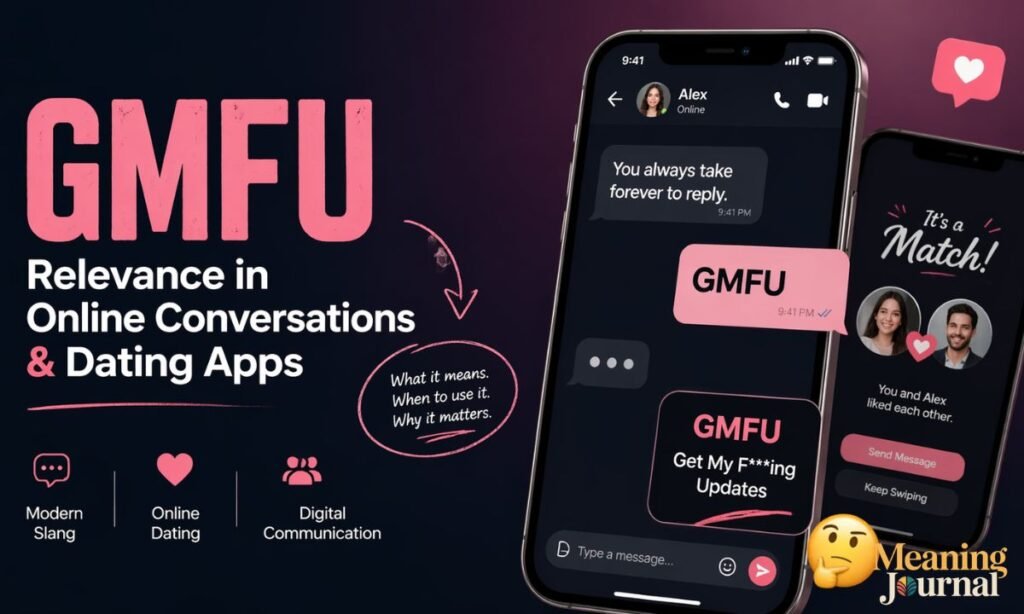
Dating apps like Hinge, Bumble, and Tinder have become their own little language ecosystems. GMFU shows up there too — usually when someone’s venting about a bad date experience in their profile, or when two matches are already comfortable enough to text casually.
Seeing GMFU in a dating context is often a sign of emotional openness. The person isn’t hiding that something affected them. That kind of honesty — even in slang form — can actually signal emotional maturity rather than just drama.
On the flip side, if someone uses GMFU aggressively early in a conversation — especially directed at you without context — that’s worth noting. It can hint at unresolved stress or a low frustration threshold.
Frequently Asked Questions
What does GMFU mean in a text from a guy?
Same meaning as from anyone else — “got me f***ed up.” Context determines whether he’s expressing anger, disbelief, hurt, or playful exaggeration. Look at the conversation history for clues.
Is GMFU a bad word?
It contains a profanity, so yes — it’s considered strong language. Avoid it in professional settings or around people who are sensitive to that kind of phrasing.
Can GMFU be used positively?
Rarely, but in very casual, playful exchanges between close friends, it can be used in a humorous, non-serious way. But the default meaning skews negative or intense.
Is GMFU the same as “you’re crazy”?
Not exactly. “You’re crazy” is a surface-level reaction. GMFU emphasizes the speaker’s internal emotional state — it’s about the impact on them, not just a judgment of the other person.
Key Insights
GMFU means “Got Me F***ed Up” — an expression of deep frustration, disbelief, or emotional disruption rooted in AAVE and popularized through hip-hop and social media. It’s not a one-size-fits-all phrase: the tone shifts from heartbreak to humor depending entirely on context and platform.
If someone sends it your way, take a moment to read the room before responding. And if you’re thinking of using it yourself, know that it carries real emotional weight — which is exactly what makes it so effective when words feel like they’re not enough.
Language is alive. It shifts with culture, emotion, and context. GMFU is just four letters, but behind them sits a whole emotional experience that resonates with people across generations in 2026. Now you’re fully in on it.
