

Ever received a message with “DPMO” and had absolutely no idea what to say back? You’re not alone. This acronym has been quietly spreading across social media, texting, and online chats — and it carries a surprisingly sharp emotional punch for something only four letters long.
Let’s break it down completely.
DPMO – What It Actually Means
DPMO stands for “Don’t Play Me Out.”
In plain English, it means: Don’t disrespect me, don’t take me for a fool, and don’t try to manipulate or deceive me.
It’s a direct, confident statement. When someone texts you DPMO, they’re drawing a line. They’re saying, “I see what you’re doing, and I’m not going to let it slide.”
Think of it as the digital equivalent of crossing your arms and raising an eyebrow.
Where Did DPMO Come From?
DPMO didn’t appear out of nowhere. It grew out of African American Vernacular English (AAVE) and urban slang culture, where the phrase “playing someone out” has long meant publicly embarrassing them, making them look stupid, or treating them with disrespect.
As texting and social media exploded in the 2010s, full phrases got compressed into acronyms. DPMO followed that same natural path — from spoken expression to typed shorthand.
By the early 2020s, it had spread well beyond its origins. You’ll now find it on Twitter/X, Instagram comments, Snapchat, TikTok captions, and everyday text conversations across different age groups and backgrounds.
Real Conversations: How DPMO Actually Gets Used
Sometimes an example does more work than a definition ever could. Here are a few realistic scenarios:
Scenario 1 – Caught in a Lie
Friend: “I told you I’d be there at 7.” You: “You literally texted me you weren’t coming.” Friend: “I never said that.” You: “DPMO, I have the screenshots.”
Scenario 2 – Being Taken for Granted
Partner: “It’s not a big deal.” You: “DPMO. You’ve cancelled three times this week.”
Scenario 3 – Playful Banter
Friend: “You can’t cook at all, admit it.” You: “DPMO, my pasta is legendary and you know it.”
Notice how the third one is lighter in tone. Context is everything with DPMO — it can be serious or completely playful depending on the relationship and the conversation around it.
What Does DPMO Mean in Text from a Girl?
This is one of the most searched questions around this acronym, and honestly, it makes sense. Tone in text is hard to read.
When a girl texts DPMO, the meaning doesn’t technically change — but the emotional weight behind it often does. Here’s a rough breakdown:
If she uses it in a frustrated or serious context, she’s genuinely calling out behavior she finds disrespectful or dismissive. It’s a signal to take seriously, not brush off.
If it’s used mid-joke or in a teasing conversation, it’s more of a playful “stop playing around with me” — lighthearted, not confrontational.
The biggest mistake people make is assuming DPMO is always aggressive. From a girl (or anyone, really), it can just as easily be flirtatious banter as it can be a genuine boundary. Read the full conversation, not just the acronym.
The Emotional Weight Behind DPMO — Why It Hits Different
Here’s something most articles skip over: DPMO isn’t just slang. It’s a boundary statement.
When someone uses it, they’re communicating self-respect. They’re saying, “I know my worth, and I’m not going to let you test it.” That’s actually psychologically significant in digital communication, where it’s very easy to feel dismissed, ignored, or gaslit.
In a world where people ghost, breadcrumb, and double-text without accountability, DPMO is a form of emotional self-defense. It’s brief, but it’s clear. And in text communication, clarity is power.
Using it also signals social awareness — the person knows they’re being played, they’re not pretending otherwise, and they’re calling it out without a lengthy explanation. That confidence is what gives the acronym its edge.
DPMO Across Different Situations
The way DPMO lands depends heavily on where and how it’s used:
In romantic conversations: It usually signals frustration with mixed signals, being stood up, or feeling like the other person isn’t being genuine.
Among friends: It’s often more playful — used when someone is being teased, accused of something they didn’t do, or jokingly called out.
On social media: It tends to be more public and assertive, often used in comment sections when someone feels they’re being misrepresented or talked down to.
In professional-adjacent texting (like between coworkers): It would be unusual and likely too casual, so context really does matter here.
DPMO vs Similar Acronyms — What’s the Difference?
People often confuse DPMO with a handful of other acronyms. Here’s a simple comparison:
| Acronym | Full Meaning | Tone | When Used |
| DPMO | Don’t Play Me Out | Assertive / Confident | Feeling disrespected or deceived |
| SMH | Shaking My Head | Disappointed | Reacting to something foolish |
| NGL | Not Gonna Lie | Honest / Direct | Sharing an opinion openly |
| ISTG | I Swear to God | Intense / Serious | Emphasizing sincerity or frustration |
| IJS | I’m Just Saying | Casual / Pointed | Subtle call-out |
DPMO is unique in that it’s directed at someone’s behavior specifically. It’s not just expressing an emotion — it’s addressing an action.
Does DPMO Have a Medical Meaning?

Yes — and this is where things get a little interesting, because the same acronym means something completely different outside of texting.
In medical and quality management settings, DPMO stands for Defects Per Million Opportunities. It’s a Six Sigma metric used to measure process quality — specifically, how many defects occur per one million opportunities in a manufacturing or business process.
So if you’re in a healthcare administration meeting or reading a quality control report and you see DPMO, it has nothing to do with slang. It’s a statistical measurement.
The lesson? Always consider your environment before interpreting acronyms. A term that means self-respect in a text thread means process efficiency in a boardroom.
How to Respond When Someone Sends You DPMO
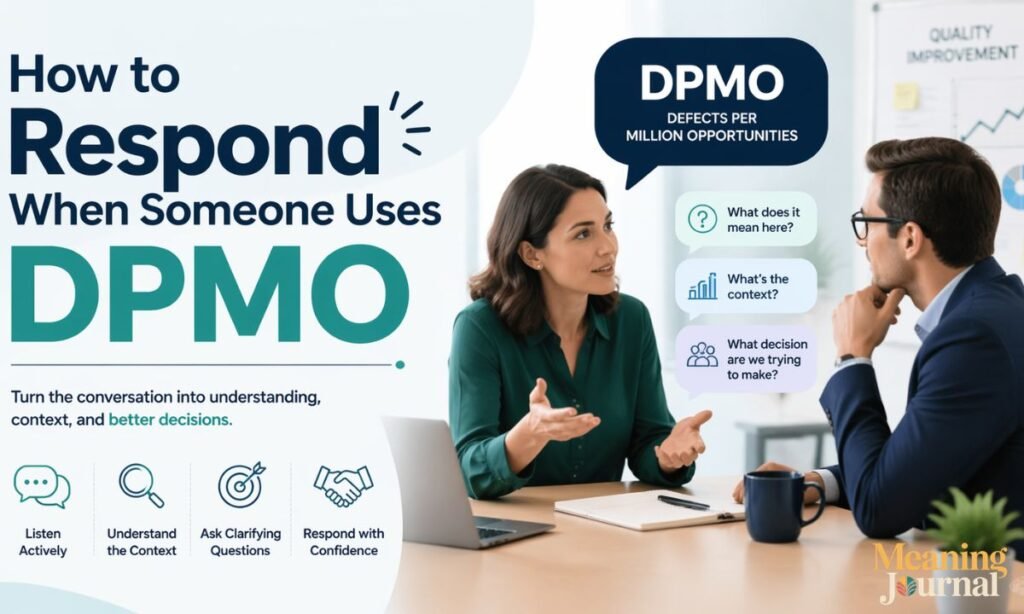
Getting a DPMO in your inbox can feel a little jarring if you weren’t expecting it. Here’s how to handle it well:
If you genuinely did something wrong: Acknowledge it. Don’t get defensive. Something like “You’re right, I hear you” goes a long way.
If you think it’s a misunderstanding: Calmly explain your side without dismissing their feeling. “I wasn’t trying to play you out — let me explain what actually happened.”
If it was playful banter: Match the energy. “DPMO back, you know you loved it” keeps the tone light.
If you’re genuinely confused: Just ask. “Wait, what do you think I did?” — straightforward and opens the door for real conversation.
What you should absolutely avoid is ignoring it or responding with sarcasm when the person is clearly serious. DPMO is a signal that someone feels disrespected. Dismissing it will only make things worse.
One Thing Nobody Else Is Telling You About DPMO
Here’s the section you won’t find on most other sites.
DPMO is also a test of communication style. When someone drops it into a conversation, they’re not just expressing frustration — they’re watching how you respond. Do you get defensive? Do you explain calmly? Do you laugh it off or take it seriously?
Your response to DPMO reveals a lot about your emotional intelligence in digital spaces. People who handle it well — by staying calm, listening, and not escalating — tend to have healthier text-based relationships overall.
In 2026, where so much of our social life happens through screens, knowing how to read and respond to emotionally loaded acronyms like DPMO is genuinely a useful skill. It’s not just slang literacy — it’s digital emotional literacy.
Frequently Asked Questions
Is DPMO offensive?
Not inherently. It’s assertive, but it’s not a slur or an insult. Whether it feels offensive depends entirely on the context and relationship.
Can DPMO be used humorously?
Absolutely. Between close friends, it’s often used in a joking way — like calling someone out in a lighthearted moment.
Is DPMO only used by younger generations?
It started with younger audiences, but like most internet slang, it’s spread across age groups. You’ll find it used by people well into their 30s and 40s in casual digital communication.
What if I’m not sure if someone is being serious with DPMO?
When in doubt, take it seriously. It’s better to acknowledge someone’s feelings and be wrong about the tone than to dismiss a genuine concern.
Key Takeaways
DPMO — four letters that pack in confidence, self-awareness, and clear communication. Whether it’s showing up in a heated argument, a flirty back-and-forth, or a Six Sigma report, knowing what it means and how to respond puts you ahead of the conversation.
The next time you see it, you won’t be scrambling to Google it. You’ll already know: someone is drawing a line, asking to be treated with respect, and waiting to see how you handle it.
That’s actually a pretty powerful thing to say in just four letters.
