

Ever typed “imput” in an email and second-guessed yourself? You are not alone. This is one of the most common spelling mistakes in everyday writing, and it trips up both native speakers and English learners alike. This guide gives you the clear answer, explains why the confusion happens, and shows you exactly how to use the correct word in real contexts.
Input or Imput – Quick Answer
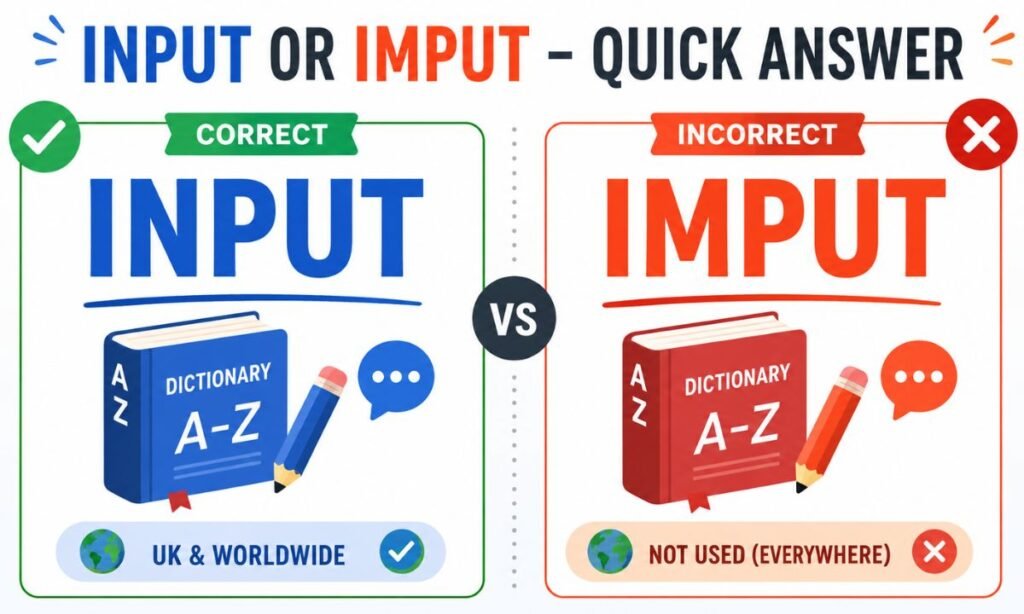
Input is the only correct spelling. Imput does not exist as a standard English word and is not found in any major dictionary, including Merriam-Webster, Oxford, or Cambridge.
The rule is simple: if you mean data entered into a system, feedback shared in a discussion, or any contribution of information, always write input.
Memory trick: Think of it as in + put. You are putting something in. The word tells you exactly how to spell it.
The Origin of Input or Imput
The word input is built from two Old English elements:
- in – meaning “into” or “within”
- put – meaning “to place” or “to set”
Together, input literally means to place something in. The word entered common use in the late 1800s and became widely used in the 20th century as machines, data systems, and computers became part of everyday life.
So where does “imput” come from?
It comes from a natural speech pattern called nasal place assimilation. When you say “input” quickly, the n sound shifts toward m because m is easier to pronounce before the p sound. Your mouth is doing you a small favor, but it creates a spelling error when you write what you hear.
The same shift happens in other English words. The word “impossible” follows the same pattern, where “in” + “possible” became “impossible” because of how the sounds blend. But “input” never made that official shift in spelling.
What is the Difference Between Input and Impute?
This is where many writers get confused. Impute is a real English word, but it means something completely different from input.
- Input = data, information, feedback, or a contribution entered into a system or discussion
- Impute = to attribute something (usually blame or responsibility) to someone, often in legal or formal contexts
Example of impute: The court imputed liability to the contractor for the building defect.
These two words are not interchangeable. If you are talking about entering data or giving your opinion on something, use input. If you are assigning fault or responsibility in a formal context, use impute.
British English vs American English Spelling
One common question is whether “imput” might be a valid British or American regional variant. The answer is no.
Both British English and American English use input as the only accepted spelling. There is no regional version that accepts “imput.”
However, there is one small difference between British and American English when it comes to the past tense of input used as a verb:
| Form | British English | American English |
| Present tense | input | input |
| Past tense | inputted | input |
| Past participle | inputted | input |
British English tends to use inputted as the past tense form, while American English more commonly uses input for both present and past tense. Both are grammatically correct.
Example (British): She inputted the records manually. Example (American): She input the records manually.
Also Read This: Receive or Recieve: Which Spelling Is Correct? Meaning & Examples (2026)
Which Spelling Should You Use?
Always use input. There is no context, region, or style guide where “imput” is acceptable.
Here is a quick guide for when to use input correctly:
- Writing an email or report: use input
- Entering data into software or a computer: use input
- Asking for someone’s opinion or feedback: use input
- Formal legal or academic writing about assigning blame: use impute (different word entirely)
If your spell-check is not catching “imput,” that does not mean it is correct. Some basic or outdated text processors miss this error. Always double-check manually when in doubt.
Common Mistakes with Input or Imput
Writers make a few recurring errors around this word. Here are the most common ones and how to avoid them:
Mistake 1: Writing “imput” instead of “input” The n and m keys sit next to each other on a keyboard, making this a frequent typo. Slow down and read your work before sending.
Mistake 2: Confusing “input” with “impute” These words look and sound similar but have completely different meanings. If you are talking about contributing ideas or entering data, the word is input, not impute.
Mistake 3: Using “imputting” as a verb form Some writers go further and write “imputting” thinking it is the present participle. The correct form is inputting.
Mistake 4: Assuming “imput” is valid in informal writing Even in casual texts, messages, or social media posts, “imput” is a spelling error. There is no context where it becomes acceptable.
Input or Imput in Everyday Examples
Here are real-life sentence examples showing input used correctly across different contexts:
Technology and computing:
- Please input your PIN to access the account.
- The system requires data input before processing begins.
- She input the customer records into the new database.
Business and workplace:
- We value your input on the new company policy.
- The manager asked for input from all team members before the decision.
- Your input helped shape the final product design.
Education and academic writing:
- Students were encouraged to input their ideas into the class discussion.
- The teacher sought input from parents during the curriculum review.
Everyday conversation:
- Can I get your input on this before I send it?
- I need more input before I can make a final call.
In every one of these examples, writing “imput” would be a spelling error.
Input or Imput – Google Trends & Usage Data

Search data confirms that this confusion is widespread and global. People regularly search for “input or imput,” “imput vs input,” and “correct spelling of imput” across search engines.
Key usage insights:
- “Input” appears in virtually every major English dictionary and style guide
- “Imput” returns zero results as a valid dictionary entry
- The misspelling is especially common in South Asia, Africa, and among non-native English speakers, where pronunciation differences make the n/m blend harder to catch
- In professional writing surveys, a significant portion of office workers reported occasionally typing “imput” in emails or documents before catching the error
Google Trends data shows that searches for “imput” spike whenever new learners encounter the word in a typing or data entry context, confirming that the confusion is rooted in pronunciation and fast typing rather than genuine spelling uncertainty.
Comparison Table: Input vs Imput
| Feature | Input | Imput |
| Correct spelling | Yes | No |
| Found in dictionaries | Yes (all major dictionaries) | No |
| Used in formal writing | Yes | Never |
| Used in British English | Yes | No |
| Used in American English | Yes | No |
| Valid past tense form | Input / Inputted | Not applicable |
| Meaning | Data, feedback, contribution | Does not exist |
| Confused with | Imput (misspelling), Impute (different word) | Should not be used |
Conclusion
The answer is straightforward: input is correct, imput is not. There is no regional variant, no informal exception, and no context where “imput” becomes acceptable.
The confusion exists because of how the word sounds in natural speech, not because of any real ambiguity in spelling. Once you see input as simply in + put, the correct form becomes easy to remember and hard to forget.
Whether you are writing professional emails, entering data into software, or contributing ideas in a team meeting, input is always the right word. Keep it simple, check your spelling, and your writing will reflect both clarity and credibility.
