

If you’ve ever stopped mid-sentence wondering whether to write licence or license, you’re not alone. This is one of the most common spelling confusions in the English language — and the answer depends on where you’re writing and how you’re using the word. This guide breaks it all down clearly so you never second-guess yourself again.
Licence or License – Quick Answer
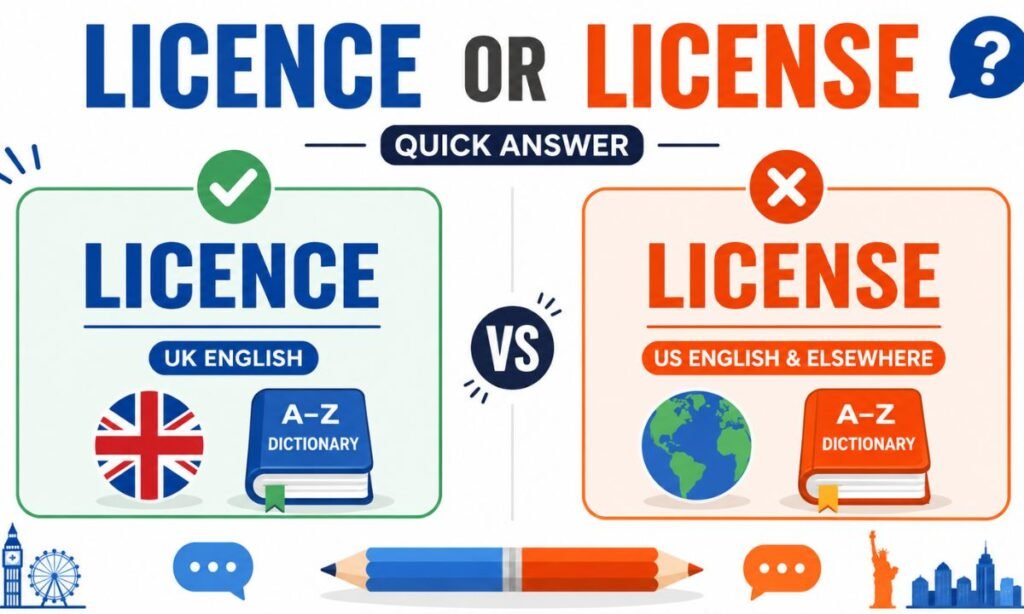
Both spellings are correct — but in different contexts:
- License = used in American English for both the noun and the verb
- Licence = used in British English as a noun only
- License = used in British English as a verb only
Simple rule: If you’re writing for a US audience, always use license. If you’re writing for a UK or Commonwealth audience, use licence for the noun and license for the verb.
| Form | American English | British English |
| Noun | license | licence |
| Verb | license | license |
| Adjective (licensed) | licensed | licensed |
| Gerund (licensing) | licensing | licensing |
The Origin of Licence / License
The word comes from the Latin licentia, meaning “freedom” or “permission.” It entered Middle English through Old French as licence. For centuries, British English kept this spelling for all uses of the word.
The split between licence and license emerged in the 18th and 19th centuries when British lexicographers began distinguishing noun and verb forms by spelling — a pattern seen in other word pairs like advice/advise and practice/practise.
In the United States, spelling reformer Noah Webster simplified American English by dropping the noun-verb distinction entirely. His influential dictionaries standardized license for both functions, and that usage has been consistent in American English ever since.
British English vs American English Spelling
This is the core of the licence vs license debate: regional spelling conventions.
British English Rules
In British English (and most Commonwealth countries — UK, Australia, Canada, India, Pakistan, New Zealand, South Africa), the rule is clear:
- Noun → licence
- She applied for a driving licence.
- The pub needs a licence to sell alcohol.
- He was granted a firearms licence.
- Verb → license
- The council will license the new restaurant.
- The government licenses broadcasters.
A helpful trick: think of the advice/advise pattern. Advice (noun) ends in -ce, just like licence. Advise (verb) ends in -se, just like license.
American English Rules
In American English, the rule couldn’t be simpler:
- Use license always — noun or verb, no exceptions.
- She renewed her driver’s license.
- The state will license the new clinic.
- He has a license to practice law.
What About Canada and Australia?
Both follow British English conventions. In Canadian and Australian publications, you’ll regularly see licence as the noun form and license as the verb.
Which Spelling Should You Use?
The correct spelling depends entirely on your target audience:
- Writing for US readers? → Use license for everything.
- Writing for UK, Australian, Pakistani, or other Commonwealth readers? → Use licence (noun) and license (verb).
- Writing for a global audience? → License (American form) is increasingly accepted as a neutral international standard in digital content and SEO writing.
- Academic or business writing? → Match the style guide of your institution or publisher.
Pro tip for content writers: Consistency is key. Never mix licence and license in the same document when referring to the same thing. Pick one convention and stick to it throughout.
Also Read This: Kindergarten or Kindergarden: Which Spelling Is Correct? Complete Guide (2026)
Common Mistakes with Licence / License
Even experienced writers get this wrong. Here are the most frequent errors and their corrections:
| Mistake | Correct Version | Reason |
| He forgot his driving license. (UK context) | He forgot his driving licence. | Noun in British English |
| The government will licence the company. | The government will license the company. | Verb always uses -se |
| She received her driver’s licence in New York. | She received her driver’s license in New York. | American English uses license for nouns |
| The shop is licenced to sell tobacco. | The shop is licensed to sell tobacco. | licenced is never correct in any dialect |
| The licencing authority approved it. | The licensing authority approved it. | licencing does not exist |
Key point: The forms licensed, licensing, and unlicensed are always spelled with an “s” in both British and American English — they come from the verb, not the noun.
Licence / License in Everyday Examples
Seeing the word in real-life contexts makes the rule stick. Here are common uses across different categories:
Driving
- US: She passed her test and got her driver’s license.
- UK: She passed her test and got her driving licence.
Business
- US: The city licenses food trucks operating downtown.
- UK: The council will license food trucks in the area.
- UK (noun): You need a street trading licence before you start.
Software
- Microsoft licenses its products to millions of users. (verb — same in both dialects)
- Read the software licence agreement before installing. (UK noun)
- Read the software license agreement before installing. (US noun)
Media & Broadcasting
- UK: The BBC is funded by the TV licence fee.
- US: The FCC grants broadcast licenses to radio stations.
Healthcare & Law
- Doctors must hold a valid licence to practise. (UK)
- Doctors must hold a valid license to practice. (US)
Licence or License – Google Trends & Usage Data
Search volume and usage data confirm clear regional patterns:
- “driver’s license” dominates search queries globally due to American English’s larger digital footprint.
- “driving licence” ranks high in the UK, Australia, and South Asia.
- For SEO content targeting international audiences, using both variants naturally within an article can improve visibility across regions.
- American English is the dominant standard for most global digital content, making license the more common spelling online overall.
Also Read this: Weiner or Wiener: Which Spelling Is Actually Correct?
| Search Term | Primary Region | Usage Context |
| driver’s license | United States | Noun (American English) |
| driving licence | United Kingdom, Australia | Noun (British English) |
| software license | Global (US standard) | Noun/Verb |
| licence agreement | UK, Commonwealth | Noun |
| licensed professional | Global | Adjective (both dialects) |
Keyword Comparison Table
| Keyword / Term | British English | American English |
| Noun spelling | licence | license |
| Verb spelling | license | license |
| Driver’s document | driving licence | driver’s license |
| Official permit | licence | license |
| Permission to operate | licence (noun) | license |
| To grant permission | to license | to license |
| Adjective form | licensed | licensed |
| Present participle | licensing | licensing |
| Related: practice/practise | practise (verb) | practice (verb/noun) |
| Related: advice/advise | advise (verb) | advise (verb) |
Conclusion
The licence vs license question has one clear answer: it depends on your dialect and how you’re using the word.
- In American English, use license for everything — noun and verb.
- In British English, use licence for the noun and license for the verb.
- Forms like licensed, licensing, and unlicensed are always spelled with an s, regardless of dialect.
For writers, bloggers, and content creators: know your audience. A UK-based business article should say licence, while a US marketing piece should say license. Get this right, and your writing immediately looks more polished, professional, and credible — which is exactly what Google’s EEAT guidelines reward.
When in doubt, ask yourself: Am I writing for American readers or British readers? That single question resolves the confusion every time.
