

You’ve seen both spellings online — fiending and feening — and you’re not sure which one is right. You’re not alone. These two words appear side by side in song lyrics, TikTok captions, text messages, and everyday slang. But only one of them is actually correct in standard English.
This guide breaks down the difference once and for all: what each word means, where it came from, how to pronounce it, and when to use which version.
Fiending or Feening – Quick Answer
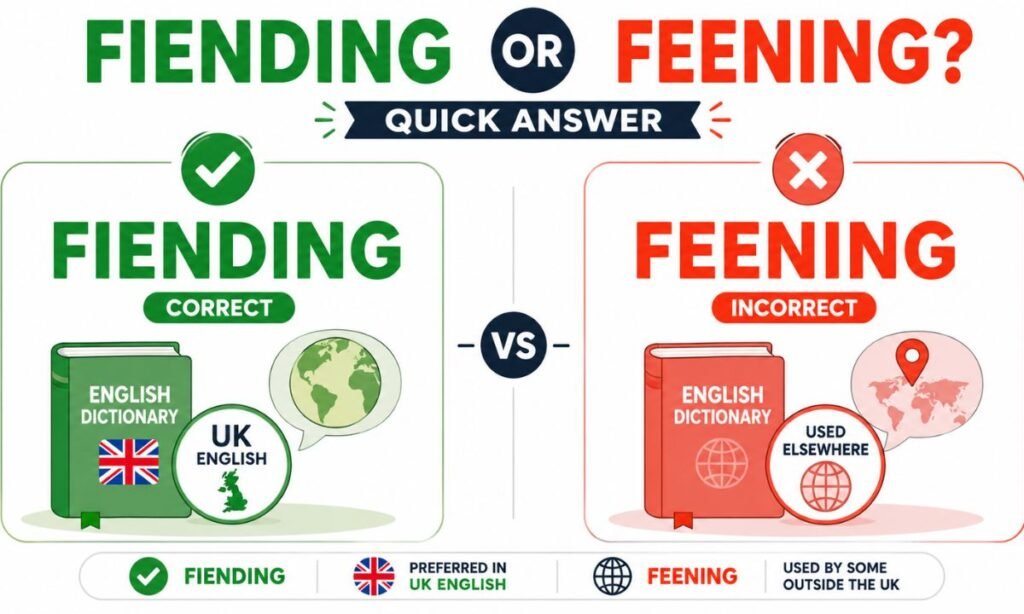
Fiending is the correct, standard spelling. It means craving or intensely desiring something, and it comes from the real English word fiend.
Feening is a slang spelling. It means the same thing but developed through casual speech, hip-hop culture, and social media. It is not found in standard dictionaries and should not be used in formal writing.
Short answer: Use fiending when writing for any professional, academic, or public-facing purpose. Use feening only in informal texts, captions, or creative slang contexts.
The Origin of Fiending or Feening
Where Does “Fiending” Come From?
The word fiending traces back to Old English. The root word, fiend, comes from the Old English fēond, meaning “enemy” or “one who hates.” It was the direct opposite of frēond (friend). Over centuries, the word shifted:
- In early medieval English, fiend referred to the Devil or evil spirits
- By the 1800s, it described someone obsessively devoted to something (“a coffee fiend,” “a dope fiend”)
- By the late 20th century, especially in hip-hop, fiending became a verb meaning to crave something desperately
The Oxford English Dictionary traces the verb use of fiend to as early as 1988, with the hip-hop track Microphone Fiend by Eric B. & Rakim helping push the term into mainstream slang.
Where Does “Feening” Come From?
Feening developed later as a phonetic spelling — it reflects how fiending sounds when spoken fast in casual American English. In rapid speech, the “d” softens and “fi-end-ing” becomes “fee-ning.” Musicians like Lil Wayne and Future helped spread the alternate spelling through lyrics, and social media platforms like TikTok locked it into Gen Z vocabulary.
The meaning never changed — only the spelling did.
British English vs American English Spelling
This is a common assumption: maybe fiending is the American version and feening is British, or vice versa? That’s not the case.
Both British and American English use fiending as the correct form. There is no regional spelling divide here. Feening is not a UK vs US difference — it’s a slang vs standard difference.
| Variety | Correct Spelling |
| American English | Fiending |
| British English | Fiending |
| Internet/Slang | Feening (informal only) |
Also Read This: Taught or Thought: What’s the Difference? Meaning, Usage & Examples (2026 Guide)
Which Spelling Should You Use?
The answer depends on your context:
Use fiending when:
- Writing a blog post, article, or web content
- Using the word in academic or professional writing
- You want the spelling to be credible and dictionary-backed
- You’re unsure — always default to fiending
Use feening only when:
- Texting friends or writing casual social media posts
- Writing song lyrics or dialogue that captures authentic slang
- The informal tone is intentional and your audience expects it
If clarity and credibility matter to you, fiending is always the safe choice.
Common Mistakes with Fiending or Feening
Here are the three most common errors people make with these words:
Mistake 1: Using feening in formal writing This damages your credibility. Editors will flag it, and grammar tools will mark it as non-standard. ✅ Fix: Replace feening with fiending in any professional content.
Mistake 2: Assuming both spellings are equally correct They share the same meaning, but they do not share the same status. Fiending is standard English; feening is not. ✅ Fix: Know the difference before you publish or submit anything.
Mistake 3: Thinking this is a US vs UK spelling issue It isn’t. Neither feening nor fiending is region-specific. The divide is formal vs informal, not geographic. ✅ Fix: Check context, not country.
Mistake 4: Confusing feening with feigning Feigning means pretending. Feening/fiending means craving. These are completely different words that occasionally get mixed up in fast typing. ✅ Fix: If you mean “pretending,” write feigning. If you mean “craving,” write fiending.
Fiending Pronunciation
Fiending is pronounced: /ˈfiːndɪŋ/
- Sounds like: FEE-ding with an “n” before the “-ing” — FEEN-ding
- Rhymes with: bleeding, feeding, needing
The reason feening exists as an alternate spelling is precisely because of how fiending sounds. When spoken quickly, the “d” in the middle nearly disappears, and many people hear “fee-ning” rather than “fiend-ing.” That spoken sound led to a written spelling — and a common confusion.
Fiending or Feening in Everyday Examples
Using Fiending (Correct/Standard)
- “She’s been fiending for a coffee since 7 AM.”
- “He’s fiending over that new sneaker drop.”
- “I’m fiending for pizza right now — it’s all I can think about.”
- “They were fiending to get tickets before they sold out.”
Using Feening (Slang/Informal)
- “Bro I’m feening for some Chipotle rn 😭”
- “She’s feening over his new track, it’s on repeat.”
- “We were all feening for the finale — no spoilers!”
Both examples communicate the same feeling — intense desire or craving — but the fiending versions are appropriate in any setting, while the feening versions belong in casual, informal spaces only.
Fiending or Feening – Google Trends & Usage Data
Search data consistently shows that fiending dominates in formal and informational contexts, while feening gets significant traction in music and social media-related searches.
Key patterns based on search and usage trends:
- “Fiending” appears more often in published articles, dictionaries, and grammar-focused content
- “Feening” spikes in searches tied to song lyrics, TikTok slang, and texting explainers
- “Feining” (with one “e”) is a third variant — typically a misspelling of either feening or the unrelated word feigning
- All three spellings share the same core meaning, but only fiending carries standard dictionary authority
The trend reflects a wider pattern in internet language: spoken slang gets transcribed phonetically, creating spelling variants that live online even when they lack formal recognition.
Comparison Table: Fiending vs Feening
| Feature | Fiending | Feening |
| Correct spelling | ✅ Yes | ❌ No (non-standard) |
| Found in dictionaries | ✅ Yes | ❌ No |
| Root word | Fiend (Old English) | Phonetic of “fiending” |
| Meaning | Intense craving/desire | Same |
| Used in formal writing | ✅ Yes | ❌ No |
| Used in slang/texting | ✅ Yes | ✅ Yes |
| Origin region | No regional difference | No regional difference |
| Hip-hop/social media | Common | Very common |
| Appropriate for SEO content | ✅ Yes | ❌ Avoid |
Conclusion
The spelling debate between fiending and feening comes down to one simple rule: fiending is correct, feening is slang.
Fiending has centuries of linguistic history behind it, rooted in Old English and codified in every major dictionary. Feening grew out of spoken casual speech and internet culture — widely understood but not formally recognized.
Use fiending in your writing when accuracy matters. Save feening for text messages, lyrics, or social media captions where informal expression is the point. Knowing the difference makes you a more confident, credible communicator — in any context.
