

You just received a text that says “jw, are you free tonight?” and now you are staring at your screen wondering whether your friend is inviting you out or starting a theological debate. Relax. You are not alone. Millions of people search for what does JW stand for in texting every single month. The answer is simple, the context is everything, and by the end of this guide you will never second-guess it again.
The Core Meaning: What Does JW Mean in Text?
JW in texting stands for “Just Wondering.” That is it. Nothing mysterious, nothing complicated. When someone sends you a message that starts with or includes “jw,” they are simply flagging that their question is casual and low-pressure. Think of it as the digital version of asking something while looking at the ceiling, pretending it is not a big deal.
It sits in the same family as FYI (for your information) or NGL (not gonna lie). It softens the message, keeps the tone light, and signals that the sender does not need an urgent or formal reply.
JW Meaning Religion: When JW Has a Different Hat On

Outside of texting, JW is also the widely recognized abbreviation for Jehovah’s Witnesses, a global Christian denomination founded in the United States in the late 19th century. Members are known for their door-to-door outreach, refusal of blood transfusions on religious grounds, and their publication the Watchtower.
So if someone writes “my neighbor is a JW” in a formal email or community group, they almost certainly mean Jehovah’s Witness, not “just wondering.” Context is the key that unlocks the correct meaning every single time.
Why People Use JW in Texts
People use JW because it does three things at once with just two letters:
- It softens the question. Asking someone if they like you feels intense. Starting with “jw, do you like me?” suddenly feels breezy and casual.
- It removes pressure. The sender signals they are fine with any answer, or even no answer at all.
- It saves time. Typing two letters beats typing eleven. In the world of quick-fire messaging, speed is everything.
This is why JW shows up more often in personal texts and social media DMs than in work emails. It carries a vibe, and that vibe is relaxed.
Full Breakdown: What Does JW Actually Convey in Conversation?
When someone drops JW into a message, they are communicating more than just curiosity. They are setting a tone. Here is the full emotional package that comes with it:
- Casual curiosity: “I want to know, but no big deal if you do not share.”
- Light friendliness: “I am asking this in a warm, non-interrogating way.”
- Optional urgency: “Reply whenever. This is not a fire alarm.”
Understanding this layered meaning helps you respond correctly. If someone says “jw, how did your interview go?” they genuinely care but are giving you space. A short, honest reply is perfectly appropriate.
Examples of JW in Different Situations (With Emojis)
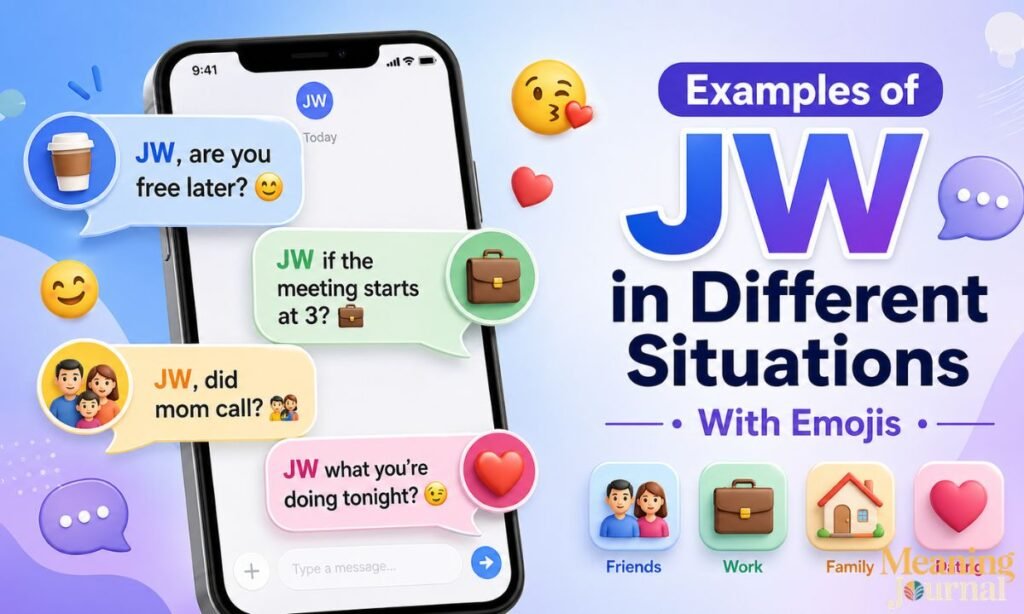
Seeing JW in action makes everything click instantly. Here are real-life style examples across different situations:
- jw, did you eat yet? 🍕
- jw if you are still coming to the party tonight 🤔
- jw what you thought of the movie lol 🎬
- jw, are you mad at me or just busy? 😅
- jw how much that cost you, no pressure 💸
Notice how each example feels light and non-confrontational. That is exactly the job JW is hired to do.
Table: JW Meaning by Context
A quick look at how JW shifts meaning depending on where you see it:
| Context | What JW Means | Example |
|---|---|---|
| Text message / DM | Just Wondering | “jw if you are free Sunday” |
| Social media comment | Just Wondering | “jw why no one talks about this” |
| Formal email | Jehovah’s Witnesses | “She is a JW and does not celebrate holidays” |
| Community forum | Either (check topic) | “Any JWs here?” (could be either) |
| News article | Jehovah’s Witnesses | “JW members gathered outside the courthouse” |
Alternate Meanings of JW (Less Common but Important)
Language is rarely a one-trick pony. Besides “Just Wondering” and Jehovah’s Witnesses, JW can occasionally stand for:
- John Wayne: Used nostalgically in pop culture discussions.
- Just Wait: Rare, but seen in gaming chats when someone asks for patience.
- J.W.: A person’s initials, especially in formal or Southern American contexts.
These meanings are far less common in everyday texting. If you see JW in a casual chat thread, “Just Wondering” is the overwhelmingly correct interpretation 95% of the time.
How to Understand JW From Context
The golden rule of decoding internet slang is this: always read the whole message before guessing the abbreviation. Ask yourself three quick questions:
- Is this a casual text or a formal document?
- Is the topic personal or informational?
- Does the sentence make sense with “Just Wondering” inserted?
If you answered casual, personal, and yes to all three, you are dealing with “Just Wondering” every single time. If the setting is formal and the subject is religion or community, you are likely looking at Jehovah’s Witnesses.
JW Meaning in School: How Students Use It
Students have fully adopted JW into their everyday academic and social texting. In a school context, you will commonly see it used to:
- Check on a friend without sounding needy (“jw if you got that assignment done”)
- Ask about plans without committing to anything (“jw if the group is hanging out after school”)
- Fish for information casually (“jw what you got on that test lol”)
Teachers and parents who come across JW in their kid’s phone messages sometimes panic, thinking it refers to a religious organization. Nine times out of ten in that context, it simply means a teenager is asking a classmate something they felt slightly awkward asking directly. Crisis averted.
How to Use JW Correctly (With Sentence Templates)
Using JW is simple, but there are a few patterns that work better than others. Here are templates you can plug directly into your own texts:
- “jw, [question]?” – The classic opener.
- “[Statement]. jw though.” – Add JW at the end to soften a bold statement.
- “not to be weird but jw [question]” – Extra casual layer for sensitive topics.
- “jw if you are okay with [situation]” – Checking for consent or comfort without pressure.
The key is keeping the surrounding message equally casual. Dropping JW into a formal, serious message creates a tonal mismatch that can confuse the reader.
What JW Does Not Mean (Common Mistakes)
A few myths floating around online deserve a quick correction:
- JW does not mean “Just Wait.” While this pops up occasionally in gaming, it is not mainstream.
- JW is not an insult or passive-aggressive dig. Some people read it that way in tense conversations, but the abbreviation itself carries no hostility.
- JW is not exclusive to one generation. While Gen Z popularized it, Millennials and even some Gen X users send it freely today.
The biggest mistake people make is reading tone into the abbreviation itself. JW is neutral. The tone of the full message tells you everything else.
When You Should Avoid Using JW
JW is a gem in casual conversations, but it has no place in certain settings:
- Work emails or professional Slack messages
- Messages to people significantly older who may not recognize the abbreviation
- Sensitive conversations where you need to sound sincere and direct
- Any situation where ambiguity could cause a genuine misunderstanding
If you are texting your boss about a deadline or messaging a new acquaintance you have not yet found common ground with, spell it out. “I was just wondering if…” always lands clearly, regardless of who is reading it.
JW vs. Similar Abbreviations (Comparison Table)
How does JW stack up against its closest cousins in the texting world?
| Abbreviation | Full Form | Tone | Best Used When |
|---|---|---|---|
| JW | Just Wondering | Casual, curious | Asking something low-stakes |
| NGL | Not Gonna Lie | Honest, blunt | Sharing an opinion |
| TBH | To Be Honest | Direct, sincere | Giving real feedback |
| FYI | For Your Info | Neutral, helpful | Sharing useful info |
| IDK | I Don’t Know | Unsure, relaxed | Admitting uncertainty |
| LMK | Let Me Know | Friendly, waiting | Requesting a response |
Does JW Change Meaning in Different Countries?
Great question, and the answer is: mostly no, but religion context varies. The “Just Wondering” meaning is universally understood in English-speaking texting culture across the United States, United Kingdom, Canada, Australia, and beyond.
Where things shift slightly is in countries with a larger Jehovah’s Witness presence or in regions where the organization has been in the news. In those areas, an older audience reading JW in any written context may default to the religious meaning first. Younger audiences almost everywhere still read it as “Just Wondering” in casual digital settings.
Emotional Meaning: What JW Really Signals
Here is something most texting guides miss entirely. JW does not just convey curiosity. It also signals emotional intelligence. People who use JW are often:
- Aware that their question might feel intrusive without a softener
- Trying to preserve the other person’s comfort and autonomy
- Keeping the interaction light so neither party feels pressured
In short, using JW thoughtfully shows you understand social dynamics. It is a tiny abbreviation doing a lot of emotional heavy lifting. And that is actually kind of impressive for two letters.
JW in Flirting and Relationships

JW has carved out a very comfortable home in the world of flirting and early-stage relationships. Here is why it works so well:
- It lets someone ask an emotionally risky question without fully exposing themselves
- It creates plausible deniability (“I was just asking, no big deal”)
- It keeps the energy light and fun, which is exactly what early flirting needs
For example, “jw, do you find yourself thinking about me sometimes?” is far less terrifying to send than its unabbreviated version. JW gives the sender a tiny emotional parachute. Whether it opens depends entirely on the reply.
Cultural and Linguistic Insight (Expert Quote Section)
Linguists who study digital communication note that abbreviations like JW function as what researchers call “hedging devices.” They reduce the social risk of asking questions by framing curiosity as non-committal and casual. This mirrors older spoken phrases like “I don’t want to pry, but…” or “not to be nosy, but…” JW is simply the compressed, text-friendly evolution of that same social strategy.
This also explains why JW is more common in personal texting than in professional communication. The higher the social stakes, the more people rely on softening language. And in 2026, JW is one of the most efficient softeners in the digital English toolkit.
Example Dialogues Using JW
Reading JW in real conversation flow removes any remaining confusion. Here are three short dialogues:
Dialogue 1: Between Friends
Alex: jw, did you eat lunch yet?
Sam: lol no, starving. wanna grab something?
Alex: yes! was jw bc I didn’t want to eat alone haha
Dialogue 2: Casual Romantic Interest
Jamie: jw what you are doing this weekend
Riley: nothing planned yet, why?
Jamie: jw if you’d want to hang out maybe
Dialogue 3: Group Chat
Mia: jw are we still doing brunch Sunday or nah
Chris: I’m in!
Lena: same, just let me know the time
Variations of JW People Commonly Use
Like most popular abbreviations, JW has spawned a few close relatives:
- jw lol – adds humor to make the question even lighter
- jw tho – “though” tacked on for emphasis, often used after a statement
- just wondering – the full written version, more sincere in tone
- was jw – past tense version, often used to follow up on something
- jw no pressure – explicitly removes any obligation from the recipient
These variations all carry the same core meaning. The add-ons simply fine-tune the emotional temperature of the message.
Best Alternatives to JW When You Want More Clarity
Sometimes JW is too casual for the moment, or you are texting someone who might not recognize it. Here are clear alternatives that carry a similar spirit:
- “I was just curious…”
- “Not to pry, but…”
- “Out of curiosity…”
- “Feel free to ignore this, but…”
- “No pressure, just wanted to ask…”
These phrases achieve the same emotional goal as JW but work in any audience, any age group, and any level of formality. Use them when you need the softer touch without the abbreviation.
How JW Appears in Generational Communication
Texting abbreviations do not land the same way across every age group. Here is a quick generational snapshot of how JW travels:
- Gen Z (born 1997-2012): Fully fluent. Uses JW instinctively without thinking.
- Millennials (born 1981-1996): Comfortable with it. Has been in use long enough that most recognize and use it naturally.
- Gen X (born 1965-1980): Mixed. Many know it; some may pause to decode it.
- Baby Boomers (born 1946-1964): Less likely to recognize it. Safer to write it out in full when texting this age group.
Knowing your audience is not just good communication advice in boardrooms. It is equally smart advice in text threads.
Sentences You Can Use (Custom Examples)
Need to use JW yourself right now? Here are ready-made sentences across different scenarios:
- jw if you got home safe
- jw, do you prefer coffee or tea?
- jw what time works for you
- not to be weird but jw if you like hanging out with me
- jw if the plan changed at all
- was jw how the presentation went
- jw bc I care about you
Pick any of these, adjust the details to fit your situation, and you are good to go. JW is that plug-and-play.
Frequently Asked Questions
Q1: Can JW be used in a professional setting?
Generally, no. JW belongs in casual, personal communication. In professional emails or formal messages, write out “I was just wondering” in full. Your colleagues will appreciate the clarity, and your boss will not Google what JW means mid-meeting.
Q2: Is JW always lowercase?
Most of the time, yes. In casual texting, lowercase “jw” is the norm because it matches the relaxed tone the abbreviation is meant to set. Uppercase JW is more often associated with Jehovah’s Witnesses in print or formal writing.
Q3: What if someone uses JW and I am not sure which meaning they intend?
Read the full message and the context around it. If the conversation is casual and personal, it is “Just Wondering.” If the message is formal, informational, or about religion or community, it likely means Jehovah’s Witnesses. When genuinely unsure, a quick “what do you mean?” never hurt anyone.
Conclusion
JW in texting almost always means “Just Wondering.” It is a two-letter shortcut that softens questions, keeps conversations breezy, and signals that the sender respects the other person’s emotional space. It is casual, friendly, and genuinely useful in everyday digital communication.
The only time you need to pause and reconsider is when the context clearly points to a formal or religious setting, where JW refers to Jehovah’s Witnesses instead.
Now that you know the full picture, from meaning and origin to usage, mistakes, and generational nuance, you are fully equipped. The next time someone texts you “jw…” you will know exactly what they mean, exactly how to respond, and honestly, you might even use it yourself by tomorrow.
And jw, did this guide help? 😄
