

If you’ve ever received a quick “ty” after doing something nice and stared at it for a second — you’re not alone. It’s one of those abbreviations that feels obvious once you know it, but surprisingly confusing the first time you see it.
So let’s clear it up, explore how it’s actually used, and help you use it like a natural.
What TY Actually Means (And Why It Matters)
TY simply means “Thank You.”
It’s a shorthand born out of the texting culture — where speed matters and people would rather type two letters than ten. You’ll see it everywhere: iMessage threads, Instagram comments, Discord servers, Snapchat replies, and even some workplace Slack channels.
The beauty of TY is how lightweight it is. It carries genuine gratitude without demanding a full sentence back. It’s the digital equivalent of a quick nod or a smile — warm, efficient, and completely natural in the right context.
The Emotional Weight Behind Two Letters

Here’s something people rarely talk about: TY isn’t always the same emotionally.
When your best friend helps you move apartments and texts “ty so much 🙏”, that hits differently than a stranger replying “ty” after you answer their Reddit question. Same abbreviation, completely different emotional charge.
Context is everything. The tone around TY — the emojis, the punctuation, the capitalisation — shifts its meaning more than you’d expect. A plain lowercase “ty” is casual and breezy. “TY!!” with capitals and exclamation marks feels enthusiastic and warm. “Ty…” with ellipses can even feel a little passive-aggressive depending on the situation.
Pay attention to what surrounds the word. That’s where the real message lives.
How TY Evolved: A Quick Origin Story
Text abbreviations like TY didn’t appear overnight. They grew out of early SMS culture in the late 1990s and early 2000s, when mobile keypads made typing painful and slow. Every character cost effort — sometimes literally, since early texts had character limits.
“Thank you” became “thx”, then “thnx”, then eventually the ultra-compact “ty.” Online chat platforms like AOL Instant Messenger, MSN Messenger, and early IRC rooms pushed these shortcuts into mainstream use.
By the time smartphones arrived and keyboards got easier, the abbreviations had already stuck. TY survived because it’s genuinely convenient and it doesn’t feel cold. That balance is rare in text slang.
TY vs Other Ways to Say Thank You in Texts
People have a whole toolkit for expressing gratitude online. Here’s how TY compares to the alternatives — because knowing which one to use matters more than most people realise.
| Abbreviation | Meaning | Vibe |
| TY | Thank You | Casual, warm, universal |
| THX / THNX | Thanks | Slightly older, still common |
| TIA | Thanks In Advance | Used before asking a favour |
| TYSM | Thank You So Much | More expressive, emotional |
| TYVM | Thank You Very Much | Formal-ish or slightly sarcastic |
| IKR + ty | I Know Right + Thank You | Excited agreement |
TYSM is worth a special mention. When someone writes “tysm” instead of just “ty”, they’re signalling that the gratitude is deeper — it’s the text equivalent of saying thank you and meaning it extra hard. You’ll see it a lot in friendships, fan communities, and anywhere emotions run higher.
What Does TY Mean From a Girl (Or Anyone You’re Texting Romantically)?
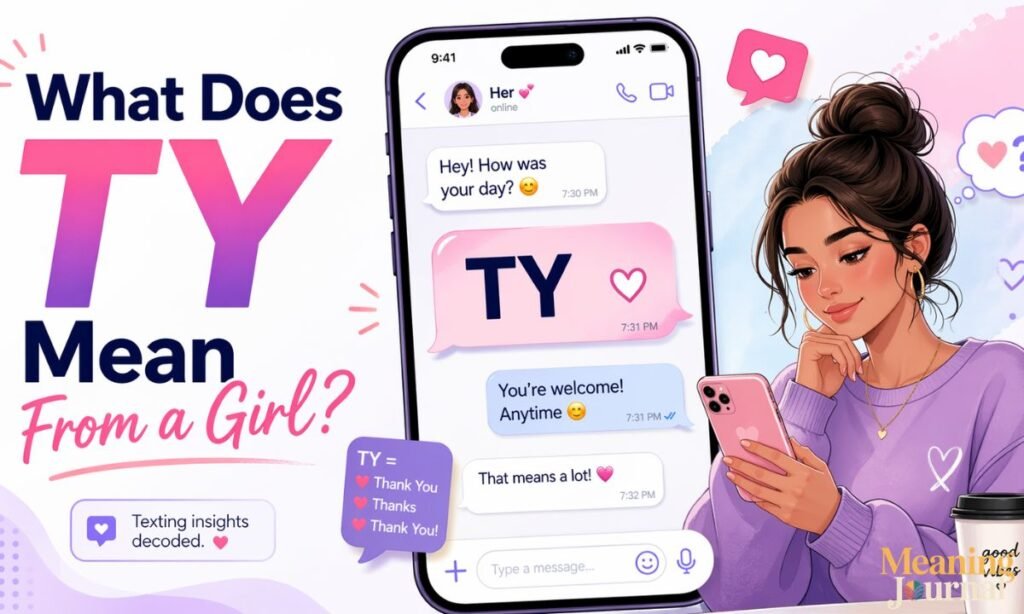
Let’s be real — this is one of the most Googled questions about TY, and it deserves a straight answer.
When someone you’re interested in sends “ty” or “tysm” after you do something thoughtful for them, it usually means exactly what it says: they appreciated it. But in a romantic context, pay attention to what else is in the message.
“ty 😊” — friendly and warm, nothing more to read into it.
“tysm you’re literally the sweetest 🥺” — that’s a different story.
The abbreviation itself is neutral. The rest of the message carries the signal. Don’t try to decode TY alone — look at the whole picture.
TY Across Different Platforms (It Behaves Differently Everywhere)
One thing that surprises people: TY doesn’t land the same way on every platform. Here’s a quick breakdown.
Text Messages / iMessage: Totally normal, expected even. TY fits naturally in everyday conversation between friends, family, and casual contacts.
Instagram / TikTok Comments: Very common. Creators reply “ty!!” to fan comments constantly. It’s one of the fastest ways to acknowledge appreciation without writing individual responses.
Discord / Gaming Chats: TY is practically a reflex here. Someone heals you in a game? “ty”. Someone shares a useful link? “ty”. It’s the digital handshake of gaming culture.
Twitter / X: Used frequently in replies, especially after a compliment or retweet. Short-form platforms make TY a natural fit.
Slack / Work Tools: This is where it gets interesting. TY in a professional Slack channel among teammates who know each other well is usually fine. But in a formal thread with senior leadership or clients, it can read as too casual. Know your audience.
What Does TY Mean in Text Other Than Thank You?
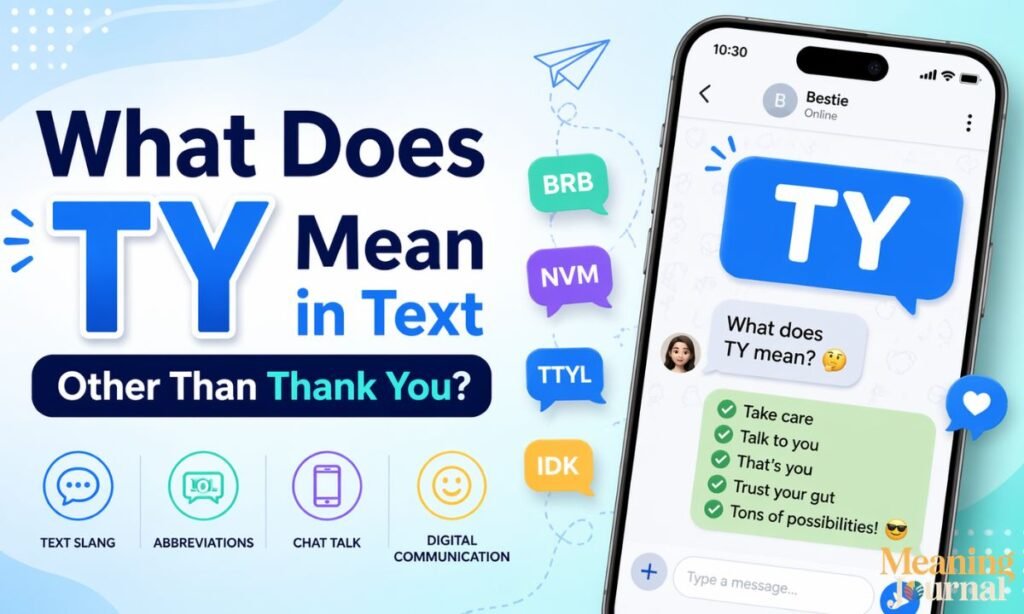
In rare cases, TY can stand for something else depending on the context. In gaming or specific online communities, it occasionally appears as an abbreviation for a username, a team tag, or a shorthand for “that’s yours.” But these uses are genuinely uncommon.
About 99% of the time you see TY in a text message or social comment, it means Thank You. Don’t overthink it.
Real-Life TY in Action: Four Quick Examples
Casual friend chat:
“I saved you a seat!” “Omg ty!! You’re the best 😭”
Gaming session:
Player revives teammate “ty” “np” (no problem)
Instagram comment:
Fan: “Your outfit is everything 🔥” Creator: “ty babe!! 🖤”
Slack message:
“Here’s the updated file you needed.” “ty, this is really helpful — will review before EOD.”
Notice how the same two letters shift in weight depending on who’s talking and where. That adaptability is exactly why TY has lasted this long.
A Section You Won’t Find Elsewhere: The Psychology of TY in Digital Conversations
Most articles just tell you TY means “thank you” and call it a day. But there’s actually something worth understanding here from a communication standpoint.
In face-to-face conversation, saying thank you involves eye contact, tone, and body language. Gratitude is multi-sensory. In text, you only have characters — so people developed shortcuts like TY to compress gratitude into something transmittable.
What’s fascinating is that receivers often interpret TY differently based on their own emotional state. If you’re already feeling close to someone, even a bare “ty” feels warm. If there’s tension or distance, that same “ty” can feel dismissive.
This is called interpretive projection — we fill in the emotional gaps with what we expect to feel. It’s not a flaw in communication; it’s just something to be aware of. When tone matters, add an emoji or a short extra line. Don’t let TY carry more weight than two letters can hold.
Common Mistakes People Make With TY
Using TY in a formal email to someone you’ve never met is probably the most common misstep. It can come across as dismissive or unprofessional. If you’re writing to a recruiter, a professor, or a new business contact — spell it out.
Another mistake: using TY sarcastically without signalling it clearly. “ty for that” can read as passive-aggressive if there’s no context around it. If you mean it sincerely, add something to show it. If you mean it ironically — make sure the other person will actually catch that.
And finally, replying with only “ty” after someone shares something emotionally vulnerable or important to them. In those moments, TY alone can feel cold. Meet the moment with the response it deserves.
How to Respond When Someone Sends You TY
You don’t need to overthink this. Common and perfectly natural responses include:
“np” (no problem), “ofc” (of course), “anytime”, “happy to help”, or just a simple 🙏 or 💙 emoji. The response should match the energy of the original message. If they sent a casual “ty”, a casual “np” is ideal. If they sent “tysm you literally saved me”, maybe give a little more back.
Frequently Asked Questions
What does TY mean in text?
TY means “Thank You” — a short, casual abbreviation widely used in texting, social media, and online chats.
Is it okay to use TY in professional messages?
It’s fine in casual workplace chats with teammates, but avoid it in formal emails or messages to new professional contacts.
What is the difference between TY and TYSM?
TY means “Thank You” while TYSM means “Thank You So Much,” expressing a deeper or more emotional level of gratitude.
What does TY mean from a girl in a text?
It simply means she’s thanking you — the real emotional tone depends on the emojis and extra words surrounding it.
an TY mean anything other than Thank You?
Rarely — in some gaming or niche online communities it may mean something else, but 99% of the time it means Thank You.
Key Insights
TY is one of those tiny pieces of digital language that says a lot about how communication has evolved. Two letters. Universal meaning. Endlessly adaptable tone.
The next time you type it or receive it, you’ll understand it in full — not just as a shorthand, but as a small, efficient act of human connection. And in a world where most conversations happen through screens, that still counts for something.
Use it where it fits. Skip it where it doesn’t. And when in doubt — just write the whole thing out. “Thank you” never goes out of style.
