

You are scrolling through your messages, and someone just replied with “yh.” That is it. Two letters. No context, no emoji, no follow-up. Now you are sitting there wondering if they are annoyed, agreeing, or just too busy to form a full sentence. You are not alone in that confusion, and the answer is actually much simpler than you think.
YH means “Yeah.” It is a casual, quick, informal way to say yes in texting, online chats, and social media conversations. That is the complete answer. But knowing what it means and knowing how to read it correctly are two very different things, and that gap is exactly what this article closes.
What Does YH Actually Stand For?
Let us start at the beginning because this part trips people up more than expected.
YH is a shortened form of “yeah,” which is itself an informal version of “yes.” Think of it as a double abbreviation. First, English speakers swapped “yes” for “yeah” in casual speech. Then, texting culture swooped in and trimmed “yeah” down to just its two consonants, dropping the “e” and the “a” entirely.
This shortening happens through a linguistic process called vowel omission, where vowels get removed to shorten the word. Instead of typing four letters, users type two.
Some sources also describe YH as standing for “Yuh-Huh,” which carries the same affirmative meaning. In that case, YH is used as an acronym in place of “Yuh-Huh,” which also means “yes,” making it a substitute for “yeah,” “yes,” or any similar affirmative word.
Either way, both roads lead to the same destination. YH = Yes = Yeah. Simple.
How Did YH Even Start? A Quick Origin Story
Nobody woke up one morning and formally invented YH. That is not how internet slang works, and honestly, that makes the story more interesting.
As texting evolved, people naturally started shortening words to save time. Just like “u” replaced “you” and “r” replaced “are,” “yeah” slowly became “yh.” There was not a single moment when YH was invented. It grew naturally, the way slang usually does: people used it, others copied it, and suddenly it was everywhere.
YH became commonly used on MSN Messenger and other early chatting websites, back when typing on a tiny keypad took real effort and every saved letter felt like a small victory. SMS messaging had strict character limits in its early days, and shortening words was not just stylish, it was practical.
By the 2010s, YH had become a staple of social media slang, used across platforms like Snapchat, Instagram, and TikTok, anywhere quick responses were the norm.
So YH is not a recent Gen Z invention. It has been quietly living in text conversations for well over a decade. You just might not have noticed it until now.
Where You Will See YH Used Online
YH does not live in one place. It shows up across the entire digital world wherever casual conversation happens.
YH is used in digital communication especially on platforms like Snapchat, TikTok, and Instagram. You will also spot it in WhatsApp group chats, Discord servers, iMessage threads, Twitter or X replies, and even Reddit comment sections when someone wants to agree quickly without writing an essay.
Snapchat is probably its most natural home. The whole platform is built around fast, disposable communication, and YH fits that energy perfectly. Someone asks “you free tonight?” and you snap back “yh” before your screen even fully loads. Done. Conversation moves forward.
YH is mainly used for convenience and brevity in informal communication settings like texting, chatting, and social media. It allows users to express agreement or confirmation swiftly while keeping a conversational tone. Moreover, as it is only two characters long, it saves time and effort in typing.
The rule of thumb is simple. Anywhere casual conversation flows fast, YH belongs.
The Real Tone of YH: Is It Rude, Lazy, or Just Quick?
Here is where things get genuinely interesting, and where most articles stop too early.
YH is not rude by default. But it can feel that way depending on the situation. The word itself is neutral. The tone it carries depends entirely on context, punctuation, and the relationship between the two people texting.
Think of it this way:
“Yh 😊” reads warm and friendly.
“Yh.” (with a period) reads cold, possibly irritated.
“Yh lol” reads relaxed and easy.
“Yh” as a response to an emotional story reads dismissive and careless.
The core meaning is casual agreement. The emotional effect depends on context. YH slang is not rude by default, but it can feel dry depending on the situation. Because it is so minimal, it can sometimes feel cold, distracted, or uninterested if the situation calls for a warmer reply.
So the word itself is innocent. The problem arises when there is a mismatch between emotional effort. If your friend just shared something heavy and you reply with “yh,” that lands wrong. Not because YH is mean, but because the moment called for more.
A “YH” from your best friend probably means something different than one from your boss. Relationship and context do the heavy lifting here.
Real-Life Examples of YH in Actual Conversations
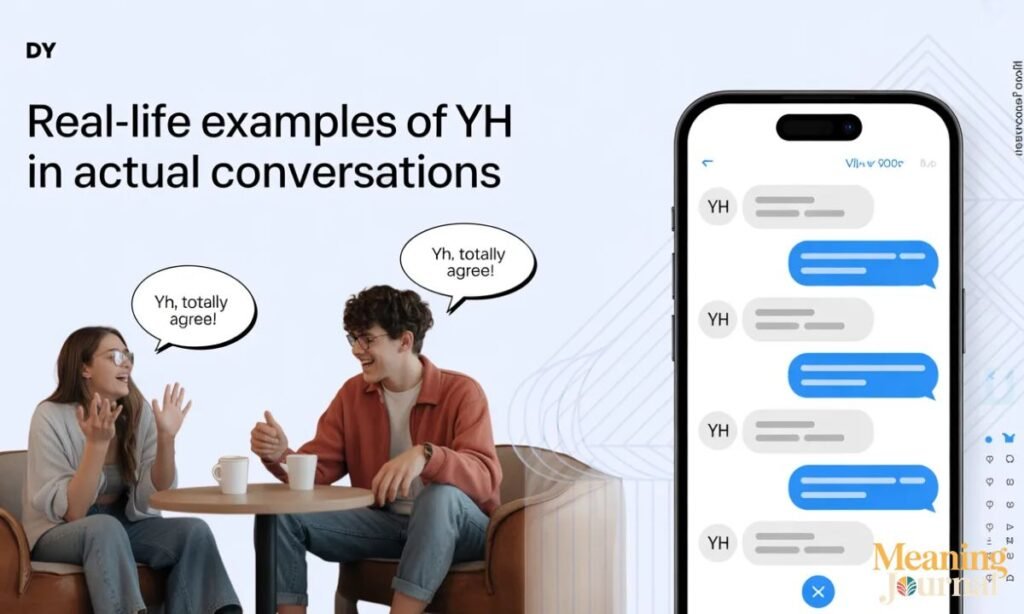
Enough theory. Here is how YH actually appears in everyday digital life:
Example 1: Making Plans Friend: “Pizza tonight? My place, 7pm.” You: “Yh sounds good, I’ll bring drinks.”
Example 2: Quick Confirmation Mom: “Are you home yet?” Son: “Yh, just walked in.”
Example 3: Group Chat Agreement Someone: “Should we move the meeting to Friday?” You: “Yh that works better for me.”
Example 4: Gaming Teammate: “Ready for the next round?” You: “Yh let’s go.”
Example 5: Casual Acknowledgment Friend: “That show was actually really good.” You: “Yh I told you.”
These examples show how flexible the slang is. It can be neutral, functional, or simply efficient depending on the vibe of the conversation.
Notice something in every example above. YH works best when the conversation is already moving at a fast, casual pace. It is a response that keeps momentum going, not one that starts something new.
YH vs Yeah vs Yep vs Yup: What Is Actually the Difference?
You might wonder why someone would type “yh” instead of just “yeah,” since both are already short. Fair question. Here is a quick breakdown of how these variations compare:
| Term | Tone | Energy Level | Best Used When |
| YH | Neutral, minimal | Low effort | Quick agreement, fast chats |
| Yeah | Casual, clear | Moderate | Standard informal reply |
| Yep | Cheerful, light | Moderate to high | Friendly confirmation |
| Yup | Playful, relaxed | Moderate | Lighthearted agreement |
| Yes | Formal, clear | Neutral | Professional or polite settings |
| Absolutely | Enthusiastic, warm | High | When you really mean it |
YH vs Yeah: “Yeah” is a full acknowledgment, often more enthusiastic, whereas YH feels quicker and more neutral. YH vs Yup: “Yup” is playful and casual, while YH may stay more neutral. YH vs Yep: “Yep” sounds cheerful and friendly, but YH can seem dry if used alone.
The short version: the fewer letters you use, the more casual and low-energy the reply feels. YH sits at the very minimal end of that scale. Not cold, just efficient.
Does YH Have Any Other Meanings?
In the vast majority of conversations, YH means one thing: yeah. But language is never completely clean, and there are two rare alternate readings worth knowing.
“Yh?” can mean “You here?” or “You home?” This usually shows up when someone is trying to check if you have arrived somewhere or if you are available. Context clues play a big part in spotting this usage. If you are meeting up with someone and have not just been asked a question, this might be what they mean. If you are not sure, ask them to clarify.
YH can also occasionally stand for “Yahoo,” either the expression of excitement or a casual reference to the website. This is rare enough that you will almost never encounter it in modern chats.
Outside of texting, YH can mean “Yours Happily” in some rare email sign-off contexts, but in everyday chat it almost exclusively means “yeah.”
The practical advice here is simple. If the context makes the meaning obvious, go with it. If it does not, just ask. A quick “what do you mean?” never hurt anyone.
Common Mistakes People Make With YH
Knowing what a word means is only half the battle. Knowing how to use it without accidentally coming across wrong is the other half.
Mistake 1: Using YH in professional messages. Replying to your manager’s email with “yh” is not a career move you want to make. Save YH for friends, family, and casual digital spaces. Professional settings call for “Yes,” “Absolutely,” or “Sounds good.”
Mistake 2: Using YH during serious conversations. If someone is sharing something emotional, personal, or heavy, “yh” as a response reads as dismissive. It is not that you meant it that way. It just signals low engagement at the exact moment high engagement matters.
Mistake 3: Assuming YH always sounds unfriendly. Some people panic when they get a “yh” reply, thinking the person is upset. More often than not, they are just busy, multitasking, or texting quickly. Do not read too much into the letters themselves. Read the whole conversation.
Mistake 4: Repeating “YHYH” thinking it shows enthusiasm. Using multiple “Yeahs” such as “YHYH” might actually indicate sarcasm or impatience in text messages rather than excitement. If you want to sound enthusiastic, try “Yeah!!” or an emoji instead.
Mistake 5: Thinking YH means something negative or passive-aggressive. YH is not rude. It does not show attitude automatically. It does not mean anything inappropriate. It is literally just “yeah,” used quickly and casually.
Who Uses YH the Most?
YH can be used by anyone, but it tends to be used mostly by people who frequently shorten their words online. This includes teenagers and young adults, adults who grew up using text speak, and even older adults who want to lessen the pain in their hands caused by excessive typing.
Gen Z owns this abbreviation in the current digital landscape. It fits perfectly into their communication style, which values speed, brevity, and casual tone above all. You will find it especially common in British online communities, where it gained early traction, though it is now used worldwide without much geographic distinction.
Gamers use it. Group chat regulars use it. Social media comment sections are full of it. If someone is comfortable with internet shorthand, YH is part of their vocabulary whether they consciously think about it or not.
When Should You Use YH vs When Should You Not?
Here is the honest, practical guide to getting this right every time:
Use YH when:
- Texting friends or close family in a fast, casual back-and-forth
- Replying in a group chat where everyone is keeping things light
- Responding to simple yes or no questions where no extra detail is needed
- The conversation has a quick, breezy energy and you want to match it
- You are gaming, scrolling, or multitasking and need to respond fast
Avoid YH when:
- You are texting a boss, client, teacher, or anyone in a professional role
- The other person has just shared something emotional or serious
- You want to show genuine enthusiasm, because YH does not really communicate excitement
- The context is ambiguous and a short reply might confuse or concern the other person
- You are writing anything that will be read by an audience, a formal group, or strangers who do not know your communication style
The golden rule: match the energy of the room. If the conversation is fast and casual, YH fits. If it is slow, serious, or formal, reach for something more complete.
Quick Alternatives to YH When You Need More Flavour
Sometimes “yh” is perfect. Other times you want a little more personality in your reply without going full formal. Here are natural alternatives that still keep things casual:
For friendly warmth: “Yeah for sure” / “Yep!” / “Totally”
For enthusiasm: “Absolutely!” / “100%” / “Yes!! Let’s go”
For playful tone: “Yup” / “Obvs” / “For real”
For agreement with added info: “Yeah, sounds good” / “Yeah, I was thinking the same”
For formal situations: “Yes, that works” / “Understood” / “Sounds good to me”
Adding context, small phrases, or emojis can soften replies and clarify tone. For example, “YH 😊” conveys friendliness in casual texting, while “Yes, that works perfectly” is ideal in formal communication.
Small additions make a significant difference. Two letters alone carry minimal warmth. Two letters plus a smile emoji carry enough warmth to land exactly right.
FAQ: Your Remaining YH Questions, Answered Fast
Q: Is YH the same as “yes” in meaning?
Yes, essentially. The meaning is close, but “yes” sounds more formal, while YH sounds much more casual. Both express agreement, but the register is very different. “Yes” belongs in emails. “Yh” belongs in Snapchat.
Q: Can YH come across as rude?
It can, but it usually is not meant that way. YH has the ability to turn a whole conversation into a one-word exchange, and when you send a “yh” to someone, that person might not reply because of how short the response feels. If you want to keep a conversation alive and warm, add a follow-up sentence or an emoji alongside it.
Q: Does YH mean the same thing on Snapchat, Instagram, and WhatsApp?
Yes, completely. YH consistently means “yeah” across regions and platforms. The platform does not change the meaning. Only the context and tone around it does.
The Bottom Line on YH
YH is one of the easiest pieces of text slang to understand once someone just tells you what it means. It is “yeah.” It has always been “yeah.” It will keep being “yeah” for the foreseeable future, because brevity is not going anywhere in digital communication.
What makes it worth understanding more deeply is the tone layer underneath the meaning. The word is simple. The context it sits in is where the real communication happens. A “yh” with an emoji is warm. A “yh” alone is neutral. A “yh” at the wrong moment is a missed opportunity to actually connect.
Use it when it fits. Expand it when it matters. And the next time someone sends you those two letters, you will know exactly what they mean and exactly how to read it.
Text slang is not a foreign language. It is just English in a hurry.
